Click here to get this post in PDF
Most facilities teams think about environmental control in terms of HVAC capacity, filtration ratings, and humidity sensors. That thinking is correct, but incomplete. If the building’s own surfaces are shedding dust, off-gassing chemicals, or accumulating static charge, no filtration system in the world will fully compensate, the contamination source is already inside the perimeter.
The Concrete Dusting Problem Nobody Wants to Talk About
Concrete might appear to be inorganic. However, it’s not. Unsealed concrete subfloors and walls constantly have material separating from their surface; over time, foot traffic, equipment vibration, and thermal cycling all contribute to the fine silica and calcium carbonate particles that come loose from the surface, accelerating this natural process. These particles are more than just “floor dust”, they’re microscopic, abrasive, and alkaline.
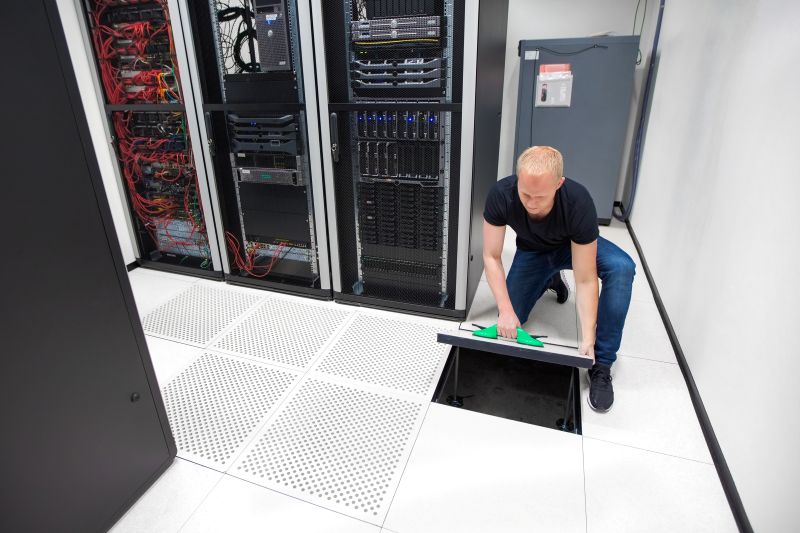
High-velocity underfloor cooling systems draw substantial volumes of air through plenum spaces. Any particulate matter present on an unsealed concrete subfloor becomes part of that airstream and is delivered directly to server inlets. Once inside the rack, the particles settle on motherboards and effectively act as an insulator. Heat cannot dissipate as it should. Components overheat. Failure rates skyrocket.
The achievable target by ASHRAE TC 9.9 guidelines for mission-critical facilities is ISO 14644-1 Class 8 cleanliness, no more than 3,520,000 particles of 0.5 micrometers or larger per cubic meter of air. It is virtually impossible to meet that metric while leaving unsealed concrete subfloors and walls working against you.
The solution is high-solids epoxy encapsulation of every concrete surface linked to an air distribution path. This is not a coating in the cosmetic sense of the word; this is a seal that prevents the concrete matrix from shedding its components. The result of this is a non-porous, non-abrasive, cleanable surface. The subfloor plenum stops being a contamination reservoir and starts acting as a clean-air delivery path.
Executing Coating Work in a Live Facility
The technical specifications for each coating type are only half the challenge. The other half is applying these products in a facility that may never be able to go fully offline.
Working in a live data center environment requires containment protocols that standard commercial painting work doesn’t demand. Negative-pressure containment zones prevent dust and chemical vapors from migrating to active equipment areas. Airflow management during application ensures that off-gassing, even from zero-VOC products during their wet phase, doesn’t reach server intakes. Dust suppression during surface preparation is aggressive and continuous rather than incidental.
Fast-cure formulations matter too. In a phased project where sections of floor are being encapsulated while adjacent rows remain live, extended cure windows aren’t operationally acceptable. Product selection has to account for both performance characteristics and the practical timeline constraints of working around active infrastructure.
Engaging an experienced data center painting contractor who understands containment protocols, airflow management, and how to work around live electrical infrastructure is not a luxury consideration. It’s what separates a successful project from one that creates the exact contamination and downtime risks the coatings were intended to prevent. A contractor without specific mission-critical experience will default to standard commercial site practices, which aren’t adequate for this environment.
Static Electricity and Why Flooring Material is an Electrical Decision
Data centers have a lot of air in motion. Air movement creates static charge. Humans walking also create static charge. The question is not whether or not static charge is generated, it is. The question is where it goes.
Off-the-shelf commercial flooring solutions leave static accumulation unchecked. It builds until it finds a path to discharge, often through a human touching a server chassis or even directly into a sensitive component. A single electrostatic discharge can make a component fail outright or, worse, it can result in latent damage that causes component failure weeks later.
An ESD control coating, either conductive or static-dissipative depending on the risk profile of the environment, provides that charge a path to ground before it hits the equipment. These are typically a floor coating system, although they’re also used on the occasional wall surface particularly in areas of very high air flow or in equipment staging zones. It makes a difference whether you use conductive or dissipative materials: conductive coatings move the charge so fast that they’re inappropriate for use around sensitive electronic components, although perfect for protecting PCB assembly lines in a memory fab. Dissipative coatings slow this transfer to a rate that won’t damage your microelectronics.
If you get this specification wrong, you can make things far worse. A coated or carpeted floor may suddenly cost you thousands in service replacement because the epoxy was conductive, or your floor provider didn’t know the difference between a conductive and static-dissipative material. For example, they apply a standard epoxy system during construction and call it “ESD-safe”.
VOC Outgassing and What it Does to Optical Components
Regular commercial paints are unsuitable for mission-critical IT spaces. Smell and occupant comfort are not the issue here, it’s the impact of Volatile Organic Compounds on sensitive technology over an extended period.
Most paints are still off-gassing VOCs for several weeks or even months after they’re applied. In housing or an open office, that’s not necessarily a problem. The paint is on the wall, the room is open, VOCs are blown out by the wind or the HVAC system, and in time, concentrations drop low. In a data center, the stakes are higher, the air exchanges less frequent, and VOCs don’t just blow out, they circulate through the space and gradually settle onto any surfaces they contact.
Optical transceivers, laser diodes, fiber connectors, delicate microcircuitry connections, these components have the tightest tolerances in the room, and it’s possible for chemical components in a recirculated atmosphere to knock out a significant number of them in a short time. High-density server connections and exposed contact points are similarly vulnerable.
The solution is a paint specification calling for zero-VOC coatings that are laboratory tested and certified for use in mission-critical environments. That takes virtually everything on the Lowe’s shelf out of the running. It also means application timing matters, even zero-VOC products need cure time before an environment returns to full operation, and understanding that cure window is part of proper project execution.
Reflectivity as an Energy Strategy
Ceiling and upper wall surfaces in large data halls cover a lot of area. Most of the time, they’re painted white or light gray and nobody thinks much about them. That’s a missed efficiency opportunity.
High-albedo coatings, formulated to achieve light reflectance values significantly above what standard paints deliver, change how light behaves inside the space. LED lighting systems designed around high-reflectivity surfaces distribute light more evenly with fewer fixtures at lower power draw. The energy savings on lighting are real, but the secondary benefit matters more: fewer fixtures running at lower wattage means less ambient heat load for cooling systems to manage.
In a facility where every kilowatt of heat requires capital and operational investment to remove, reducing the heat generated by the building’s own lighting infrastructure is a meaningful mechanical engineering decision. The coating is doing work that would otherwise fall to the HVAC system.
This is worth including in any energy modeling exercise when a facility is being planned or retrofitted. The numbers aren’t dramatic in isolation, but combined with other efficiency measures they contribute to a more defensible PUE.
Moisture, Corrosion, and the Hidden Cost of Free Cooling
Free cooling and evaporative cooling are processes widely used in modern data centers because they can eliminate the large mechanical cooling costs. However, they also introduce a problem not seen in purely mechanical systems: seasonal and daily moisture swings.
When relatively humid outdoor air is brought into a building, or when evaporative processes are used to cool incoming air streams, humidity levels can swing well outside the range of the low-humidity conditions that mechanical refrigerant systems historically have generated. That can lead to corrosion of structural elements and long-term degradation of wall assemblies and other materials.
By applying non-permeable moisture barrier coatings directly to structural steel and wall substrates, the fluctuations are interrupted, the coating prevents moisture from reaching the substrate, meaning no corrosion pathway exists, even if ambient humidity bounces significantly. In facilities using aggressive free-cooling configurations, this isn’t optional maintenance planning, it’s a structural integrity requirement.
The same logic applies to HVAC components and especially ductwork where condensation is a way of life. By adding a broad-spectrum, microbial-resistant additive to the moisture-resistant coating, mold and mildew aren’t able to grow on the surface. This is important to maintain good air quality, and it also significantly improves the expected life span of the ductwork and the HVAC system as a whole.
Vibration Damping as a Data Protection Measure
You might be surprised to learn that server fans, large cooling generators, and CRAC units all produce continuous vibration that transmits through the building structure. Hard disk drives, still present in large numbers in backup, archival, and some primary storage applications, are sensitive to vibration at specific frequencies. Sustained vibration at the wrong frequency increases read/write error rates and accelerates drive wear.
High-build elastomeric coatings and specialized vibration-damping systems applied to structural surfaces can absorb and attenuate some of this mechanical energy before it reaches equipment. This is not a complete solution to facility vibration problems, and it works in combination with proper equipment mounting and vibration isolation strategies. But it’s a contribution that costs relatively little compared to its potential benefit in terms of storage reliability.
For facilities with large on-site generator sets or cooling infrastructure, the proximity of those systems to storage equipment is worth mapping during the design phase, with surface treatment options included in the analysis.
Coatings as Infrastructure, Not Finish Work
Describing surface coatings as something aesthetic or decorative does not apply when we talk about mission-critical areas. In data centers, each surface, whether it is the floor, wall, ceiling, plenum, or structural steel, actually serves an environmental purpose. Coatings are what enable those surfaces to effectively fulfill that purpose and support the systems put in place to protect delicate equipment.
If this isn’t done correctly during original construction, the costs of remediation become apparent only after equipment loss. If not done right during retrofit, operators need to understand the technical specs as well as the day-to-day operations of their specific site.
Also read:
Innovations in Industrial Processing and Measurement
Navigating the Strict Standards of Aerospace and Medical CNC Machining
Image source: elements.envato.com