Click here to get this post in PDF
Roughly nine out of ten experimental drugs that enter human testing never reach a pharmacy shelf, and the dominant reason sits at the top of nearly every industry analysis of why: the drug simply didn’t work in patients. Not in a petri dish. Not in a mouse. In actual people, during the trial designed to prove it would help them. Leen Kawas, the biotechnology executive and co-founder of Propel Bio Partners, has cited that figure in her own writing as evidence of a sequencing problem baked into how the industry builds medicines. A scientist identifies a molecular target, tests it in a dish, moves to animal models, and only after years of work and enormous expense does the patient enter the picture at all. That’s the point at which, in Kawas’s words, “the patient finally walks onstage,” by which point most of the important design decisions have already been locked in.
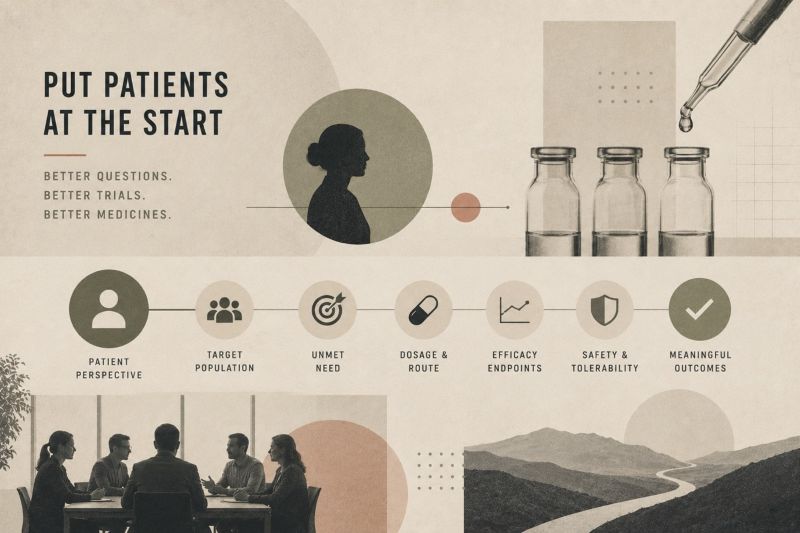
A growing body of regulatory guidance and internal industry practice now aims at that exact sequencing problem. The goal is moving patients earlier into the process. A trial subject who shows up once a protocol is already finalized has arrived too late to matter. Real input requires a seat at the table where a company first defines what a successful drug is even supposed to look like.
The Document That Decides Everything, Long Before a Trial Begins
That document has a name: the Target Product Profile, or TPP. The concept dates to 1997, when the FDA and a clinical development working group introduced it as a planning tool to improve how sponsors and the agency communicate about a drug candidate. A TPP lays out, in advance, the characteristics a medicine needs to succeed: the target patient population, dosing regimen, formulation, route of administration, the efficacy and safety endpoints a trial will measure, and the pricing and access assumptions built around it. According to a 2025 paper in Therapeutic Innovation & Regulatory Science describing Novartis’s approach to the process, the TPP answers a single strategic question up front: what does success actually look like for this medicine? Get that answer wrong, and no amount of downstream trial execution can fix it.
The trouble, according to the same paper, is that patient input into that early document has historically been rare. A 2019 survey of pharmaceutical companies found that only two of eleven reported engaging patient advocacy groups or patient representatives in TPP development at all. Most of the profile gets written by scientists, statisticians, and commercial teams working from assumptions about what patients want rather than direct evidence of it.
Five Questions Only Patients Can Answer
Novartis’s guidance, developed with patient organizations over a multi-year iterative process, narrows the problem to five specific areas where a company can’t substitute internal assumptions for the lived experience of the people the drug is meant to treat: target population, unmet need, dosage frequency and route of administration, efficacy endpoints, and how much patients are willing to tolerate a given side-effect profile in exchange for a given benefit.
One case example from that paper makes the stakes concrete. When Novartis studied patient preferences between intravenous and subcutaneous administration of an existing lymphoma drug, most patients strongly preferred the subcutaneous version, largely because of shorter administration time and less discomfort. That preference had nothing to do with efficacy data. It had everything to do with whether a patient would tolerate showing up for treatment. A TPP written without that input might have deprioritized the reformulation entirely, on the theory that the existing intravenous version already worked.
Regulators Are Building the Same Argument Into Law
The FDA has spent more than a decade pushing the industry toward this kind of earlier engagement through its Patient-Focused Drug Development guidance series, four methodological documents describing how sponsors should collect and use patient experience data in regulatory decisions. On Nov. 18, 2025, the agency finalized the third installment, covering how to select, develop, or modify what regulators call fit-for-purpose clinical outcome assessments, the tools used to measure whether a treatment actually changed something that matters to a patient. That guidance had been sitting in draft form since June 2022.
The final version introduced a concept the agency calls the “meaningful aspect of health,” an attribute of a patient’s condition that matters to them and can be directly improved by treatment. A detailed analysis from the law firm Akin Gump lays out the roadmap the guidance now expects sponsors to follow: understand the disease from the patient’s perspective, conceptualize what a meaningful clinical benefit actually looks like for that population, then select or build the outcome measure that captures it. That sequence puts the patient’s own account of their condition ahead of the statistical convenience of an existing measurement tool, a real shift from a regulatory culture that has often defaulted to whatever endpoint was easiest to standardize across sites.
What the Next Generation of Biotech Leaders Should Take From This
Leen Kawas has built an investing thesis, expressed across her portfolio and in her own public writing, around companies that ask what patients need before they finalize what the science will attempt to prove. The regulatory infrastructure is now catching up to that instinct: a finalized federal guidance defining what a meaningful health outcome means to the person experiencing it, and an industry framework identifying the five specific junctures where patient testimony belongs in a planning document written years before a single patient is enrolled. None of it guarantees a drug will work. What it offers instead is a better chance of finding out early, while a redesign is still cheap, rather than after a Phase 3 program has already spent the money and the years finding out the hard way.
You may also like: LogicFlo raises $2.7M to arm every life sciences expert with their own AI workforce
Image source: Leen Kawas