Click here to get this post in PDF

Defining Professional Services and Their Core Structures
In the intricate landscape of modern life and business, safeguarding our interests and ensuring sustainable growth requires more than just good intentions. It demands specialized knowledge and expert guidance.
This is the essence of professional services. These are non-physical offerings delivered by individuals or firms with extensive training, often holding specific licenses or degrees. They apply their deep expertise to help us solve complex problems, manage risks, and achieve critical objectives.
From strategic business consulting to robust financial planning, and from IT support to essential legal advocacy, professional services are indispensable. For instance, when unexpected events lead to severe accidents, securing legal representation can be crucial for protecting your rights and future.
In this comprehensive guide, we will explore the definition, evolution, and profound impact of professional services. We will also examine how they contribute to business success and personal security, particularly through legal support and insurance solutions.
Professional services stand apart from other service types due to their reliance on specialized intellectual capital, often acquired through extensive education, training, and experience. Unlike transactional services that deliver a tangible product or a standardized, repeatable task (like basic cleaning or transportation), professional services provide bespoke solutions to complex, often unique, problems. They are characterized by high customization, direct client interaction, and the application of expert judgment.
Consider the difference: a mechanic offers a service to repair a car, which is a tangible outcome. A management consultant, however, offers strategic advice to restructure a company, an intangible output based on great analytical skills and industry knowledge. This distinction highlights the knowledge intensity inherent in professional services – the value lies in the expertise and insight they provide, rather than in a physical good.
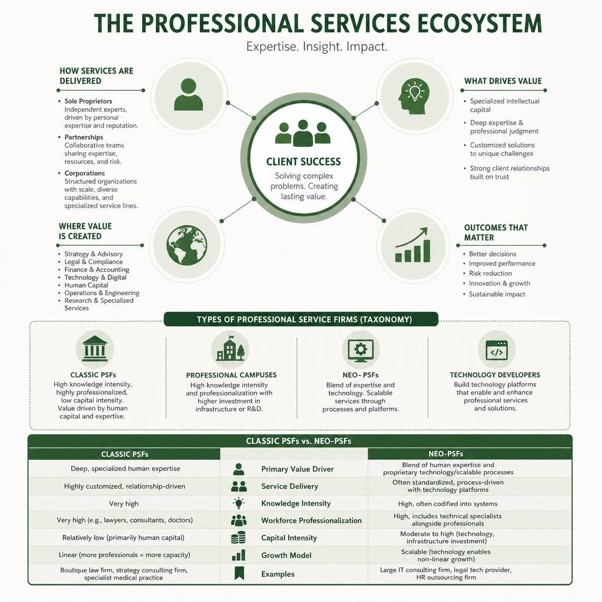
The structure through which these services are delivered can vary significantly. They can be provided by:
- Sole Proprietors: Individual experts operating independently, such as a freelance graphic designer, an independent financial advisor, or a solo attorney. Their personal brand and expertise are paramount.
- Partnerships: Common in fields like law, accounting, and consulting, where professionals pool their expertise and resources. This structure often fosters a collaborative environment and allows for the sharing of liability and profits.
- Corporations: Larger entities that can range from small, specialized firms to massive global organizations like the Big Four accounting firms (Deloitte, PwC, EY, KPMG). These firms often have complex hierarchies, diverse service lines, and significant capital investment.
A deeper understanding of professional services firms (PSFs) can be gained through academic taxonomies. For example, Von Nordenflycht’s taxonomy categorizes PSFs based on factors like knowledge intensity, workforce professionalization, and capital intensity. This framework helps us understand the diverse landscape of firms:
- Classic PSFs: These are characterized by high knowledge intensity, a highly professionalized workforce (e.g., lawyers, doctors, senior consultants), and relatively low capital intensity. Their value is almost entirely in their human capital and intellectual property. Think of traditional law firms or boutique consulting practices.
- Professional Campuses: Similar to Classic PSFs in knowledge intensity and professionalization, but often with higher capital investment in infrastructure or R&D, such as specialized research institutions or advanced engineering firms.
- Neo-PSFs: These firms often blend professional expertise with significant technological or capital investments. They might offer more standardized, scalable services delivered through proprietary platforms. Examples include large IT consulting firms or certain financial services providers.
- Technology Developers: While not strictly PSFs in the traditional sense, these firms develop and sell specialized software or technology platforms that enable other professional services. Their core offering is technology, which underpins their professional advice or solutions.
To illustrate the fundamental differences between the two prominent types, consider the following comparison:
Feature Classic Professional Service Firms (PSFs) Neo-Professional Service Firms (Neo-PSFs) Primary Value Driver Deep, specialized human expertise; intellectual capital Blend of human expertise and proprietary technology/scalable processes Service Delivery Highly customized, relationship-driven, often one-on-one Often standardized, process-driven, leveraging technology platforms Knowledge Intensity Very high High, but often codified into systems Workforce Professionalization Very high (e.g., lawyers, senior consultants, doctors) High, but may include technical specialists alongside traditional professionals Capital Intensity Relatively low (primarily human capital) Moderate to high (investment in technology, infrastructure) Growth Model Linear (more professionals = more capacity) Scalable (technology enables non-linear growth) Examples Boutique law firm, strategy consulting firm, specialist medical practice Large IT consulting firm, legal tech provider, HR outsourcing firm.
The professional services industry is a colossal force in the global economy. As of June 2026, it accounts for approximately 10% of global GDP and employs over 200 million people worldwide. The global professional services market was valued at $5.7 trillion in 2023 and is projected to reach $8.4 trillion by 2030, underscoring its indispensable role in supporting businesses and individuals alike.
Common Occupations in Richmond Professional Services
Within this vast industry, a diverse array of occupations thrives, each requiring specific skills, qualifications, and often, professional licensure. Our vibrant city of Richmond, Virginia, serves as a microcosm of this global trend, with a robust professional services sector supporting its growing economy.
Some of the most common and impactful occupations in professional services in Richmond include:
- Legal Services: Attorneys, paralegals, and legal support staff provide essential advice and representation across a range of specializations, including corporate law and intellectual property, as well as family law and personal injury. The need for legal expertise is constant, whether it’s for navigating complex regulations or advocating for individual rights.
- Accounting and Financial Services: Certified Public Accountants (CPAs), auditors, financial planners, and tax consultants are crucial for individuals and businesses managing their finances. They provide services ranging from tax preparation and auditing to investment management and strategic financial planning.
- IT Consulting and Technology Services: With the rapid pace of technological change, IT consultants, software developers, cybersecurity specialists, and data analysts are in high demand. They help businesses implement new systems, secure their data, optimize operations, and leverage technology to gain a competitive advantage.
- Management Consulting: Consultants specializing in strategy, operations, human resources, and marketing help organizations improve their performance and efficiency. They bring external perspectives and specialized methodologies to solve complex business problems. Management consulting alone generated $160 billion in revenue globally in 2024, reflecting the high value placed on strategic advice.
- Engineering and Architecture: Civil, mechanical, electrical, and software engineers, along with architects and urban planners, provide critical services for infrastructure development, construction projects, and technological innovation.
- Healthcare Administration and Specialized Medical Services: While direct patient care is often considered a separate sector, the administrative, consulting, and specialized support roles within healthcare fall under professional services. For instance, consultants advising hospitals like VCU Medical Center on operational efficiency, or specialists providing medical-legal consulting, are key examples.
- Marketing and Public Relations: Experts in brand development, digital marketing, social media management, and public relations help businesses connect with their audiences and build strong reputations.
To work in these fields, specific skills, qualifications, and certifications are typically required. These often include:
- Professional Degrees: Juris Doctor (JD) for lawyers, Master of Business Administration (MBA) for many consultants, and specialized degrees for engineers and architects.
- Licensing and Certification: Many professions require state-issued licenses (e.g., bar admission for attorneys, CPA license for accountants, professional engineer license). Certifications like Project Management Professional (PMP) or Certified Information Systems Security Professional (CISSP) are highly valued in IT and project management.
- Soft Skills: Beyond technical expertise, critical thinking, problem-solving, communication (both written and verbal), client relationship management, and ethical conduct are paramount. The ability to understand client needs and translate complex solutions into actionable advice is a hallmark of a successful professional service provider.
The presence of major educational institutions and a thriving business environment makes Richmond a hub for these diverse professional service occupations, contributing significantly to the city’s knowledge-based economy.
Marketing, Selection, and Pricing of Professional Services
The marketing and selection of professional services operate on principles distinct from those for tangible goods. Because the “product” is often intangible, highly customized, and delivered through human interaction, trust and reputation become paramount. Clients aren’t just buying a service; they’re investing in expertise and a relationship.
When clients are selecting a professional services provider, several factors weigh heavily:
- Skill and Knowledge: The demonstrated expertise and depth of understanding in the specific area of need are fundamental. Academic credentials, professional certifications, and a track record of successful engagements often evidence this.
- Experience: Clients seek providers who have successfully tackled similar challenges. Experience assures the practical application of knowledge.
- Reputation: Word of mouth, testimonials, case studies, and industry recognition play a crucial role. A strong reputation signals reliability, quality, and ethical practice.
- Capacity: Can the provider handle the project’s scope and timeline? This includes human resources, technological capabilities, and organizational structure.
- Ethics and Integrity: Given the sensitive nature of many professional services (e.g., legal, financial, medical), clients must trust that their interests will be handled with the utmost confidentiality and in accordance with ethical standards.
- Creativity and Innovation: For complex problems, clients often seek providers who can offer novel solutions, think outside the box, and adapt to evolving challenges.
Marketing professional services often involves thought leadership (publishing articles, speaking at conferences), networking, and demonstrating value through case studies rather than traditional advertising. The focus is on building credibility and showcasing expertise.

Pricing models for professional services are equally diverse and depend on the industry, complexity of the service, and the client-provider relationship:
- Hourly Billing: This is a common model, particularly in legal and consulting fields, where providers charge for the actual time spent on a project. Rates vary significantly by seniority and specialization, with average hourly billing rates for management consultants in the US ranging from $150 to $500.
- Fixed Rates/Project-Based Pricing: For well-defined projects with clear deliverables, firms may offer a single, agreed-upon fee. This provides the client with cost predictability.
- Retainer Models: Clients pay a regular fee for ongoing access to a provider’s services, common in legal counsel, public relations, or IT support.
- Value-Based or Outcome-Based Pricing: This emerging model ties the fee to the value delivered or the achievement of specific client outcomes. For example, a marketing agency might charge a percentage of the revenue increase they generate for a client. This aligns incentives but requires clear metrics and agreement on success.
- Subscription-Based Models: Increasingly popular, especially in technology-enabled professional services, where clients pay a recurring fee for access to a service or platform, often bundled with expert support.
For professional services firms themselves, managing risk is a critical consideration. Ensuring that their operations are safeguarded against unforeseen circumstances is vital for long-term stability and client trust. This often involves securing robust professional insurance services to cover potential liabilities, errors, or omissions that can arise from the provision of expert advice.
Risk Management and Professional Services in Virginia
In Virginia, as elsewhere, professional services firms operate in an environment fraught with potential risks. The very nature of providing expert advice means that mistakes, omissions, or even perceived failures can lead to significant financial and reputational damage. Effective risk management is not just a best practice; it’s a necessity for survival and growth.
Key areas of risk for professional services firms include:
- Professional Liability: This is perhaps the most significant risk, covering claims of negligence, errors, or omissions in the professional services rendered. For example, an accounting firm making a mistake on a client’s tax filing, or a consulting firm providing flawed strategic advice.
- Contractual Risks: Ambiguities in professional service agreements, failure to meet contractual obligations, or disputes over scope can lead to costly litigation. Clear, precise contracts are essential for defining deliverables, responsibilities, and expectations.
- Data Security and Privacy: With the increasing reliance on digital tools and the handling of sensitive client information, cybersecurity breaches and data privacy violations pose immense threats. Compliance with regulations such as HIPAA, GDPR, and state-specific privacy laws is paramount.
- Reputational Risk: Negative client experiences, ethical lapses, or public controversies can severely damage a firm’s standing and ability to attract new business.
- Talent Risk: The loss of key personnel, especially in knowledge-intensive fields, can disrupt service delivery and client relationships.
To mitigate these risks, firms in Virginia employ several strategies:
- Robust Professional Service Agreements: These contracts clearly outline the scope of work, deliverables, timelines, fees, and responsibilities of both parties. They also include clauses for dispute resolution and limitation of liability.
- Strict Compliance Protocols: Adherence to industry regulations, professional standards, and legal requirements is non-negotiable. This includes ongoing staff training and regular audits of internal processes.
- Quality Assurance: Implementing rigorous quality control measures ensures that services consistently meet high standards, reducing the likelihood of errors or client dissatisfaction.
- Comprehensive Business Insurance Coverage: This is a critical safety net. Beyond general liability, professional services firms typically invest in Errors & Omissions (E&O) insurance (also known as professional liability insurance) to protect against claims arising from professional negligence. Other essential coverages might include cyber liability insurance, directors & officers (D&O) insurance, and business interruption insurance. Having comprehensive business insurance coverage is not just a protective measure; it signals professionalism and financial stability to clients, reinforcing trust.
By proactively addressing these risks, professional services firms in Virginia can safeguard their operations, protect their clients’ interests, and maintain their reputation for excellence.
Key Challenges and Evolving Industry Trends
The professional services industry, while robust, is not immune to disruption. In June 2026, firms face a dynamic environment shaped by technological advancements, changing client expectations, and global economic shifts. Understanding these challenges and trends is crucial for strategic planning and sustained success.
Key Challenges Faced by Professional Services Teams and Firms Today:
- Talent Retention and Acquisition: The competition for highly skilled professionals is fierce. Firms struggle to attract and retain top talent, especially those with expertise in emerging technologies like AI and data science. High demand and the desire for work-life balance mean firms must offer competitive compensation, professional development opportunities, and a compelling culture.
- Profit Margin Squeeze: Clients increasingly demand more value for less, putting pressure on traditional billing models. The commoditization of certain services and increased competition mean firms must constantly innovate to maintain profitability.
- Strategic Alignment and Outcome-Based Delivery: Shifting from simply delivering a service to ensuring tangible, measurable outcomes for clients is a significant challenge. This requires deeper client collaboration, robust project management, and a clear understanding of client business objectives.
- Resource Management Complexity: Optimizing the utilization of a highly skilled workforce across multiple projects and clients is a constant balancing act. Effective resource planning is essential to avoid burnout, ensure project success, and maximize profitability.
- Security and Compliance: As firms handle sensitive client data and intellectual property, maintaining robust cybersecurity defenses and adhering to complex regulatory frameworks (both domestic and international) is a continuous and evolving challenge. A single breach can have catastrophic consequences.
- Keeping Pace with Technological Change: The rapid evolution of AI, automation, and other digital tools necessitates continuous investment in technology and workforce upskilling. Firms that fail to adopt new technologies risk falling behind.
Evolving Industry Trends:
- AI Integration and Automation: This is perhaps the most transformative trend. Over 60% of professional services firms report that AI and automation are transforming their service delivery models. AI is used to automate repetitive tasks (e.g., data entry, legal document review, basic accounting), enhance analytics, and even generate preliminary advice. This allows human professionals to focus on higher-value, strategic work.
- Shift to Subscription and Outcome-Based Models: The industry is moving away from purely hourly billing towards models that offer recurring revenue and align fees with achieved results. This provides clients with greater cost predictability and ensures providers are incentivized for success.
- Digital Transformation as a Standard: Digital tools are no longer a luxury but a necessity. This includes client portals for seamless communication, advanced analytics platforms for data-driven insights, and integrated project management software for efficiency.
- Remote Work and Hybrid Models: The pandemic accelerated the adoption of remote and hybrid work models, which are now firmly entrenched. This offers firms access to a wider talent pool but also presents challenges in fostering culture, collaboration, and cybersecurity. The I-95 corridor, a major economic artery, exemplifies how firms can leverage remote talent across a broader geographic area.
- Data-Driven Decision Making: Professional services are becoming increasingly data-centric. Firms leverage data analytics to understand client needs, optimize service delivery, predict market trends, and measure the impact of their advice.
- Focus on Niche Specialization: As the market matures, firms are increasingly specializing in niche areas to differentiate themselves and offer deeper expertise to specific industries or problem sets.
- The Rise of IT Services and Consulting: This segment is experiencing explosive growth, with a 8.5% CAGR through 2030, making it the fastest-growing segment of professional services. This reflects the pervasive need for technology expertise across all industries.
These trends signify a fundamental shift in how professional services are designed, delivered, and valued. Firms that embrace innovation, prioritize client outcomes, and invest in their people and technology will be best positioned for success in the coming years.
How AI and Automation Reshape Professional Services Delivery
The integration of Artificial Intelligence (AI) and automation is not merely an enhancement but a fundamental reshaping of the professional services landscape. These technologies are revolutionizing every aspect of service delivery, from initial client engagement to final project execution.
- Enhanced Efficiency and Speed: Automation takes over repetitive, rule-based tasks that traditionally consumed significant professional time. For instance, in legal services, AI can rapidly review thousands of documents for relevance, drastically speeding up due diligence processes. In accounting, automated reconciliation and data entry free up CPAs for more complex analysis and advisory roles. This allows firms to deliver services faster and with fewer errors.
- Superior Data-Driven Insights: AI’s ability to process and analyze vast datasets far surpasses human capabilities. This translates into deeper insights for clients. Management consultants can leverage AI to identify subtle market trends, predict consumer behavior, or optimize operational inefficiencies with unprecedented accuracy. Financial advisors can use AI to build more sophisticated risk models and personalized investment strategies.
- Personalized Client Experiences: AI-powered client portals and chatbots provide 24/7 support, answer routine queries, and offer personalized recommendations. This enhances client satisfaction by providing immediate access to information and freeing up human professionals to focus on high-touch, complex interactions.
- Optimized Resource Management: AI tools can predict project needs, allocate resources more effectively, and monitor project progress in real-time. This helps firms manage their talent pool more efficiently, reduce bench time, and ensure the right expertise is deployed to the right project at the right time.
- New Service Offerings: AI and automation enable firms to offer entirely new services that were previously impossible or cost-prohibitive. This includes predictive analytics, automated compliance monitoring, and AI-driven content creation for marketing.
- Digital Transformation Acceleration: The adoption of AI and automation is a core component of digital transformation initiatives within professional services firms. It pushes organizations to streamline workflows, integrate disparate systems, and adopt a more agile, technology-first mindset.
- Focus on Strategic Value: By automating lower-level tasks, AI empowers professionals to dedicate more time to strategic thinking, creative problem-solving, and building deeper client relationships. The role of the human professional evolves from task execution to strategic guidance and innovation.
While AI and automation bring immense benefits, they also necessitate significant investment in technology infrastructure, data governance, and continuous workforce upskilling. The goal is not to replace human expertise but to augment it, creating a more efficient, insightful, and client-centric professional services ecosystem.
Legal Safeguards and Business Outcomes for Richmond Firms
Professional services are ultimately judged by their contribution to business outcomes and customer success. For firms in Richmond, delivering tangible value means not only providing expert advice but also safeguarding that value through robust legal frameworks and ensuring positive results for their clients.
The direct impact of professional services on business outcomes is profound:
- Strategic Growth: Management consultants help businesses identify new markets, optimize operations, and craft growth strategies that lead to increased revenue and market share.
- Financial Stability: Accountants and financial advisors ensure compliance, minimize tax liabilities, and provide investment guidance that strengthens a company’s financial health.
- Operational Efficiency: IT consultants implement systems and processes that streamline operations, reduce costs, and improve productivity.
- Risk Mitigation: Legal professionals and risk consultants help businesses navigate complex regulatory landscapes, avoid costly litigation, and protect their assets. This is particularly vital in industries with high stakes, such as healthcare, where facilities like Chippenham Hospital rely on expert legal counsel to manage patient care protocols and potential liabilities.
- Innovation and Competitiveness: Engineering and R&D services drive product development and technological advancements, keeping businesses competitive.
Customer success is the ultimate measure of a professional service firm’s effectiveness. It’s about helping clients achieve their goals, whether that’s successfully launching a new product, winning a critical lawsuit, or navigating a complex merger. This success builds long-term value and fosters enduring client relationships.
However, even with the best intentions, disputes can arise. This is where legal safeguards become critical. Professional service agreements are designed to minimize misunderstandings and provide a clear path for dispute resolution. These agreements protect both the client and the provider by defining expectations, responsibilities, and remedies.
In tragic situations where professional negligence or oversight leads to severe consequences, such as a wrongful death, the need for specialized legal services becomes paramount. Securing Professional wrongful death compensation is a critical legal outcome that helps families recover from devastating losses. This demonstrates how professional services, specifically legal advocacy, directly contribute to justice and financial security in the most challenging circumstances.

Navigating Liability and Legal Advocacy in Richmond
For businesses and individuals in Richmond, understanding and navigating the complexities of liability and legal advocacy is a cornerstone of protecting their future. Professional services, particularly in the legal sector, play an indispensable role in this regard.
Corporate law firms in Richmond provide essential services to businesses, including formation, governance, contracts, mergers and acquisitions, and intellectual property protection. Their expertise is vital for ensuring that companies operate within legal boundaries, minimize risks, and achieve their strategic objectives.
Risk mitigation is a proactive approach to identifying, assessing, and controlling threats to an organization’s capital and earnings. Legal professionals assist firms in developing robust compliance programs, drafting comprehensive policies, and providing counsel on potential legal exposures. This includes advising on employment law, environmental regulations, and data privacy.
When disputes or unforeseen incidents occur, legal representation becomes crucial. Whether it’s a contract dispute, regulatory investigation, or personal injury claim, having skilled legal advocates ensures that rights are protected and fair outcomes are pursued. For example, if you’ve been involved in a serious incident, choosing the right personal injury lawyer is a critical first step. You might also need to ask 5 questions before hiring a car accident attorney in Richmond to ensure you find the right fit for your specific needs.
In the unfortunate event of severe accidents, the role of legal advocacy cannot be overstated. For instance, if you’ve sustained a traumatic brain injury due to someone else’s negligence, a traumatic brain injury attorney can help you pursue compensation for medical expenses, lost wages, and pain and suffering. Similarly, for victims of distracted driving, a distracted driving accident lawyer provides essential support. You should never accept a settlement without a lawyer to ensure your rights are fully protected.
From navigating the aftermath of a motorcycle accident to understanding your rights after a rear-end collision, Richmond’s legal professionals are equipped to provide the guidance and representation you need. They ensure that individuals and businesses can confidently face legal challenges, securing their interests and future.
Frequently Asked Questions About Richmond Professional Services
What is the difference between professional services and managed services?
While both professional services and managed services involve external expertise, they differ fundamentally in their delivery model and scope. Professional services are typically project-based, finite engagements focused on solving a specific problem or achieving a particular outcome. They involve specialized knowledge applied to unique client challenges, such as developing a new marketing strategy, conducting an audit, or representing a client in court. The engagement usually ends once the project is completed.
Managed services, on the other hand, involve continuous, ongoing operational support for a client’s existing functions or infrastructure. Instead of a one-off project, it’s a long-term relationship where a provider takes responsibility for managing and maintaining specific IT systems, cybersecurity, HR functions, or even certain financial processes. It’s about recurring maintenance, monitoring, and proactive management to ensure smooth, uninterrupted operations. For example, an IT firm that provides 24/7 network monitoring is offering managed services, whereas an IT firm that designs and implements a new software system is providing professional services.
How do Richmond firms determine their pricing models?
Richmond professional services firms determine their pricing models based on a combination of factors, including service type, the complexity of the client’s needs, market rates, and the firm’s cost structure.
- Hourly Billing: Common for services where the scope of work is difficult to define upfront or requires ongoing, flexible engagement, such as litigation or complex consulting projects. The professional’s experience and seniority often tier rates.
- Fixed-Fee Projects: Preferred for well-defined projects with clear deliverables, like website development, tax preparation, or specific audit engagements. This provides the client with cost certainty.
- Value-Based Pricing: An increasingly popular model, especially for strategic consulting or marketing services, where the fee is tied directly to the measurable value or outcome delivered to the client. This requires a strong partnership and a clear agreement on success metrics.
- Retainer Agreements: Used for ongoing advisory or support services where clients pay a regular fee for access to expertise.
Market rates along Broad Street and throughout Richmond are influenced by factors such as the local economy, the specific industry, the firm’s reputation, and demand for specialized skills. Firms often benchmark their rates against competitors and consider their unique value proposition.
What qualifications are required to practice professional services in Virginia?
The qualifications required to practice professional services in Virginia vary significantly by profession but generally involve a combination of education, experience, and adherence to regulatory standards.
- Professional Degrees: Many fields require specific academic degrees, such as a Juris Doctor (JD) for lawyers, a Master of Business Administration (MBA) for many consultants, or a Bachelor’s/Master’s degree in engineering or accounting.
- State Licensing Boards: Most regulated professions in Virginia require licensure from a state board. Examples include the Virginia State Bar for attorneys, the Virginia Board of Accountancy for CPAs, and the Virginia Board for Architects, Professional Engineers, Land Surveyors, Certified Interior Designers, and Landscape Architects. These boards typically oversee examinations, ethical conduct, and continuing education requirements.
- Certifications: Beyond state licenses, many professionals pursue industry-specific certifications (e.g., Project Management Professional (PMP), Certified Financial Planner (CFP), Certified Information Systems Security Professional (CISSP)) to demonstrate specialized expertise and enhance their credibility.
- Continuing Education: To maintain licenses and certifications, professionals are often required to complete a certain number of continuing education credits annually or biannually, ensuring their knowledge remains current with evolving practices and regulations.
- Ethical Standards: All professional services in Virginia operate under strict ethical codes of conduct, enforced by their respective licensing bodies. Adherence to these standards is crucial for maintaining public trust and professional standing.
These requirements ensure that professionals operating in Virginia possess the necessary competence and integrity to deliver high-quality services to their clients.
Conclusion
As we look towards the latter half of the 2020s, the professional services sector remains a cornerstone of economic stability and innovation. Its indispensable role in fostering business growth, navigating complex challenges, and safeguarding individual and corporate futures cannot be overstated. The future outlook for professional services is one of dynamic evolution, driven by technological advancements such as AI and automation, persistent demand for specialized expertise, and an increasing focus on outcome-based value delivery.
For businesses and individuals in Richmond and beyond, engaging with professional services is an investment in strategic planning and resilience. Whether it’s for expert legal counsel, astute financial guidance, cutting-edge IT solutions, or transformative business strategy, these services provide the critical support needed to thrive in an ever-changing world. The foundation of this industry remains trust – the confidence that expert advice will lead to positive, tangible results.
As the Richmond business landscape continues its impressive growth trajectory, the demand for sophisticated professional services will only intensify. Firms that embrace innovation, prioritize ethical practice, and consistently deliver measurable value will be the ones that shape the future.
You may also like: 7 Professional Services That Every Business Could Benefit From