Click here to get this post in PDF
The Landscape of Modern Federal Legal Challenges

In our increasingly intricate world, legal challenges are a common reality. They can affect individuals, businesses, and even the highest levels of government. Understanding these complex issues is not just beneficial; it’s often essential for safeguarding our rights and interests.
We recognize that the prospect of confronting a legal challenge can feel overwhelming. From personal disputes to significant federal litigation, the legal system can be a maze. Whether you are dealing with contractual disagreements, family matters, or even specific personal injury cases like Florida car accident legal challenges, knowing how to approach these situations makes a real difference.
We will explore the many facets of legal challenges. We will delve into their constitutional foundations and review key judicial rulings. Our aim is to provide a clear overview of the current legal landscape as of June 2026. Join us as we navigate these complex areas, offering insights into their broader implications for society.

The federal legal landscape in June 2026 is characterized by a dynamic interplay of executive actions, legislative intent, and judicial review. Our comprehensive litigation tracker reveals a significant volume of cases challenging various aspects of federal policy and executive authority. As of this month, we are monitoring approximately 860 active legal challenges against the current administration, a figure that underscores the persistent scrutiny applied to governmental decisions.
These cases are broadly distributed across several key policy areas, reflecting the diverse priorities and points of contention within society. A substantial portion of these challenges revolves around executive orders, which often become immediate targets for litigation due to their direct and far-reaching impact. For instance, immigration policy continues to be a hotbed of legal disputes, with numerous lawsuits contesting border enforcement, asylum procedures, and visa regulations. Similarly, military policy, particularly concerning recruitment, service conditions, and resource allocation, has generated its share of federal court battles.
A growing area of litigation in recent years, and particularly prominent in June 2026, involves gender-affirming care policies. These cases often pit individual rights and medical autonomy against state or federal regulations, leading to complex constitutional arguments. Beyond policy-specific disputes, the legal profession itself is not immune to challenges. We’ve observed instances of law firm sanctions, particularly in cases where courts have found conduct to be in violation of ethical standards or procedural rules. This highlights the rigorous demands placed on legal practitioners and the accountability mechanisms within the judicial system.
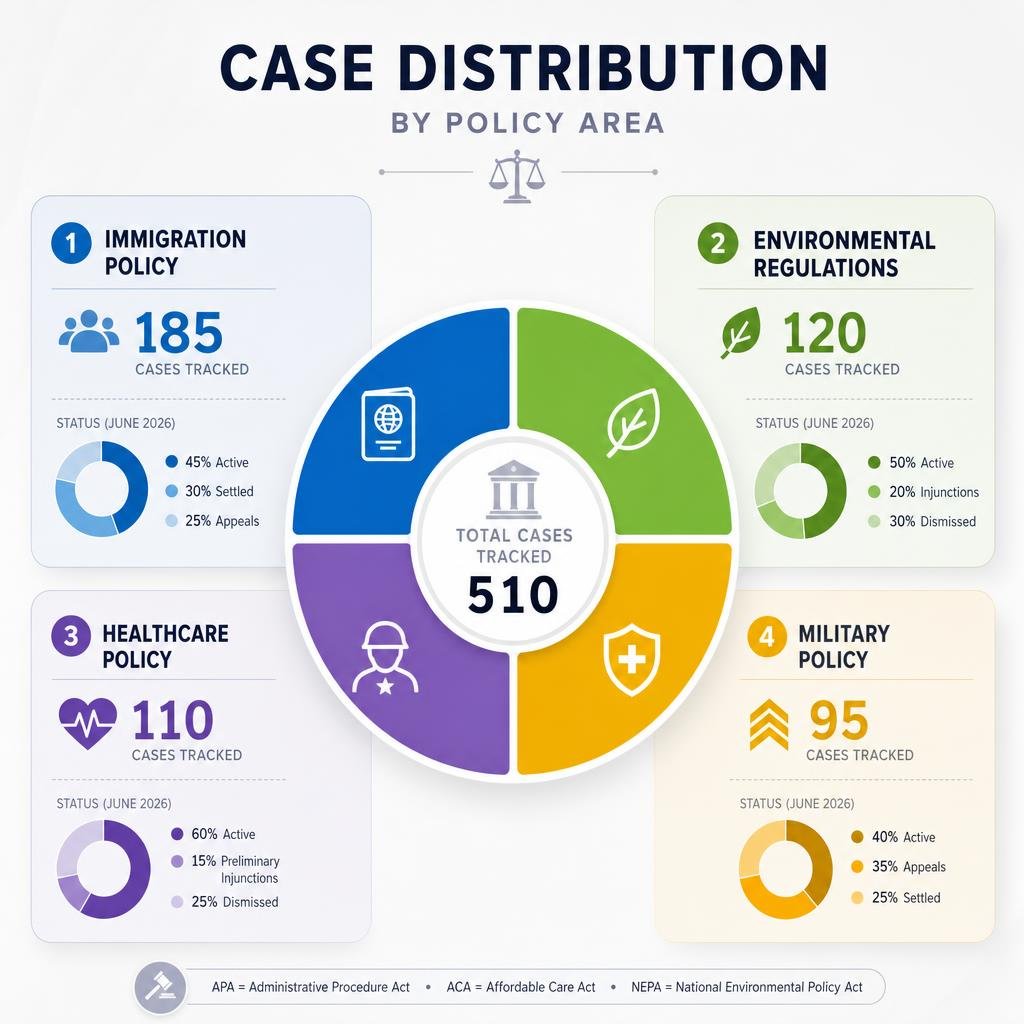
To illustrate the breadth and status of these challenges, consider the following distribution:
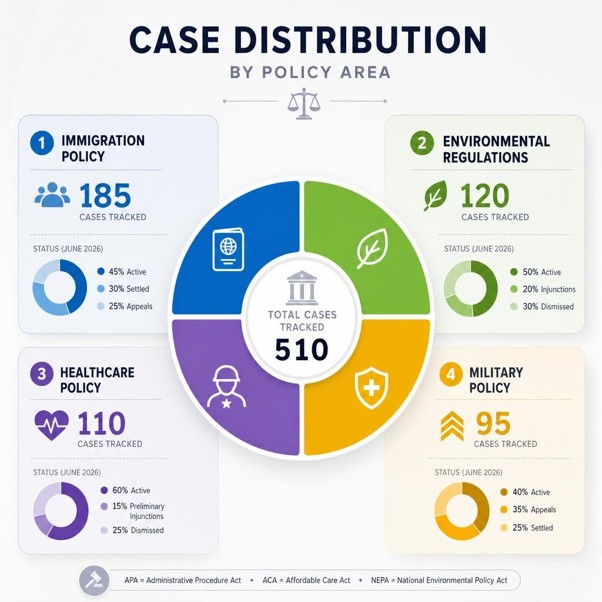
Policy Area Number of Cases Tracked Status (June 2026) Common Legal Grounds Immigration Policy 185 45% Active, 30% Settled, 25% Appeals APA, Equal Protection, Due Process Environmental Regulations 120 50% Active, 20% Injunctions, 30% Dismissed APA, Commerce Clause, NEPA Healthcare Policy 110 60% Active, 15% Preliminary Injunctions, 25% Dismissed ACA, APA, First Amendment Military Policy 95 40% Active, 35% Appeals, 25% Settled Equal Protection, Due Process, Statutory Interpretation Gender-Affirming Care 80 70% Active, 20% Injunctions, 10% Appeals Equal Protection, First Amendment, Medical Autonomy Economic & Trade Policy 75 55% Active, 25% Settled, 20% Appeals APA, Commerce Clause, International Law Cybersecurity & Data Privacy 60 80% Active, 10% Early Stage, 10% Dismissed Fourth Amendment, Statutory Interpretation, APA Law Firm Sanctions & Ethics 35 65% Active, 20% Appeals, 15% Resolved Professional Conduct Rules, Court Orders Other 100 Varied Varied Navigating this intricate web of litigation requires sophisticated tools and methodologies. The sheer volume and complexity of these cases necessitate advanced tracking and analysis systems. For those interested in how technology is increasingly being leveraged to manage and understand such vast legal datasets, exploring innovations in legal tech that address ParkerGPT legal challenges offers valuable insights into the future of legal process management and dispute resolution. These advancements are crucial for legal professionals striving to maintain efficiency and accuracy in an ever-evolving legal environment.
Constitutional and Statutory Grounds for Litigation
At the heart of most federal legal challenges lie fundamental constitutional principles and statutory mandates. These provide the legal bedrock upon which arguments are built and judicial decisions are rendered. Understanding these grounds is essential to comprehending the nature and potential outcomes of the disputes.
First Amendment and Administrative Procedure Act Legal Challenges
The First Amendment to the U.S. Constitution is a frequent basis for legal challenges, particularly concerning issues of free speech, religion, and assembly. Cases often arise when government actions are perceived to infringe upon these fundamental liberties. For example, disputes over protest regulations, censorship in public forums, or restrictions on religious practices regularly lead to litigation. The scope of free speech, especially in the digital age, continues to be a contested area, with courts frequently asked to balance individual expression against public order or safety concerns.
Alongside constitutional claims, the Administrative Procedure Act (APA) is a cornerstone for challenging federal agency actions. The APA sets out the procedures federal agencies must follow when promulgating regulations, adjudicating cases, and performing other agency functions. Challenges under the APA typically argue that an agency’s action was “arbitrary, capricious, an abuse of discretion, or otherwise not in accordance with law,” or that the agency failed to follow proper rulemaking procedures. These challenges ensure that federal agencies operate within their statutory authority and adhere to due process.
A notable example of statutory challenges involves the Rehabilitation Act, which prohibits discrimination on the basis of disability by federal agencies and programs. Litigation under this act often focuses on ensuring accessibility and equal opportunity. For instance, cases demanding ASL interpretation services in government proceedings or accessible digital platforms for federal services are common. The intersection of these statutory rights with broader constitutional protections often creates complex legal battles. For a broader perspective on emerging legal issues, including those impacting state-level governance and individual rights, one might consider the insights provided in articles discussing The Top 10 Legal Issues Shaping Florida in 2025: What You Need … which often touch upon similar themes of constitutional interpretation and statutory application within a state context.
Equal Protection and Due Process Legal Challenges
The Fifth Amendment and Fourteenth Amendment of the U.S. Constitution are critical for ensuring equal protection and due process under the law. The Fifth Amendment applies to the federal government, guaranteeing due process and prohibiting the taking of private property without just compensation, among other things. The Fourteenth Amendment extends these protections to state governments, famously including the Equal Protection Clause and the Due Process Clause.
Equal protection challenges assert that a law or government action discriminates against a particular group of people without a legitimate governmental purpose. This can involve discrimination based on race, national origin, gender, or other classifications. Cases under Title IX (prohibiting sex-based discrimination in education) and Title VII (prohibiting employment discrimination) often invoke equal protection principles, aiming to rectify systemic inequalities and ensure fair treatment for all individuals.
Due process challenges, on the other hand, focus on the fairness of governmental procedures and the protection of fundamental rights. This includes both procedural due process (ensuring fair hearings and notice before deprivation of life, liberty, or property) and substantive due process (protecting certain fundamental rights from government interference, regardless of the procedures used). The Sixth Amendment, guaranteeing the right to counsel in criminal cases, is a specific manifestation of due process, ensuring that individuals facing criminal charges have adequate legal representation.
The importance of robust legal advocacy in these areas cannot be overstated. When fundamental rights are at stake, individuals and groups often require strong, dedicated representation to navigate the complexities of constitutional law. Securing aggressive legal challenges representation is often paramount for those seeking to uphold their rights against governmental overreach or discriminatory practices, ensuring their voices are heard and their claims are meticulously presented in court.
Key Judicial Rulings and Sector-Specific Outcomes

The trajectory of many legal challenges is ultimately shaped by pivotal judicial rulings, which not only resolve individual cases but also set precedents that influence future litigation and policy. In recent years, we have observed several significant outcomes across various sectors, reflecting the judiciary’s role in interpreting law and holding governmental bodies accountable.
One prominent area of judicial intervention has been related to transgender military service. Several cases have addressed policies impacting the ability of transgender individuals to serve openly in the armed forces, with courts often scrutinizing the legal basis and practical implications of such regulations. Similarly, challenges concerning gender-affirming care have led to crucial rulings, with courts weighing state interests against individual rights to medical treatment, often resulting in injunctions that temporarily block restrictive laws. These decisions have significant implications for healthcare access and LGBTQ+ rights nationwide.
Beyond policy-specific cases, the judiciary also plays a role in regulating the conduct of legal professionals. We have seen instances of law firm sanctions, where courts have imposed penalties on firms or individual attorneys for misconduct, such as discovery abuses, ethical violations, or frivolous litigation. The case involving Perkins Coie, for example, highlighted the judiciary’s willingness to enforce professional standards and ensure the integrity of the legal process. Such actions serve as a reminder that all participants in the legal system are subject to rigorous oversight.
Advocacy groups frequently play a critical role in bringing these issues to the forefront. The National Association of the Deaf, for instance, has been instrumental in numerous lawsuits advocating for the rights of deaf and hard-of-hearing individuals, particularly concerning access to communication and information. Their efforts have led to significant legal victories that have expanded accommodations and services in various public and private settings.
Furthermore, the D.C. Circuit Court of Appeals often sees a consolidation of cases challenging federal agency actions due to its specialized jurisdiction over many regulatory matters. This consolidation allows for efficient judicial review of similar claims, leading to comprehensive rulings that can have nationwide impact. These rulings often shape the regulatory environment for industries and government programs alike. For businesses navigating complex regulatory landscapes or facing disputes, understanding these judicial trends is vital. Engaging with attorneys specializing in commercial litigation, such as a St. Petersburg Commercial Litigation Attorney, can provide strategic guidance on how these judicial outcomes might affect their operations and legal strategies.
State-Level Dynamics and the Role of Advocacy Groups
While federal litigation often captures headlines, state-level dynamics are equally crucial in shaping the broader legal landscape. State attorneys general, as the chief legal officers of their respective states, wield significant influence over both state and federal policy through their enforcement actions and their participation in multi-state litigation.
State attorneys general frequently engage in cooperative efforts, forming multi-state coalitions to challenge federal policies they deem unlawful or detrimental to their constituents. These coalitions often file amicus briefs in federal cases, offering their unique perspectives and legal arguments to appellate courts, including the Supreme Court. Their involvement can significantly sway judicial opinion by demonstrating widespread state-level concern or support for a particular legal position. This interplay highlights the principles of federalism, where states retain significant autonomy and a voice in national legal debates.
Advocacy groups, whether national or local, are indispensable players in identifying legal challenges, mobilizing support, and pursuing litigation to advance their causes. Civil rights organizations, environmental groups, consumer protection advocates, and many others actively monitor governmental actions, draft legislation, and initiate lawsuits to protect the interests of their members and the public. Their strategic litigation often targets systemic issues, pushing for broader reforms rather than just individual relief. These groups frequently collaborate with private law firms and pro bono attorneys to maximize their impact.
The work of these groups extends to ensuring access to justice for underserved populations. Many organizations provide free legal help for eligible clients, addressing a wide range of civil legal needs from housing and employment to family law and consumer debt. For instance, initiatives like those offering Free Legal Help for Eligible Clients in Largo – Bay Area Legal Services play a vital role in closing the justice gap, ensuring that individuals who cannot afford legal representation still have access to the legal system. These efforts are fundamental to upholding the principle of equal justice under the law, ensuring that legal challenges are not solely the purview of those with significant financial resources.
Broader Implications for Executive Power and the Justice Gap
The constant stream of legal challenges against federal actions carries profound implications for the balance of power within the U.S. government, particularly concerning executive authority. Judicial review, a cornerstone of our constitutional system, acts as a critical check on the executive branch, ensuring that presidential actions and agency regulations remain within the bounds of statutory law and constitutional principles. This ongoing scrutiny reinforces the separation of powers, preventing any single branch from overstepping its designated authority.
Each legal victory or defeat for the administration contributes to the evolving understanding of executive power. When courts rule against executive orders or agency policies, it can constrain future presidential actions, forcing administrations to consider the legal vulnerabilities of their initiatives more carefully. Conversely, judicial affirmations of executive authority can embolden an administration to pursue its agenda with greater confidence. This dynamic interplay between the executive and judicial branches is a continuous process of negotiation and redefinition of governmental scope.
Beyond the halls of power, legal challenges highlight a persistent and pervasive issue: the justice gap. This term refers to the significant disparity between the civil legal needs of low-income individuals and the resources available to meet those needs. While the focus of many federal challenges is on high-stakes policy, millions of Americans face everyday legal problems—evictions, domestic violence, consumer fraud, employment disputes—without adequate legal representation. The lack of federal funding for civil legal aid programs exacerbates this problem, leaving countless individuals to navigate complex legal systems on their own.
Addressing the justice gap is not merely a matter of charity; it is fundamental to a fair and equitable society. When individuals cannot access legal assistance, their rights can be violated, their economic stability undermined, and their trust in the legal system eroded. The broader implications of legal challenges, therefore, extend far beyond the specific policy at hand. They touch upon the very accessibility and fairness of the legal process for all citizens. Understanding the intricacies of the Litigation Process is crucial, not only for high-profile federal cases but also for individuals navigating personal legal battles, as it underscores the importance of legal guidance at every step. Bridging the justice gap requires sustained commitment from government, legal professionals, and advocacy groups to ensure that the promise of justice is available to everyone, regardless of their socioeconomic status.
Frequently Asked Questions About Federal Legal Challenges
How many legal challenges against the administration are currently pending in June 2026?
As of June 2026, our litigation tracker indicates that there are approximately 391 pending cases actively challenging various actions and policies of the current administration. This number represents cases that are still in various stages of the litigation process, including initial filings, discovery, motion practice, and appeals. The status of these cases is constantly evolving, with new lawsuits being filed and others reaching resolution through settlement, dismissal, or judicial ruling. This figure is a subset of the 860 total cases tracked, reflecting those that have not yet reached a final disposition.
What are the most common constitutional grounds cited in these lawsuits?
The most common constitutional grounds cited in federal legal challenges against the administration primarily revolve around fundamental rights and the structure of government. The First Amendment, protecting freedom of speech, religion, and assembly, is frequently invoked. Challenges often allege that government actions infringe upon these liberties. The Fifth Amendment, guaranteeing due process and equal protection under federal law, is another cornerstone, particularly in cases concerning immigration, property rights, and fair governmental procedures. Additionally, the principle of separation of powers is a recurring theme, with lawsuits arguing that the executive branch has overstepped its constitutional authority or encroached upon legislative or judicial prerogatives. Equal protection clauses, both from the Fifth and Fourteenth Amendments, are also commonly cited in cases alleging discrimination or disparate treatment.
How do state attorneys general influence federal litigation outcomes?
State attorneys general exert significant influence on federal litigation outcomes through several key mechanisms. Firstly, they often file amicus curiae (“friend of the court”) briefs in federal cases, providing the court with their state’s perspective, legal arguments, and potential impacts of a ruling. These briefs can carry substantial weight, especially when filed by a coalition of states. Secondly, state attorneys general frequently form multi-state coalitions to directly challenge federal policies in court. These coordinated efforts amplify their legal and political leverage, making it more difficult for federal agencies to defend their actions. Lastly, their involvement reflects the principles of federalism, where states act as independent sovereigns with the authority to challenge federal overreach. By taking strong state-level positioning, they can shape the national legal discourse and influence how federal courts interpret and apply laws, ultimately impacting the outcomes of federal litigation and the balance of power between state and federal governments.
Conclusion
The landscape of legal challenges, particularly at the federal level, remains a complex and ever-evolving domain in June 2026. From the intricate web of constitutional arguments under the First and Fifth Amendments to the procedural safeguards of the Administrative Procedure Act, these cases underscore the vital role of judicial review in maintaining the rule of law and ensuring executive accountability. The judiciary acts as a critical arbiter, interpreting statutes, defining the boundaries of executive power, and safeguarding individual rights against potential governmental overreach.
As we look to the future, the implications of these challenges will continue to reverberate across society. Decisions rendered by district courts, appellate panels, and ultimately the Supreme Court, will not only resolve immediate disputes but also shape policy, influence future executive actions, and refine our understanding of constitutional principles. The ongoing scrutiny of executive actions, coupled with the persistent efforts of advocacy groups and state attorneys general, ensures a dynamic legal environment where governmental decisions are continuously tested and refined. Navigating these complexities requires vigilance, expertise, and a steadfast commitment to justice, ensuring that the legal system continues to serve as a cornerstone of our democratic society.
You may also like: Protecting Your Future: Legal Advocacy and Insurance Solutions