Click here to get this post in PDF

Mitigating Organizational Risk Through HR Consulting and Leadership Training
Navigating the complexities of employment law, particularly concerning disparate impact, is a significant challenge for modern organizations. Beyond mere compliance, proactive risk mitigation is essential for fostering a thriving, equitable workplace culture. HR consulting and leadership training are invaluable tools in this endeavor, helping to build robust leadership pipelines, ensure fair succession planning, and equip managers with the skills to lead inclusively. These strategic investments not only safeguard against potential liabilities but also drive organizational growth and enhance employee engagement.
Building Robust Leadership Pipelines to Prevent Systemic Disparities
A critical area where disparate impact can manifest is in an organization’s leadership pipeline and talent development programs. While seemingly neutral, criteria for advancement or specific roles can inadvertently create systemic barriers for protected groups. For instance, a physical ability test, if not directly related to job functions, could disproportionately exclude certain demographics. This was starkly illustrated in 2020, when Walmart, Inc. paid a substantial $20 million to settle an EEOC nationwide hiring discrimination case over such physical ability tests. This case underscores the potential financial and reputational consequences for employers who fail to scrutinize their policies for unintentional disparate impact.
HR consulting plays a pivotal role in identifying these subtle yet impactful biases within talent acquisition and development processes. By conducting thorough audits of job requirements, assessment methods, and promotion criteria, consultants can pinpoint practices that, despite good intentions, may be leading to discriminatory outcomes. Furthermore, leadership training is crucial for equipping managers and executives with the awareness and skills to design and implement truly equitable talent strategies. This includes understanding how to define job-relatedness, validate selection tools, and consciously work to dismantle systemic barriers that might impede the progress of diverse talent. By fostering an environment where merit is genuinely assessed through objective and validated means, organizations can build stronger, more diverse leadership pipelines.
To prevent these systemic barriers, HR consultants often conduct comprehensive job analyses. A job analysis involves systematically gathering, documenting, and analyzing information about the content, context, and human requirements of a job. This process ensures that any criteria used for hiring or promotion—such as educational degrees, specific certifications, or physical requirements—are directly tied to the actual duties of the position. When organizations rely on outdated job descriptions or arbitrary requirements, they risk creating an artificial barrier that disproportionately excludes qualified candidates from diverse backgrounds. By aligning selection criteria with empirical job analysis data, employers can confidently defend their practices as job-related and consistent with business necessity, minimizing legal exposure while securing top-tier talent.
The Role of HR Consulting and Leadership Training in Succession Planning
Effective succession planning is vital for leadership continuity and organizational stability. However, if not carefully designed, it can inadvertently perpetuate existing biases and create disparate impacts, particularly at senior levels. Traditional succession planning might rely heavily on subjective assessments or informal networks, which can favor individuals who fit a pre-existing mold, potentially overlooking qualified candidates from underrepresented groups. This can stifle diversity at the top and limit opportunities for a broader talent pool.
Modern, inclusive succession planning, informed by expert HR consulting, moves beyond these pitfalls. It emphasizes objective performance metrics, clearly defined competencies, and a transparent process for identifying and developing future leaders. Leadership training for those involved in succession decisions helps them recognize and mitigate unconscious biases, ensuring that candidates are evaluated based on their capabilities and potential, rather than subjective preferences or historical patterns. This approach fosters a true meritocracy, ensuring that the most capable individuals, regardless of background, are prepared for leadership roles. This not only mitigates the risk of disparate impact claims but also enhances talent retention and strengthens the overall leadership bench. For a deeper dive into how a strategic approach to talent management can transform your organization, exploring resources on executive coaching and leadership training can provide valuable insights.
Teaching Managers How to Coach Their Own Teams for Fairer Outcomes
The distinction between disparate impact and disparate treatment is fundamental for managers to understand. While disparate treatment involves intentional discrimination, disparate impact refers to policies or practices that, though neutral on their face, disproportionately affect protected groups without being job-related and consistent with business necessity. Managers, often at the frontline of implementing company policies and making daily employment decisions, can inadvertently contribute to disparate impact if they lack proper training.
HR consulting can design targeted leadership training programs that empower managers to coach their teams for fairer outcomes. This involves educating them on how to apply objective performance metrics, provide constructive and unbiased feedback, and ensure equitable distribution of opportunities, such as challenging assignments or professional development. For example, training can help managers identify when a seemingly neutral policy, like a strict attendance rule, might have a disparate impact on employees with family care responsibilities. By understanding these nuances, managers can proactively adjust their approaches or advocate for policy reviews. This not only reduces the risk of liability but also cultivates a more inclusive and productive team environment where all employees feel valued and have an equal chance to succeed.
Furthermore, effective coaching requires managers to establish structured feedback loops and maintain meticulous documentation. When performance evaluations and promotion recommendations are backed by clear, contemporaneous records of objective achievements, the risk of subjective bias creeping into the decision-making process is greatly reduced. HR consulting firms often help organizations develop standardized coaching templates and evaluation rubrics that guide managers through constructive conversations. This structured approach ensures that every team member receives the same quality of guidance and support, eliminating the informal, ad-hoc coaching styles that can unconsciously favor certain individuals over others. When managers are trained to act as objective coaches, they build a culture of trust and transparency that drives overall organizational performance.
Proactive Strategies for Modern Workplace Culture and Compliance
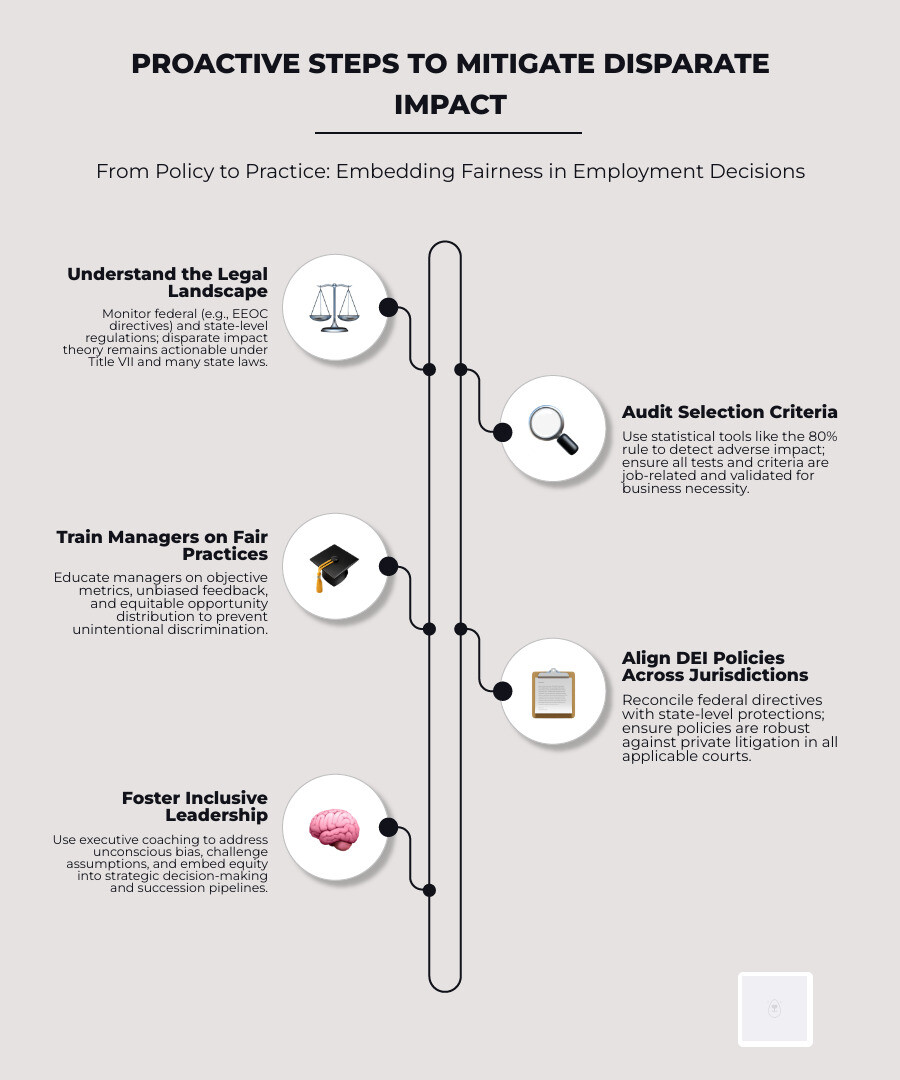
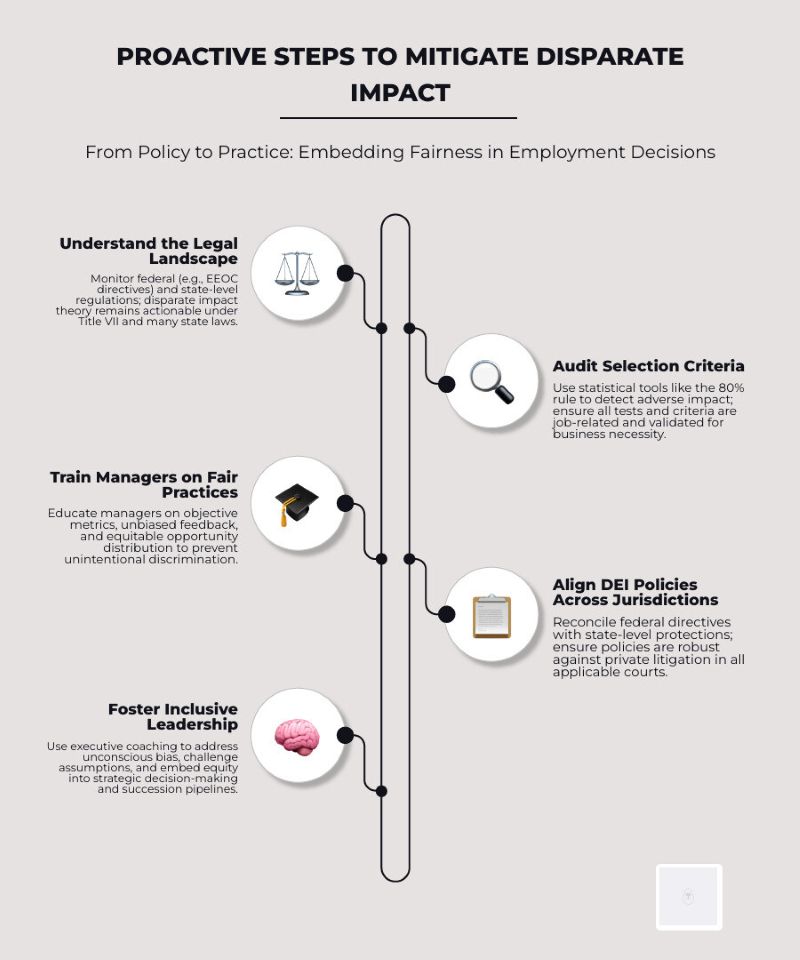
In an ever-evolving legal and social landscape, employers must adopt proactive strategies to ensure their workplace culture is both compliant and genuinely inclusive. This involves aligning Diversity, Equity, and Inclusion (DEI) policies with current standards, rigorously auditing selection criteria, and leveraging executive coaching to foster inclusive decision-making at every level.
Aligning DEI Policies with Evolving Federal and State Standards
The landscape of disparate impact enforcement is currently undergoing significant shifts. As of July 2026, employers must contend with the implications of President Trump’s Executive Order, “Restoring Equality of Opportunity and Meritocracy,” issued on April 23, 2025. This order categorically rejected the use of disparate impact theory by federal agencies like the Equal Employment Opportunity Commission (EEOC). Consequently, the EEOC has been directed to close almost all pending charges based solely on allegations of disparate impact discrimination by September 30, 2025. This directive significantly alters how federal agencies will investigate such claims, likely deprioritizing agency-led litigation based on this theory.
However, this federal policy change does not eliminate employer liability for disparate impact. While the EEOC may no longer actively pursue these claims on behalf of private plaintiffs, the theory of disparate impact remains codified in Section 703(k) of Title VII of the Civil Rights Act of 1991. This means that private plaintiffs can still file charges with the EEOC and, crucially, seek “right-to-sue” letters to pursue their claims in federal court. Moreover, many state laws continue to recognize disparate impact as a viable theory of liability for private employers, often with their own enforcement mechanisms. Therefore, organizations must ensure their DEI policies are not only aligned with federal directives but also with the often more protective state-level regulations. HR consulting can help organizations navigate this complex interplay, ensuring their policies mitigate risks across all applicable jurisdictions and remain robust against potential private litigation.
It is critical for employers to recognize that state-level enforcement of civil rights laws remains highly active and independent of federal policy shifts. Many states have enacted their own comprehensive anti-discrimination statutes that explicitly prohibit practices causing a disparate impact, regardless of federal directives. For instance, state agencies and state courts in jurisdictions like California, New York, and Illinois continue to vigorously enforce local regulations that protect employees from systemic bias. In these jurisdictions, the burden of proof on employers to justify a policy with a disparate impact can be even more stringent than under federal law. Consequently, a multi-state employer cannot rely solely on federal compliance; they must maintain a localized, highly adaptable compliance strategy. HR consultants provide the necessary expertise to monitor these regional legislative updates, helping organizations tailor their policies to meet the highest standards of compliance across all operating locations.
Leveraging HR Consulting and Leadership Training to Audit Selection Criteria
The bedrock of disparate impact theory in employment law lies in the principle that employment practices, even if neutral in intent, must not disproportionately exclude protected groups unless they are job-related and consistent with business necessity. This fundamental concept was established over five decades ago by the Supreme Court in the landmark 1971 ruling of Griggs v. Duke Power Co. The Griggs decision made it clear that a lack of discriminatory intent does not excuse practices that have a discriminatory effect and are not directly tied to job performance.
Today, leveraging HR consulting and leadership training is crucial for employers to proactively audit their selection criteria against these enduring legal standards. Consultants can guide organizations through a systematic review of all hiring, promotion, and other employment practices, assessing their potential for disparate impact. This includes analyzing data using statistical tools, such as the 80% rule, a guideline that suggests adverse impact if a protected group’s selection rate is less than 80% of the highest-selecting group. If a potential disparate impact is identified, the focus shifts to demonstrating “business necessity”—proving that the practice is essential for safe and efficient job performance. Leadership training helps managers understand the importance of job validation, ensuring that all selection procedures, from interviews to skills tests, are objectively designed to measure only those abilities critical for the role, minimizing the risk of unintentional discrimination.
In addition to the 80% rule, sophisticated HR audits utilize advanced statistical methodologies to detect potential disparities before they escalate into legal disputes. These methods include standard deviation analyses and multiple regression models, which help determine whether differences in selection rates are statistically significant or merely the result of random chance. When an audit reveals a statistically significant disparity, HR consultants work closely with organizational leaders to explore alternative selection procedures that could achieve the same business objectives with less adverse impact. This proactive approach not only prepares the organization to defend its practices under the legal framework established by Griggs, but also demonstrates a good-faith commitment to equity that can be invaluable in mitigating reputational damage and fostering employee trust.
Executive Coaching as a Catalyst for Inclusive Decision-Making
Beyond policy and procedure, the ultimate success of an organization’s efforts to prevent disparate impact and foster a truly inclusive culture rests with its leaders. Executive coaching serves as a powerful catalyst in this regard, shaping leadership behavior and decision-making at the highest levels. Through tailored coaching, leaders can develop a deeper understanding of unconscious biases and their potential influence on strategic decisions, resource allocation, and talent management.
Coaching helps executives cultivate a mindset of inclusive leadership, encouraging them to question assumptions, seek diverse perspectives, and actively champion equity within their teams and across the organization. This not only enhances cultural alignment but also directly impacts organizational performance by tapping into a wider pool of talent and fostering innovation. For example, a coached executive might re-evaluate criteria for a high-profile project, ensuring that opportunities are distributed based on merit and potential rather than historical patterns or familiarity. By integrating executive coaching into their leadership development strategy, organizations can embed inclusive decision-making into their very fabric, strengthening their succession pipelines and creating a workplace where every individual has the opportunity to thrive.
You may also like:
Company Culture: How To Strengthen Trust in the Workplace
Transforming Workplace Loneliness: Practical Solutions for Cultivating Real Connections