Click here to get this post in PDF
By Dan Luckhurst, founder, iSeal Bathrooms
In a working week I’ll take the same phone call several times. A landlord rings me, slightly panicked, because the tenant in the unit below has just clocked a water stain creeping across their ceiling. A bubble of plaster. A brown ring around a downlight. One bloke last winter had a piece of cornice come down in the night and land on his couch.
By the time visible damage shows on a ceiling, the water has usually been leaking quietly upstairs for at least six months. The repair bill that follows is rarely the kind of money any landlord planned to spend that quarter.
Here’s the good news. Shower leaks don’t come out of nowhere. They announce themselves long before they ever break through to a ceiling, just quietly enough that most landlords don’t recognise what they’re looking at.
Why bathroom leaks stay hidden for so long
There’s some surprisingly clever engineering involved in keeping an Australian bathroom waterproof. Behind the tiles of most bathrooms built in the last twenty years you’ll find a waterproof membrane, installed in strict accordance with AS 3740 and sized for the job at hand. The role of that membrane is to intercept any water that finds its way through the tile and bedding above it, and channel it back to the floor waste.
The membrane is your last line of defence, not your first. By the time it’s called on to do its job, grout and silicone have already failed.
Grout is designed to be porous. The cement-based stuff absorbs water like a sponge, swells a touch, shrinks back, and after a few seasons of that it cracks. Silicone has a similar story: it expands and contracts under temperature changes, especially around metal-framed shower screens that warm up every time the shower runs and cool down every time it doesn’t.
Once water finds those tiny failures, it has a knack for ending up in unexpected places. It weeps into the substrate, tracks along the studs and joists, and turns up somewhere with nothing visible to do with the shower. I’ve fixed bathrooms where the only outward sign was a slow ring of damp at the edge of a carpet, three metres outside the room.
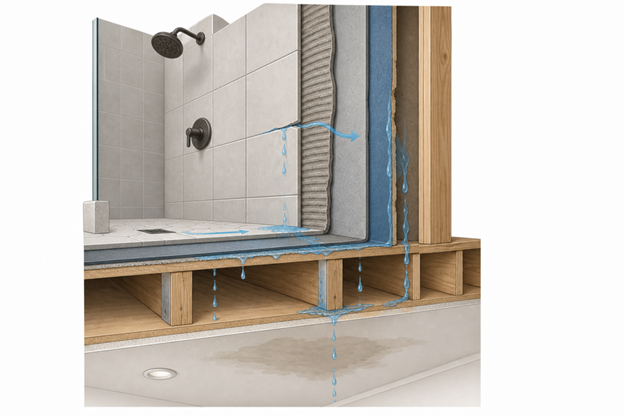
Image AI-generated
The 7 early signs of a shower leak every landlord should know
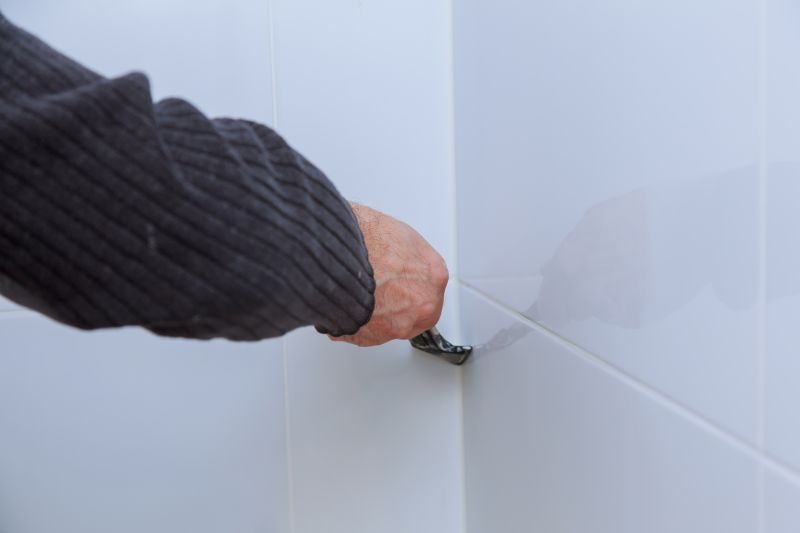
1. Loose, crumbled or failed grout. Check each section by knocking it gently with a knuckle. Good grout is hard and makes a small, dense “tink” sound. Failed grout is chalky and comes away easily under pressure, sometimes crumbling in your fingers. If you pull a fingernail through the joint and come away with little crumbs, water has been working its way behind the tiles for a while. Watch out for tenants cleaning with anything acidic, too. Descaler, vinegar and undiluted bleach all eat grout faster than most people realise.
2. Soft, sticky or discoloured silicone. Test the silicone bead at the wall-floor junction and around the shower screen frame with your thumb. Healthy silicone pushes back firmly with a slight springiness, and stays roughly the colour it was on installation day. Failing silicone is soft, often discoloured anywhere from yellow to grey to black, sometimes streaked with mould growth. The corners and the base of the screen channel fail first, and that’s where they let the most water through.
3. Tiles that sound hollow. Tap on each tile around the wet area, particularly the bottom two rows and anywhere near the screen base. A normal tile will sound solid and ring clearly. Any tile that sounds hollow, or moves the slightest bit when you press a corner, has delaminated from the substrate. By the time a delaminated tile actually works its way loose, you’re well past a cosmetic fix.
4. The musty smell that never quite goes. There are smells that relate to visible water damage and clear up once things dry out. There are also smells that linger in places that don’t seem to relate to any obvious wet patch, often hidden behind walls or in wall cavities. Tenants will mention a bad smell in the bathroom or in a nearby room. Listen to them. I’ve pulled saturated insulation out of the wall cavity behind a bathroom that looked spotless, on the back of an odour complaint. Your nose will usually pick up an active leak a week or two before your eyes do.
5. Bubbling skirting paint, or carpet that won’t dry. Water tracked under a wall plate often doesn’t show up in the same room first. It usually shows in the next one. Check the base of every skirting board that backs onto a shower or bath for peeling, bubbling or yellow-stained paint. Check the carpet directly outside the bathroom door too. A persistent damp patch there is almost never the tenant’s fault, however much they apologise.
6. Water marks on the ceiling below the bathroom. For most people this is the most obvious sign of water damage, and by the time you can see it the leak has usually been active for months. Water leaks down through the ceiling joists, finds the lowest point in the cavity, and only emerges once there’s enough of it to push through the plaster. Treat it as urgent, and don’t paint over it. The source has to be found and sealed first, or the stain will be back inside a fortnight.
7. Hairline cracks in the shower corners. Where two walls meet, or where a wall meets the floor, you should see a clean unbroken line of grout or silicone. A fine crack along one of those corners is usually a sign of failing waterproofing membrane in one of its most stressed areas. What looks like a minor cosmetic issue often reads, once you know what you’re looking at, as a structural one.
What it actually costs to act early
A shower leak seems like a small thing that can’t cause much damage, until the numbers start running.
A full shower re-seal, which means pulling the failed silicone, re-grouting with flexible epoxy, and rebuilding the perimeter beads, comes in at roughly $400 to $900 for a standard residential shower. One day on site, shower back in use that evening.
A complete bathroom rebuild lands somewhere between $15,000 and $30,000, and no matter how good the original inspection was, it can always get worse. You might start out replacing a rotten substrate and some soft plasterboard, then find that a couple of joists need to come out too. Two to four weeks of work. The property is unrentable while it happens. And in most policies I’ve read, gradual water damage isn’t covered. Burst pipes are. Slow leaks aren’t.
So the real comparison isn’t $500 versus $20,000. It’s a one-day fix while the tenant stays in place, versus a month of empty rent plus a deductible the insurance won’t pay out on. You can almost always seal a leaking shower without removing tiles if you catch it before the damage has gone past the tile line.
Building bathroom checks into your inspection routine
You don’t need a tradesman to spot any of this. An extra five minutes on your quarterly inspection covers the lot.
Run your thumb along the silicone at the wall-floor junction and around the shower screen frame. Tap a few tiles at random near the floor and at shoulder height. Step inside the screen and have a proper look at the grout in the bottom corners. On your way through the property, look up at the ceiling of whichever room sits underneath the bathroom. If there’s a unit below yours, knock and ask whoever lives there if they’ve noticed anything overhead lately.
Document any signs of unusual wear. Photograph anything that looks “off”, name the folder with the date, and store it somewhere you control in the cloud. A timestamped image folder of problem areas is one of the most valuable assets a landlord can build, both for timely maintenance and for the insurance conversation if a leak develops later.
What to ask your tenant, and what to document
There are three questions worth asking on every inspection. Is the shower draining slower than usual? Is there any musty or stale smell in the bathroom or the rooms around it? Have any new stains, marks or paint changes appeared anywhere in the property since you were last through?
None of these are accusations. They’re prompts that surface information tenants often don’t realise is important. Write the answers down. Date them.
The bottom line
In twenty years on the tools, the single most expensive bathroom water damage I’ve ever repaired was the leak that could have been stopped six months earlier with a $500 re-seal. Every one of those jobs started with one of the seven signs above, sitting in plain sight on a routine inspection.
The flip side is the good news. Catch a shower leak early enough and you’re usually looking at a same-day fix, no demolition, and a property that stays leased while the work happens. This is what I do every week at iSeal Bathrooms. Find the failure point, seal it, and walk away without lifting a tile.
About the author
Dan Luckhurst is the founder of iSeal Bathrooms in Perth, Western Australia. He has spent more than 20 years repairing leaking showers, balconies and bathrooms across WA. iSeal manufactures its own range of epoxy grouts and silicone sealants and specialises in non-destructive shower repairs.
Also read: How to Advertise Your Rental Property in London to Maximize Earnings as a Landlord
Image source: elements.envato.com