Click here to get this post in PDF
The Strategic Role of Technology for Business Success

In May 2026, the business world is evolving at an unprecedented pace. Technology is no longer just a supporting function; it is the core driver of competitive advantage and sustained growth. Companies that strategically leverage digital tools are not just surviving, they are setting new benchmarks for success.
We believe that understanding and adopting technology is paramount for any business aiming to thrive today. This article will guide us through the essential aspects of technology for business success. We will explore its primary benefits, from boosting efficiency to enhancing customer experiences, and see how it reshapes operations. We’ll also examine the transformative power of AI, discuss how to develop effective technology strategies, and address common challenges. Finally, we’ll look at the exciting emerging trends shaping 2026 and beyond. A holistic approach, which includes new methods for areas like AI-powered financial education, is now crucial for navigating this dynamic landscape.

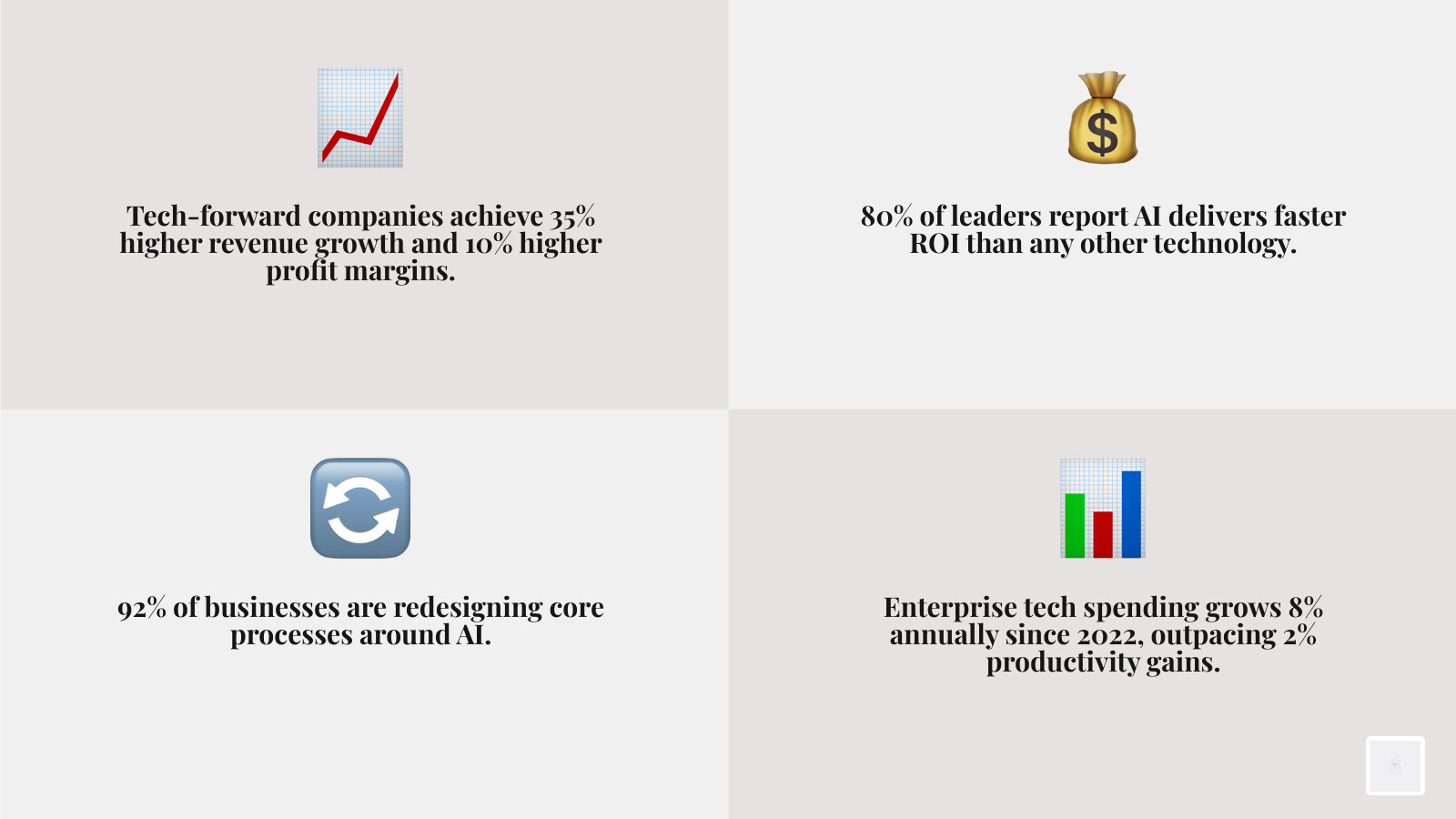
In today’s dynamic marketplace, technology has transcended its traditional role as a mere operational tool to become a central pillar of business strategy. Companies that embrace this shift are not just adapting; they are leading. The evidence is compelling: organizations with high-performing IT departments consistently demonstrate superior financial outcomes, reporting up to 35% higher revenue growth and 10% higher profit margins compared to their less tech-savvy counterparts. This isn’t a coincidence; it’s a direct result of integrating technology into the very fabric of business planning.
We observe that only a fraction of businesses, approximately 21%, are truly “tech-forward,” meaning they leverage technology to actively shape their business strategy. These forward-thinking entities are significantly more likely – 2.3 times more, to be precise – to outperform their peers in both revenue growth and return on invested capital (ROIC). This outperformance stems from a proactive approach to technology, treating it not as an expense, but as a strategic investment. For businesses seeking to optimize their operations and achieve sustained growth, exploring how various solutions, including those offered by LaunchVector technology for success, can be integrated into their strategic framework is crucial.
A robust digital core, underpinned by cloud infrastructure, advanced data analytics, and artificial intelligence, forms the bedrock of this tech-forward strategy. However, technology alone isn’t enough. The leadership team must also be fluent in technology. An impressive 75% of tech-forward companies boast both a tech-fluent CEO and tech-fluent C-suite executives, a figure 20% higher than other organizations. This collective understanding enables informed decision-making, dynamic resource allocation, and a strategic vision that truly operates at the pace of technological change.
Building a Foundation with Technology for Business Success
The benefits of technology adoption are multifaceted and profound, touching every aspect of business operations. At its core, technology drives increased efficiency by automating repetitive tasks, streamlining workflows, and optimizing resource utilization. This translates into faster production cycles, reduced operational costs, and greater output. For instance, cloud-based software allows teams to collaborate seamlessly regardless of location, transforming production chains and enabling more agile responses to market demands.
Beyond efficiency, technology profoundly enhances the customer experience. From AI-powered chatbots providing instant support to sophisticated CRM systems enabling personalized marketing campaigns, technology allows businesses to connect with customers on a deeper, more effective level. This personalized engagement fosters loyalty and drives customer satisfaction.
Moreover, technology is the engine of improved data analytics. By collecting, processing, and interpreting vast amounts of data, businesses gain invaluable insights into market trends, customer behavior, and operational performance. This data-driven decision-making capability enables precise strategic adjustments, identifies new growth opportunities, and mitigates risks more effectively. The internet has fundamentally reshaped global markets, enabling businesses of all sizes to expand their reach and compete on an international scale. Remote work, a concept rapidly accelerated by recent global events, has become a permanent fixture for many organizations, facilitated entirely by technological advancements that ensure connectivity and productivity across distributed teams.
Future-Proofing via Technology for Business Success
The pace of technological innovation demands a strategy built on adaptivity. Businesses must cultivate an agile mindset, continuously evaluating emerging technologies and integrating those that offer a competitive edge. This involves moving beyond rigid, annual planning cycles to adopt continuous strategic cycles with rapid sprints and dynamic resource reallocation. The ability to pivot quickly in response to economic shifts, market disruptions, or new technological breakthroughs is paramount for long-term viability.
Building trust is another cornerstone of a successful technology strategy. This encompasses robust cybersecurity measures to protect sensitive data, ensuring privacy for customers and employees, and building resilient systems that can withstand disruptions. A strong ethical framework guiding technology use is also essential, fostering confidence among all stakeholders.
Scalability is inherent to future-proofing. Technology solutions must be designed to grow with the business, accommodating increasing demand and evolving needs without requiring complete overhauls. This often means investing in flexible, modular architectures and cloud-native solutions. The concept of an “innovation flywheel” highlights how better technology generates more data, attracting further investment and accelerating improvements. By fostering an environment of continuous improvement and embracing this innovation cycle, businesses can stay ahead of the curve and ensure their operations remain relevant and competitive in an ever-changing landscape.
Maximizing ROI: The New Economics of AI and Automation
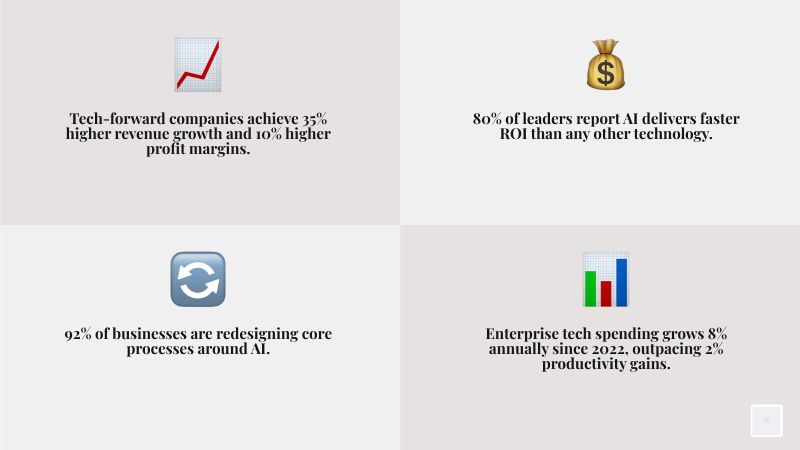
The landscape of enterprise technology spending is undergoing a profound transformation, particularly with the advent of AI. While enterprise tech spending in the United States has seen a robust 8% annual growth since 2022, traditional productivity gains have lagged, growing by only about 2%. This disparity highlights a crucial challenge: how to ensure technology investments translate into tangible business value. The answer, increasingly, lies in the strategic deployment of AI and automation.
A staggering 80% of leaders report that AI delivers faster ROI than any other technology. This isn’t just about efficiency; it’s about unlocking new levels of productivity and strategic insight. Furthermore, 86% of leaders agree that investments in automation have been instrumental in facilitating growth. For high-growth businesses, the focus is shifting from merely adding more tools to simplifying existing tech stacks and unifying data. This consolidation, coupled with intelligent automation, is proving to be a powerful catalyst for expansion. Businesses looking to harness this power to streamline operations and enhance decision-making can find valuable insights into AI automation for business success.
Operationalizing AI for Faster Returns
The high ROI attributed to AI is largely due to its ability to dramatically improve decision velocity and transform workflows. We are currently witnessing a massive redesign of core processes around AI, with 92% of businesses engaged in this transformation right now. This isn’t about automating broken processes; it’s about fundamentally rethinking operations to leverage AI’s capabilities.
Generative AI, in particular, is proving to be a game-changer, accelerating tech modernization timelines by 40-50% and reducing costs associated with tech debt by around 40%. The key to successful AI implementation, however, lies in maintaining human oversight and accountability. While AI can process vast amounts of data and execute tasks with unprecedented speed, human judgment remains critical for ethical considerations, strategic direction, and ensuring alignment with overarching business goals. This strategic partnership between human intelligence and AI capabilities is what drives true operational efficiency and positions businesses for high-growth trajectories.
Measuring Success through Modern Financial Modeling
To truly maximize the ROI of technology investments, businesses must adopt modern financial modeling approaches that move beyond traditional capital expenditure (CapEx) thinking. The rise of cloud services and “as-a-service” models means that a significant portion of IT spend, approximately 79%, now falls under operating expenditures (OpEx). This shift necessitates new frameworks like FinOps (Financial Operations).
FinOps focuses on bringing financial accountability to the variable spend model of cloud, enabling organizations to understand the unit-level cost of their technology consumption. This involves detailed consumption metering, which tracks usage and costs at a granular level, allowing for precise budgeting, cost optimization, and value attribution. By treating technology services as consumable products with transparent balance sheets, businesses can better identify and reduce waste, prioritize investments based on actual value, and ensure that every dollar spent on technology is driving value-oriented innovation. This granular visibility is crucial for making informed decisions and ensuring that technology investments contribute directly to the bottom line.
Overcoming Challenges: From Tech Debt to Tool Sprawl
While the promise of technology for business success is immense, organizations frequently encounter significant hurdles in their adoption journey. Two prominent challenges are tech debt and tool sprawl. Tech debt, the accumulation of suboptimal technical choices made for short-term gains, can add a substantial 10-20% extra cost to projects, hindering agility and innovation. Simultaneously, tool sprawl – the proliferation of disparate software and platforms – creates inefficiencies, data silos, and increased operational complexity. A striking 73% of leaders agree that actively reducing this tool sprawl is the fastest route to a healthier bottom line.
Another pressing concern is cybersecurity. With cyberattacks becoming more sophisticated and frequent, protecting sensitive data and maintaining system integrity is paramount. Security spending is projected to increase by 15% in 2025, underscoring the growing threat landscape. Moreover, the rapid evolution of technology means that 62% of leaders anticipate outgrowing their current technology within just 12 months, highlighting the constant need for adaptation and investment. These challenges, if not addressed strategically, can undermine the very benefits technology is intended to deliver.
Reducing Complexity and Enhancing Security
To navigate these challenges effectively, businesses must prioritize strategies that reduce complexity and enhance security. Eliminating redundancy by consolidating overlapping systems and applications is a critical first step in combating tool sprawl. This not only streamlines operations but also reduces maintenance costs and potential security vulnerabilities. Building scalable infrastructure, often leveraging cloud-native architectures, ensures that systems can grow and adapt without constant overhauls, mitigating future tech debt.
Cyber-resilience needs to be embedded into every aspect of technology strategy. This involves not just implementing advanced security tools, but also fostering a culture of security awareness, regular employee training, and robust incident response plans. Strong governance frameworks are essential to ensure compliance with evolving regulations and industry standards, reducing legal and reputational risks. The goal is to achieve seamless integration across platforms, fostering system interoperability that allows different tools to communicate effectively, eliminating data silos that currently hinder decision-making for 67% of leaders.
Navigating the Knowledge Half-Life
The rapid pace of technological change has created a significant challenge in talent development: the shrinking “knowledge half-life.” The time it takes to study a new technology can now exceed that technology’s relevance window, leading to skill gaps and a constant need for upskilling. This necessitates a fundamental rethink of talent models and HR evolution.
Organizations must invest in continuous learning programs that keep their workforce abreast of emerging technologies and best practices. Leadership capability also plays a crucial role; tech-fluent leaders can better guide their teams through these changes and make informed decisions about technology adoption. The rise of agentic AI dynamics, where AI systems can act autonomously, requires new approaches to training and collaboration, preparing human teams to work effectively alongside intelligent agents. By proactively addressing skill gaps and fostering a culture of continuous learning, businesses can ensure their human capital remains a competitive advantage in an AI-first world.
Future Trends: Preparing for the 2026 AI-Native Landscape
As we look towards 2026 and beyond, the technological landscape is poised for even more profound shifts, driven largely by the continued evolution of AI. We are moving rapidly towards an “AI-native” organizational model, where AI agents, physical AI, and the convergence of technologies like quantum computing and the Internet of Things (IoT) will redefine business operations. AI agents, capable of performing complex tasks autonomously, are transitioning from experimental pilots to production-scale deployment. Physical AI, integrating AI with robotics and other hardware, is revolutionizing sectors from manufacturing to logistics, exemplified by warehouses where AI-coordinated robot fleets improve efficiency by 10%.
The pace of innovation is compounding, creating an “innovation flywheel” where advances in one area accelerate others. Consider the rapid adoption of generative AI tools, reaching 100 million users in just two months – a growth rate far exceeding historical technologies like the telephone or internet. This acceleration means businesses must not just adapt, but fundamentally rebuild their infrastructure, processes, and operating models to harness AI’s full economic potential.
Shifting from Experimentation to Scalable Impact
The challenge for many organizations is bridging the “pilot-to-production gap.” While 38% are piloting AI solutions, only 11% have agents in full production. To achieve scalable impact, businesses must move beyond isolated experiments and adopt enterprise-wide scaling of digital innovations. This requires a problem-first approach, focusing on solving significant business challenges rather than merely exploring technology capabilities.
The development of “AI factories” and “Innovation-as-a-Service” (IaaS) models are becoming critical. These allow for faster prototyping, continuous improvement, and scalable deployment of intelligent solutions across the organization. By embracing agile methodologies and prioritizing velocity over perfection in early pilots, businesses can learn quickly and iterate towards market leadership. The goal is to move from asking “What can we do with AI?” to “What should we do?” focusing on sustainable value creation and transformative outcomes.
The Rise of Human-Agent Teams
The future workforce will increasingly be characterized by collaborative ecosystems of human-agent teams. This evolution demands a rethink of traditional workforce structures and knowledge management. As AI agents take on more tasks, human roles will shift towards supervision, strategic thinking, creativity, and problem-solving that requires nuanced human judgment.
Productivity gains will emerge from this synergy, but it requires strategic hybrid infrastructure that balances the elasticity of cloud with the consistency of on-premises systems and the immediacy of edge computing. Furthermore, organizations must embed governance and modular architectures to manage these complex AI-native environments. This shift also opens opportunities for new digital-first conveniences and social financial tools, as technology continues to integrate seamlessly into daily life and business interactions.
Frequently Asked Questions about Technology for Business Success
Why is technology investment critical in 2026?
Technology investment is critical in 2026 because it is no longer just a competitive advantage but a prerequisite for survival and growth. It drives efficiency, enhances customer experience, enables data-driven decision-making, and allows businesses to adapt to rapid market changes. Tech-forward companies significantly outperform their peers, demonstrating that strategic technology adoption directly translates to higher revenue growth and profit margins.
How can businesses measure the ROI of emerging tech?
Measuring ROI for emerging tech involves adopting modern financial modeling techniques like FinOps and consumption metering. This allows for unit-level cost tracking, transparent value attribution, and a clear understanding of how technology spend translates into operational efficiency and business value. It also requires defining clear KPIs for AI solutions and continuously evaluating their impact on the bottom line, rather than just focusing on initial implementation costs.
What are the biggest risks in rapid technology adoption?
The biggest risks in rapid technology adoption include accumulating tech debt from suboptimal choices, tool sprawl leading to inefficiencies and data silos, and heightened cybersecurity threats. Furthermore, the shrinking “knowledge half-life” can lead to skill gaps within the workforce, and a failure to redesign processes around AI (rather than just automating broken ones) can lead to project failures. Ethical considerations and ensuring human oversight remain crucial to mitigate risks associated with autonomous AI systems.
Conclusion
In May 2026, the imperative for businesses is clear: strategic integration of technology is not merely an option, but a fundamental requirement for long-term growth and resilience. We have seen how technology drives unparalleled efficiency, enhances customer experiences, and provides the data-driven insights necessary for informed decision-making. The transformative power of AI and automation is reshaping industries, delivering faster ROI and necessitating a new approach to operational efficiency and financial modeling.
While challenges like tech debt, tool sprawl, and cybersecurity persist, they are surmountable with strategic planning, robust governance, and a commitment to continuous learning. As we look ahead, the rise of AI agents, physical AI, and AI-native organizations signals a future where human-agent teams and scalable innovation will define market leadership. By embracing these trends, moving from experimentation to impactful implementation, and fostering an adaptive, tech-fluent culture, businesses can ensure their future readiness and secure a decisive competitive edge in the evolving digital landscape.
Also read:
How Your Business Can Save Money on Important Tech
Why Enterprises Choose Software Mind as a Long-Term Technology Partner Program