Click here to get this post in PDF
Remote work is now routine, yet the public internet still exposes customer data and intellectual property. That gap is fueling demand for business-grade virtual private networks (VPNs): analysts expect the global business VPN market to climb from roughly $32.5 billion in 2024 to more than $118.7 billion by 2033. We’ve sifted through audits, speed tests, and real-world feedback, then scored each contender on security, management, performance, price, compliance, and standout extras. The upshot is a six-service shortlist that deploys fast, fits a small-business budget, and gives you evidence for the next audit.
NordLayer – the fully loaded safe bet

NordLayer is the business arm of NordVPN, so you gain access to 6,400-plus RAM-only servers in 111 countries and its WireGuard-based NordLynx protocol. Deloitte has confirmed NordVPN’s no-logs stance six times, most recently on February 3, 2026, as detailed in its 2026 Deloitte no-logs assurance engagement.
Fast, directory-ready onboarding. Spin up the web dashboard, connect Azure AD, Okta, or Google Workspace, then invite users in a few clicks. You can group teammates, limit them to specific gateways, and enforce MFA, so a new hire is protected in minutes.
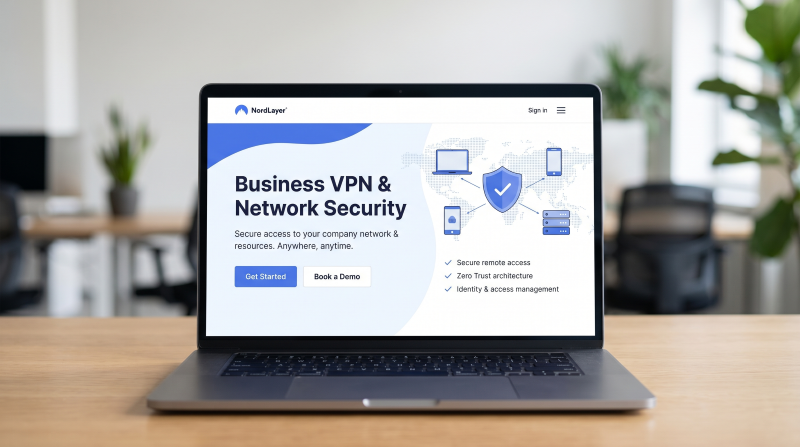
NordLayer business VPN admin dashboard with user groups and gateways.
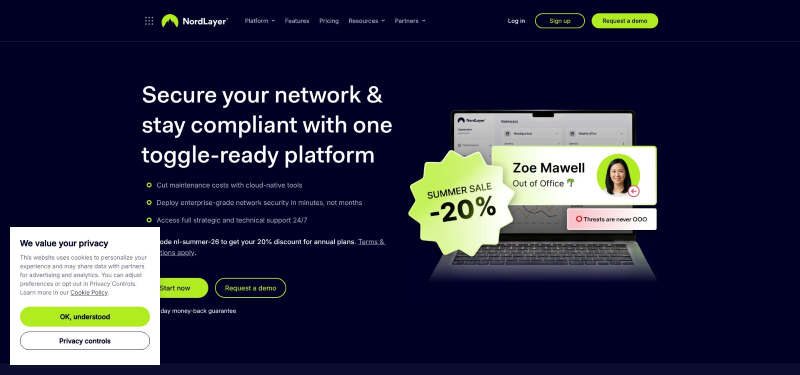
NordLayer business VPN admin console screenshot for small business teams.
Performance that rivals raw ISP speed. TechRadar’s 10 Gbps lab recorded 1,256 Mbps over NordLynx, placing NordLayer near the top of 2026 speed tables. Real-world US tests showed single-digit slow-downs on a 1 Gbps line, which is more than enough for 4K meetings and nightly cloud backups.
Extras most SMB VPNs skip.
- Double-hop routing for sensitive workflows
- Threat Protection that blocks malware and ads at DNS level
- Dedicated gateways and static IPs you can deploy from the console in under a minute
Pricing and trial. Plans start at $8 per user per month (annual Lite tier) with a 5-user minimum and include a 14-day money-back guarantee. The Core and Premium tiers add static IPs, DNS filtering, and priority support.
Bottom line: NordLayer checks every compliance box, installs quickly, and scales from five people to five hundred without forcing you to change your workflow.
Perimeter 81 – the Swiss-army knife of cloud security
Perimeter 81 began as a VPN upstart and, after its 2023 Check Point acquisition, evolved into a full Secure Service Edge (SSE) platform.
Spin up the web console and you can do more than create logins. Deploy private gateways in 40-plus regions, segment traffic into separate virtual networks for finance, dev, or contractors, and layer on a cloud firewall that blocks malicious domains before they reach a laptop, according to TechRadar.
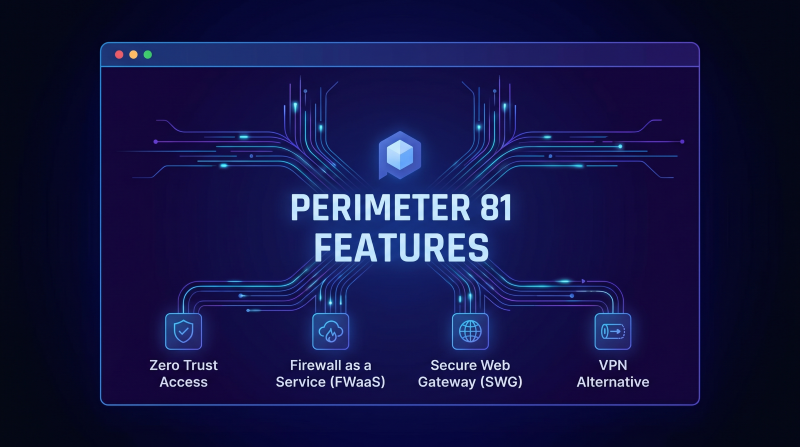
Perimeter 81 SSE console showing gateways, segments, and firewall policies.

Perimeter 81 SSE and network segmentation console screenshot.
Zero-trust baked in. Every session checks the user’s identity and device posture, so an unpatched laptop never slips through. For audits you can export connection logs, posture reports, and ISO 27001 certificates in seconds.
Performance. TechRadar found Perimeter 81’s WireGuard tunnels “blazing fast,” noting smooth HD calls and large OneDrive syncs in everyday use, even when split-tunneling left YouTube outside the pipe.
Pricing reality check.
- Premium plan: $12 per user per month when billed annually (otherwise $15) with a 10-user minimum
- Dedicated gateway: $40 per gateway per month (annual)
For a 20-user firm under compliance pressure, those numbers often work; a five-seat startup may find them steep.
If you want VPN, firewall, and zero-trust controls under one roof yet prefer to avoid hardware, Perimeter 81 delivers enterprise-grade protection without the six-figure bills of legacy vendors.
Twingate – zero-trust access without the headaches
Twingate rebuilds remote access around identity-based permissions. Instead of putting every user on one virtual LAN, it spins up a one-to-one encrypted tunnel to the exact resource that person needs—no lateral movement, no exposed subnet.
That difference matters. If a credential is stolen, the attacker hits a wall. Every request is re-authenticated, every device must pass posture checks, and internal apps stay invisible to the public internet.
15-minute rollout. Deploy a lightweight Connector in your cloud VPC or on-prem server, label resources in the console, and sync with Okta or Google Workspace. Users sign in with existing SSO credentials; the client wakes only when a protected resource is requested, so no one needs to “turn on the VPN.”
Fast by design. Normal web traffic goes direct while only whitelisted IPs travel through WireGuard tunnels, so remote engineers don’t feel a speed penalty.
Pricing that starts free.
- Starter (free): up to 5 users and 1 remote network—ideal for a pilot
- Teams: $5 per user per month (annual) for up to 100 users, unlimited devices, and full SSO integration
Know the trade-offs. Twingate relies on tickets and a lively Slack community rather than 24/7 phone support, and as a younger company it lacks decades of brand recognition. For teams that want zero-trust access without managing hardware or juggling VPN split-tunnel rules, Twingate delivers enterprise-grade control in a start-up-friendly package.
Proton VPN for Business – privacy purists, this one’s for you
If your board worries about jurisdiction and data sovereignty, Proton VPN is the name that quiets the room. Headquartered in Switzerland, home to some of the world’s strictest privacy laws, Proton builds its products so that no one, not even the company itself, can view your traffic.
Proven no-logs stance. Proton’s apps are 100 percent open source, and a fourth independent audit by Securitum in August 2025 confirmed zero logging and no hidden telemetry.
Secure Core and accelerator. For sensitive workloads you can route traffic through hardened servers in Switzerland or Iceland before exiting to the wider internet. When speed matters, Proton’s VPN Accelerator and WireGuard combo reached 1,475 Mbps in TechRadar’s latest tests, topping most rivals on short and long routes.
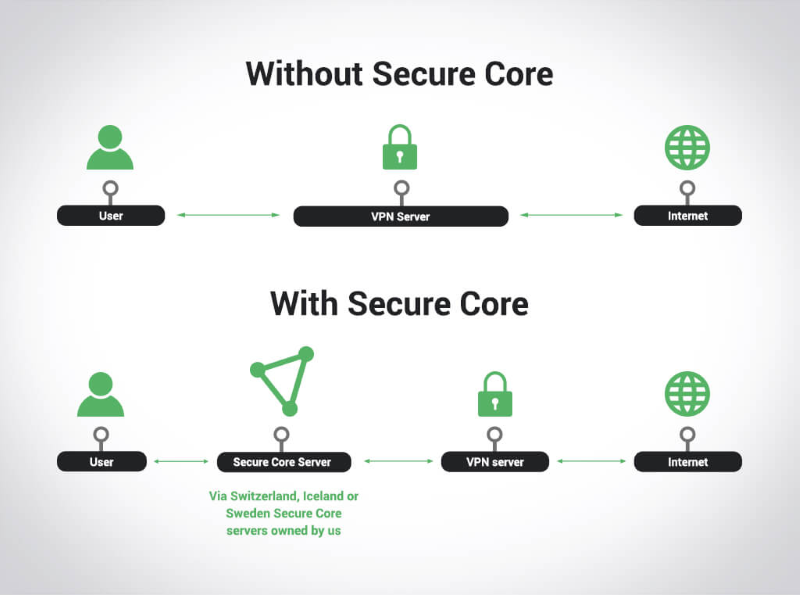
Proton VPN Secure Core routing diagram for Swiss and Icelandic privacy.
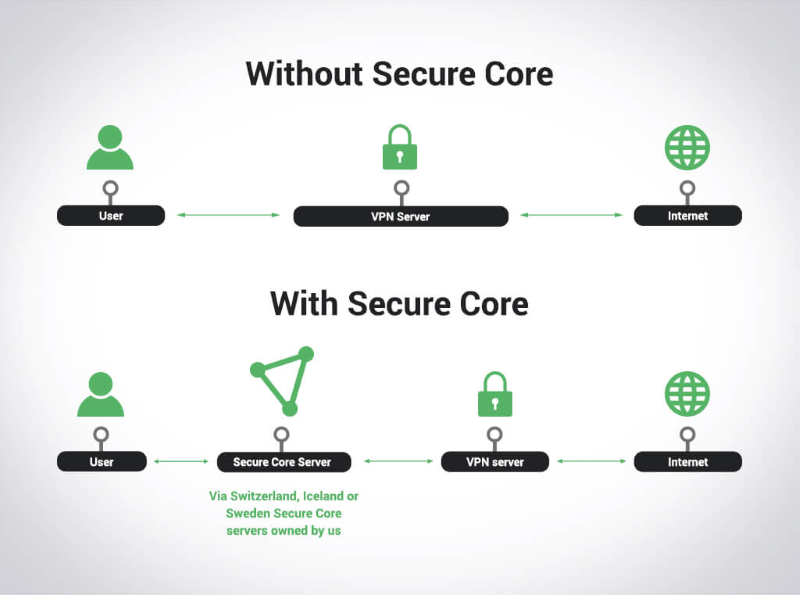
Proton VPN Secure Core infrastructure diagram for business privacy.
Management and devices. Admins assign licenses, and each user can protect up to 10 devices. SSO with Google Workspace or Azure AD is available on Business plans, and a dedicated server with a static IP costs about €40 per month, useful for firewall allow-lists.
Pricing.
- VPN Essentials: €6.99 per user per month (annual)
- VPN Professional: €9.99 per user per month, adds Secure Core and the 10-device limit
- Only 2-seat minimum, so small teams can start fast.
For a boutique law firm, healthcare nonprofit, or distributed newsroom, that’s a modest premium for Swiss transparency and audit-ready privacy.
Windscribe ScribeForce – big protection on a shoe-string budget
Windscribe is known for its free consumer tier, yet ScribeForce is where small teams save real money. The plan costs $3 per user per month (five-seat minimum) and delivers unlimited bandwidth, unlimited devices, and access to servers in 69 countries.
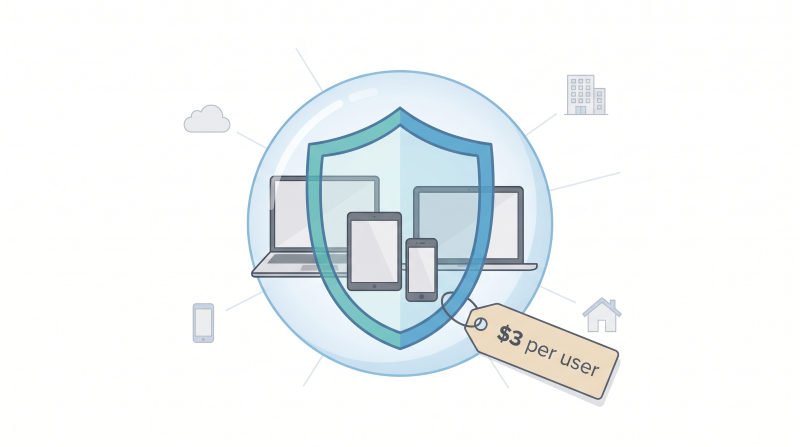
Getting started is quicker than a coffee run: create an organization, buy the seats you need, and email the invite links, with no SSO setup or role matrix required.
Security covers the essentials: AES-256 encryption, WireGuard support, a kill switch, and an audited no-logs policy. You also get ROBERT, Windscribe’s DNS filter that blocks ads, trackers, and malware for the whole team with one toggle.
Performance outpaces the price tag. TechRadar clocked Windscribe’s WireGuard speeds at over 950 Mbps on a 10 Gbps line, with everyday tests still clearing 200 Mbps on nearby servers, plenty for simultaneous Dropbox syncs and HD calls. Static data-center IPs are available as an optional add-on if you need a whitelisted address.
The caveats: support is ticket-only, Canada’s jurisdiction worries the strictest compliance teams, and you won’t find SSO or device-posture checks. When budgets are tight and encryption is non-negotiable, though, ScribeForce wraps every laptop, phone, and tablet in a secure tunnel for less than the price of a latte.
Need more muscle while still under $9 per seat? TorGuard’s business VPN Starter bundle costs $44.99 for five users—about $8.99 each—and folds in HIPAA-compliant management, 24/7 dedicated account support, a static IP, and access to the same 3,000-plus servers in 50 countries that its enterprise plans use. An intuitive admin portal lets you add or revoke users in seconds, making it a sensible upgrade when Windscribe’s free-wheeling approach falls short for audit trails or IP allow-lists.
How to choose the right VPN for your team
Start with one clear question: what problem are you solving?
- Fast onboarding/off-boarding? Prioritize SSO, SCIM provisioning, and visual dashboards; think NordLayer or Perimeter 81.
- Strict privacy or data-sovereignty rules? Put jurisdiction and third-party no-logs audits first; Proton VPN leads here.
- Budget above all? TorGuard and Windscribe trim cost without skimping on encryption.
- Zero-trust mandate? If you’re replacing a legacy VPN, Twingate’s resource-level tunnels may fit better than any network-level tool.
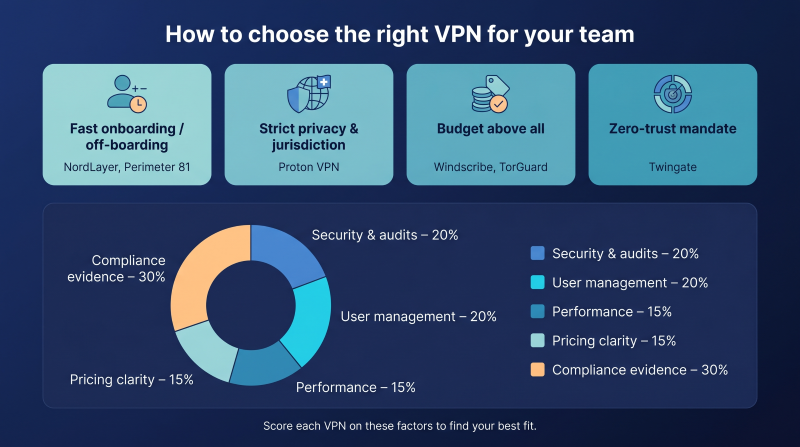
Score contenders against these five weighted factors:
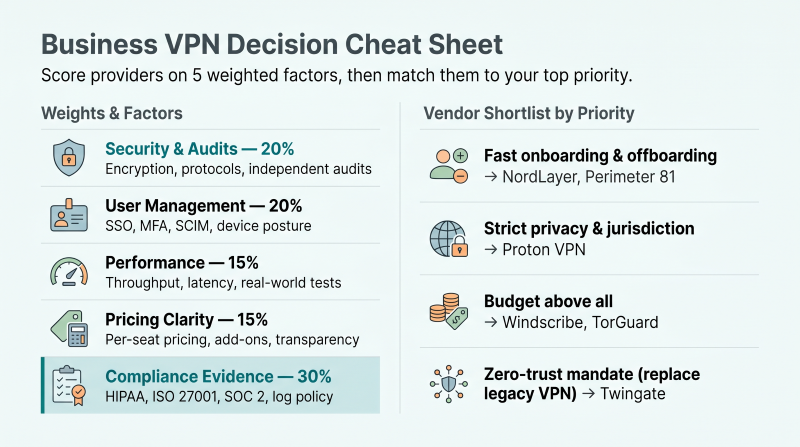
- Security and audits (20 %) – encryption, WireGuard, independent assessments
- User management (20 %) – SSO, MFA, SCIM, device posture
- Performance (15 %) – median Mbps loss on a nearby server
- Pricing clarity (15 %) – per-user cost plus static IP or gateway add-ons
- Compliance evidence (30 %) – HIPAA BAAs, ISO 27001, SOC 2, log-retention policy
Add the numbers, and the best option usually surfaces in ten minutes, not ten meetings.
Conclusion
Align your priorities with the weighted factors above, and one of these six VPNs should meet your security, performance, and budget needs—often before the next coffee break.
You may also like: 5 Reasons Why Business Broadband is Needed in Remote Working
Image source: NordVPN.com