Click here to get this post in PDF
Defining Industrial Organization and the Theory of the Firm

In today’s fast-moving business world, understanding industrial organization is crucial for success. It helps companies achieve efficiency and stay competitive. This field covers more than just economic ideas; it also includes how businesses organize their physical operations and communication systems.
This guide explores the many aspects of industrial organization. It looks at economic theories that shape competition and the practical tools that keep operations flowing smoothly. We will discuss different market structures, how companies make strategic choices, and the vital role of physical infrastructure. For example, keeping complex wiring organized with effective solutions, like Industrial Heli-Tube spiral wrap, is a basic step for reliable communication in any facility.
By understanding both the theories and how they apply in the real world, this article aims to show how businesses can improve their structure and communication. This leads to lasting growth and strength in various industries.
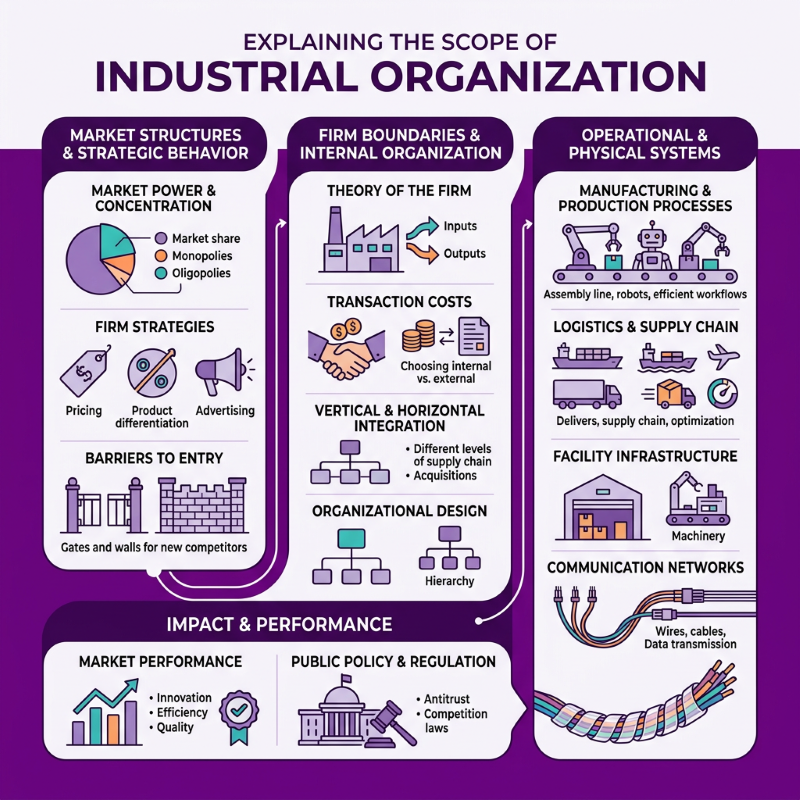
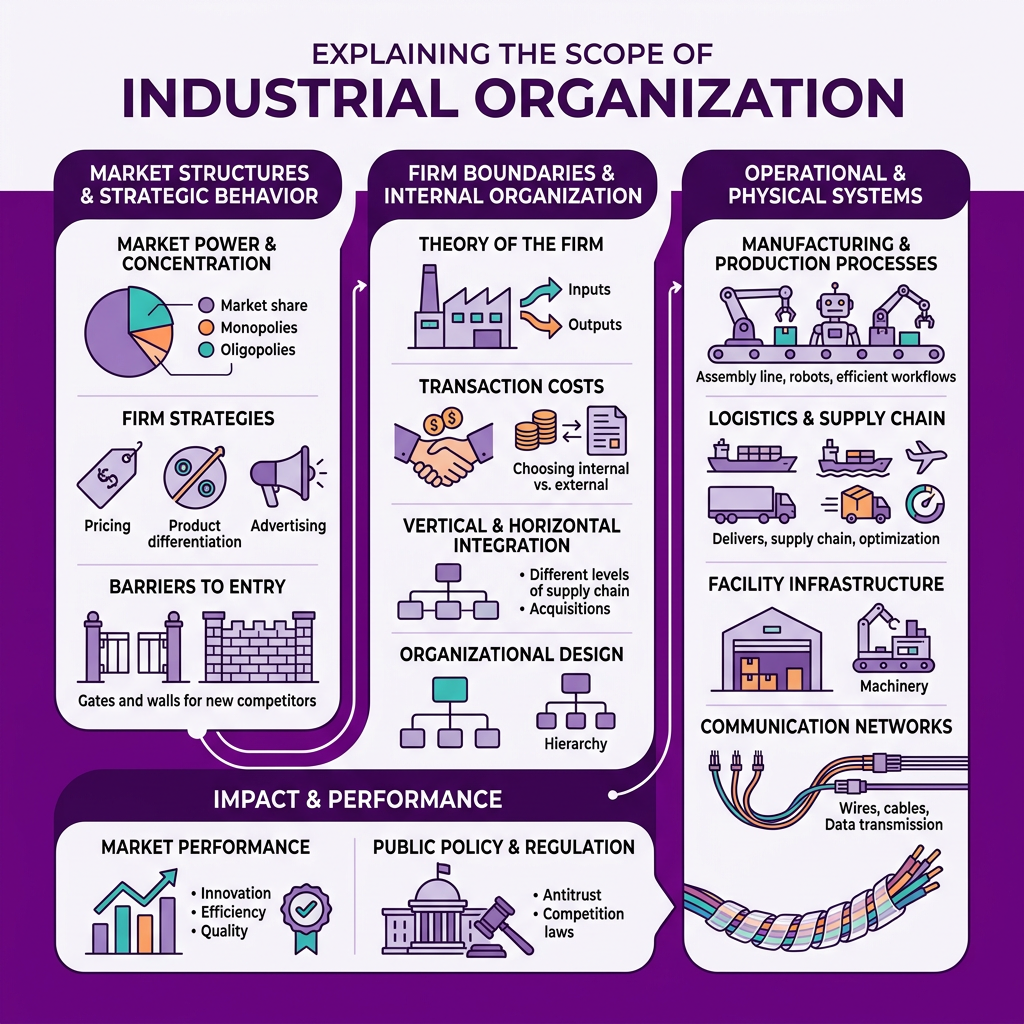
Industrial organization (IO) is a specialized field within economics that delves into the intricacies of firm and market structures. It significantly extends the traditional theory of the firm by moving beyond simplistic assumptions to analyze the complex boundaries between firms and markets. While standard microeconomics often treats firms as abstract entities that maximize profits within perfectly competitive environments, industrial organization acknowledges and examines real-world complexities. These include factors such as transaction costs, imperfect information, and strategic interactions that shape market outcomes.
The core of industrial organization lies in understanding how industries are structured, how firms behave within these structures, and how these behaviors impact market performance. It explores questions like why industries are concentrated in certain ways, how firms make pricing and output decisions, and what role government policy plays in shaping market dynamics. The field is systematically categorized within the Journal of Economic Literature (JEL) classification system, with various subcategories (e.g., L10-L17 for market structure, firm strategy, and market performance) detailing its broad scope. For a comprehensive overview of this economic discipline, the Industrial organization Wikipedia entry serves as an excellent starting point.
The Evolution of Industrial Organization Theory
The roots of industrial organization can be traced back to classical economists like Adam Smith, whose observations on market dynamics laid foundational principles. However, the field truly began to formalize in the early to mid-20th century, evolving from a largely descriptive approach to a more analytical and theoretical discipline. Key contributors were instrumental in this transformation.
Economists such as Edward Chamberlin and Joan Robinson, in the 1930s, challenged the perfect competition paradigm by introducing concepts like monopolistic competition, highlighting product differentiation and market power. Later, figures like Edward S. Mason and J. M. Clark focused on the relationship between market structure, firm conduct, and performance, laying the groundwork for the “Structure-Conduct-Performance” (SCP) paradigm. Joe S. Bain further developed these ideas, emphasizing the role of barriers to entry in shaping industry profitability and market power.
In more recent decades, the field has been profoundly influenced by the application of game theory, leading to what is often referred to as the “New Industrial Organization.” A seminal work in this modern era is Jean Tirole’s “The Theory of Industrial Organization,” published in 1988. Tirole, a Nobel laureate, provided a unified and rigorous framework for analyzing strategic interactions among firms, which became a cornerstone for advanced study in the field. His work, detailed on the MIT Press website, helped integrate complex game-theoretic models into the core curriculum, moving the field towards a more microeconomic modeling approach of firm strategy.
Subareas and Research Topics in the Field
The breadth of industrial organization is reflected in its numerous subareas and research topics, which collectively address a wide array of economic phenomena. These topics often involve a blend of theoretical modeling and empirical analysis to understand real-world market behavior.
Some of the primary areas of investigation include:
- Market Power and Pricing Strategies: This examines how firms with market power set prices, including various forms of price discrimination, and how these strategies impact consumer welfare and competition.
- Vertical Integration and Contract Design: Researchers explore why firms choose to integrate different stages of production (e.g., manufacturing and distribution) or how they design contracts with other firms (e.g., suppliers, distributors) to manage relationships and incentives.
- Product Differentiation and Advertising: This subarea analyzes how firms create unique products, brand identities, and use advertising to attract customers and gain market share, moving beyond the homogeneous products assumed in perfect competition.
- Research and Development (R&D) and Technological Change: Industrial organization investigates the incentives for innovation, how R&D investments are made, and their impact on market structure and economic growth.
- Mergers and Acquisitions: The field studies the motivations behind corporate consolidation, the competitive effects of mergers, and the regulatory responses to prevent anti-competitive outcomes.
- Entry and Exit Dynamics: Understanding the factors that facilitate or hinder new firms from entering a market, and existing firms from exiting, is crucial for assessing market contestability and long-run competition.
- Non-profit Organizations and Public Enterprise: IO also extends its analysis to entities beyond traditional for-profit firms, examining the behavior and market impact of non-profit organizations and state-owned enterprises.
These diverse topics highlight industrial organization’s commitment to dissecting the complex interplay between market structure, firm behavior, and overall economic performance.
Market Structures and Real-World Imperfections in Industrial Organization
A central focus of industrial organization is the study of various market structures, moving along a continuum from the theoretical ideal of perfect competition to the extreme of monopoly. While perfect competition assumes numerous small firms, homogeneous products, perfect information, and free entry/exit, real-world markets rarely fit this mold. Industrial organization critically examines these departures, focusing on how imperfections shape market outcomes.
The main market structures studied include:
- Perfect Competition: A benchmark model where no single firm can influence market price. Firms are price takers, and resources are allocated efficiently.
- Monopolistic Competition: Characterized by many firms offering differentiated products. Firms have some market power due to product uniqueness but still face competition from close substitutes.
- Oligopoly: A market dominated by a small number of large firms. These firms are interdependent, meaning each firm’s actions significantly affect the others, leading to complex strategic interactions.
- Monopoly: A market with a single seller of a unique product with no close substitutes. The monopolist has significant market power and can influence price.
- Monopsony/Oligopsony: These refer to markets where there is a single buyer (monopsony) or a few buyers (oligopsony) of a product or service, giving them significant power over sellers.
Real-world factors like transaction costs, imperfect information, and barriers to entry fundamentally affect market outcomes and are core to industrial organization analysis. Transaction costs, such as the costs of searching for information, bargaining, or enforcing contracts, can make certain market exchanges inefficient or lead firms to integrate activities internally. Imperfect information, where buyers or sellers lack complete knowledge about products or market conditions, can lead to adverse selection or moral hazard, impacting market efficiency. Barriers to entry, ranging from high capital requirements and economies of scale to legal restrictions and established brand loyalty, can limit competition and allow incumbent firms to maintain market power. These elements are thoroughly explored in discussions of the field, as highlighted by resources like the Industrial organization HandWiki entry.
Game Theory and Strategic Interactions
Game theory plays an indispensable role in modern industrial organization, particularly in analyzing markets characterized by strategic interdependence, such as oligopolies. It provides a formal framework for understanding how rational economic agents (firms) make decisions when their outcomes depend not only on their own actions but also on the actions of their rivals.
In the context of industrial organization, game theory helps model various strategic interactions:
- Strategic Pricing: Models like Bertrand (price competition) and Cournot (quantity competition) analyze how firms set prices or output levels in anticipation of competitors’ responses. These models reveal how market outcomes can vary significantly depending on the strategic variables chosen by firms.
- Collusion: Game theory is used to examine the conditions under which firms might tacitly or explicitly cooperate to restrict output or raise prices, and the factors that make such agreements stable or prone to breakdown.
- Entry Deterrence: Firms may engage in strategic behaviors, such as building excess capacity or making credible threats, to discourage potential competitors from entering the market. Game theory helps analyze the effectiveness and rationality of these strategies.
- Asymmetric Information: When firms have different levels of information (e.g., about production costs, product quality, or consumer demand), game theory models can explore how this asymmetry influences strategic decisions, such as signaling quality or screening potential partners.
- Product Positioning and Advertising: Firms use game theory to determine optimal strategies for differentiating their products, choosing advertising levels, and competing for market share in a multi-firm environment.
The application of game theory in industrial organization has been so profound that its methodologies have been exported to other fields, including behavioral economics and corporate finance, demonstrating its versatility as an analytical tool for understanding strategic decision-making in diverse economic contexts.
Practical Applications: Policy, Strategy, and Physical Infrastructure
The theoretical insights and analytical frameworks developed within industrial organization have profound practical applications across public policy, business strategy, and even the physical organization of industrial operations.
In the realm of public policy, industrial organization is the bedrock for:
- Antitrust Law and Competition Policy: Governments use IO principles to identify and remedy anti-competitive practices, such as monopolies, cartels, and anti-competitive mergers. The goal is to promote fair competition, protect consumers, and ensure market efficiency. For instance, the analysis of business concentration and potential collusion, topics frequently explored by the National Bureau of Economic Research (NBER), directly informs antitrust enforcement.
- Economic Regulation: Industries with natural monopoly characteristics (e.g., public utilities like electricity, water, and telecommunications) are often subject to regulation based on IO analysis to prevent excessive pricing and ensure service provision.
- Industrial Policy: Governments may intervene to promote specific industries or technologies, using IO insights to design policies that foster innovation, productivity, and international competitiveness.
For business strategy, industrial organization provides firms with critical tools to:
- Analyze Market Structure: Understand the competitive landscape, identify key rivals, and assess barriers to entry and exit.
- Formulate Pricing Strategies: Develop optimal pricing models, including price discrimination, based on market demand and competitive responses.
- Evaluate Mergers and Acquisitions: Assess the strategic rationale and potential competitive impact of consolidation activities.
- Develop Product Differentiation and Innovation Strategies: Determine how to create sustainable competitive advantages through unique products, branding, and R&D.
Beyond these high-level strategic and policy applications, the principles of industrial organization extend to the very tangible aspects of physical infrastructure, particularly in complex industrial environments. Sectors like aerospace, robotics, automated manufacturing, and telecommunications rely heavily on robust and organized physical systems to ensure operational efficiency and reliability. The integration of advanced polymer solutions, as seen in companies like Zeus Industrial Products, which supplies critical components for medical devices and industrial applications, underscores how fundamental material science and manufacturing organization are to the functioning of modern industries.
Physical Organization and Communication Infrastructure
In any industrial setting, the effectiveness of communication systems and the overall operational efficiency are inextricably linked to the physical organization of infrastructure. This is particularly true for complex systems involving extensive wiring and cabling. Poorly managed cables can lead to a host of problems, including signal interference, safety hazards, increased downtime, and reduced equipment lifespan.
Effective cable management is therefore an essential tool for industrial organization. It ensures that communication systems operate reliably, facilitating smooth data flow and control within a facility. This is crucial for industries ranging from automated factories to advanced telecommunications networks, where disruptions can have significant economic consequences. The principles of industrial organization, which emphasize efficiency and optimal resource allocation, extend to the meticulous arrangement and protection of these vital physical connections. For instance, understanding the competitive landscape and technological advancements in Telecommunications industrial organization highlights the need for robust and well-managed physical networks.
Solutions like Heli-Tube® spiral wrap play a critical role in achieving this physical organization. These products are designed to bundle, protect, and organize wires and cables, offering benefits such as:
- Individual Wire Breakouts: Allowing cables to exit the bundle at any point, providing flexibility for routing and maintenance.
- Color-Coded Labeling: Facilitating quick identification and troubleshooting, reducing human error.
- Protection: Shielding cables from abrasion, chemicals, and extreme temperatures, extending their lifespan.
- Reduced Downtime: By preventing damage and simplifying maintenance, organized cabling minimizes costly operational interruptions.
Many industrial products are manufactured to stringent quality standards, such as ISO 9001:2015, and comply with environmental directives like REACH and RoHS, ensuring reliability and safety in diverse applications. The application of Heli-Tube® spiral wrap in various industrial contexts exemplifies how a simple yet effective physical organization tool contributes significantly to overall operational excellence.

Material Specifications and Operational Limits
The choice of material for industrial organization tools, particularly for cable management solutions like spiral wrap, is critical and depends heavily on the specific environmental and operational demands of an application. Different polymers offer distinct properties that make them suitable for various industrial settings.
- PTFE (Polytetrafluoroethylene): Known for its exceptional chemical resistance and a wide temperature range, often from -270°C to +260°C. PTFE spiral wrap is ideal for environments exposed to harsh chemicals, extreme temperatures, or where non-flammability and low friction are paramount. Its superior dielectric properties also make it excellent for electrical insulation.
- Nylon (Polyamide): Offers excellent abrasion resistance, high tensile strength, and good thermal properties, typically suitable for temperatures up to +120°C. Nylon spiral wrap is a robust choice for applications requiring mechanical protection and durability in moderate temperature environments.
- Polyethylene (PE): A versatile and cost-effective option, available in various densities to suit different flexibility and strength requirements. Polyethylene spiral wrap is generally used for general-purpose bundling and protection, with temperature limits typically ranging from -70°C to +85°C. It is often chosen for its flexibility and ease of installation.
Understanding the environmental exposure limitations of these materials is crucial. For instance, prolonged exposure to UV radiation can degrade some polyethylene formulations, while certain aggressive chemicals might affect nylon. Manufacturers provide detailed specifications to guide appropriate material selection, ensuring that the chosen solution can withstand the operational stresses and environmental conditions of its intended use.
Beyond cable protection, specialized industrial tools also consider material properties for their applications. For example, hot tools used for cutting and sealing materials like awning fabrics or sailcloth require precise thermal control and durable components to handle various textiles without damage. These tools often incorporate materials with specific heat resistance and cutting properties, ensuring efficiency and quality in fabrication processes.
Empirical Methods and Academic Resources in Industrial Organization
Industrial organization research is characterized by a dynamic interplay between theoretical models and empirical studies. While theoretical models provide abstract frameworks to understand economic phenomena and predict firm behavior, empirical studies test these predictions using real-world data, providing evidence and refining the theories.
Theoretical models in IO often employ mathematical tools, especially game theory, to analyze strategic interactions, market power, and efficiency. They help economists understand the ‘why’ behind observed market outcomes and generate testable hypotheses. However, these models often rely on simplifying assumptions.
Empirical studies, on the other hand, use econometric techniques to analyze real-world data, such as firm-level sales, pricing data, consumer choices, and market structures. Common empirical methods include:
- Discrete Choice Models: Used to analyze consumer decisions, such as which product to buy, helping to estimate demand elasticities and the impact of product differentiation.
- Difference-in-Differences: A quasi-experimental method used to estimate the causal effect of an intervention or policy by comparing the changes in outcomes over time for a group that was exposed to the intervention with a group that was not.
- Structural Estimation: Involves estimating the parameters of a theoretical model using empirical data, allowing researchers to quantify underlying economic forces and simulate policy impacts.
This interaction is crucial: theoretical models guide empirical investigations by suggesting what to look for, while empirical findings can validate, challenge, or lead to the refinement of existing theories. For example, theoretical models might predict that certain market structures lead to higher prices, and empirical studies would then analyze pricing data across different market structures to test this hypothesis.
Here’s a simplified comparison:
Feature Theoretical Models Empirical Studies Primary Goal Explain economic phenomena; predict behavior Test hypotheses; measure real-world effects Methodology Mathematical logic; game theory; abstract reasoning Econometrics; statistical analysis; data collection Input Assumptions; axioms; stylized facts Real-world data; observations Output Predictions; insights into causal mechanisms Evidence; quantification of effects; policy implications Relationship Provides framework for empirical work Validates/refines theories; uncovers new phenomena Leading Academic Resources for Industrial Organization
For researchers, students, and practitioners seeking to deepen their understanding of industrial organization, several key academic journals and organizations serve as authoritative resources. These platforms disseminate cutting-edge research and foster intellectual discourse within the field.
One of the foremost publications is the International Journal of Industrial Organization (IJIO). This journal is a leading venue for theoretical and empirical research in industrial organization, covering topics from market structure and firm behavior to competition policy and regulation. As of June 2026, it maintains a CiteScore of 2.6 and an Impact Factor of 1.4, reflecting its significant influence in the academic community. It is also the official publication of the European Association for Research in Industrial Economics (EARIE), a prominent organization that hosts annual conferences, such as its 51st Annual Conference held in Amsterdam in 2024.
Another vital institution is the Industrial Organization Society, which promotes research and discussion in the field through its annual conferences and publications. These organizations and journals are crucial for staying abreast of new developments, methodologies, and policy debates in industrial organization. Even in academic research, the practical aspects of industrial operations, such as efficient infrastructure and robust components, can be a subject of study or a necessary condition for experimental setups. For instance, understanding the material science and application of products like Industrial Heli-Tube spiral wrap could be relevant for researchers studying the physical constraints and organizational efficiencies within various industrial sectors.
Frequently Asked Questions about Industrial Organization
This section addresses common questions about industrial organization, bridging its theoretical foundations with practical applications in various industries, including the importance of physical infrastructure for operational efficiency.
How does industrial organization extend the traditional theory of the firm?
Industrial organization significantly extends the traditional microeconomics theory of the firm by incorporating real-world complications that are often abstracted away in basic models. While the traditional theory often assumes firms operate in perfectly competitive markets with perfect information, industrial organization examines the actual structure of firms and markets. It analyzes the boundaries between them, considering factors like transaction costs, imperfect information, barriers to entry, and strategic interactions among firms. This approach allows for a more nuanced understanding of how firms make decisions, how markets function, and how these elements impact overall economic welfare, moving beyond a purely theoretical profit-maximization framework to a more realistic analysis of market behavior.
What role does game theory play in analyzing modern market structures?
Game theory is a fundamental analytical tool in modern industrial organization, particularly for understanding strategic interactions in oligopolies and other complex market structures. It provides a framework for modeling situations where the outcome of a firm’s decision depends on the actions of its rivals. This allows economists to analyze various strategic behaviors, such as how firms engage in strategic pricing (e.g., Bertrand-Cournot models), decide whether to collude, implement entry deterrence strategies to prevent new competitors, or manage situations with asymmetric information. By applying game theory, industrial organization researchers can better predict firm behavior, assess the stability of market outcomes, and inform policy decisions related to competition and regulation.
How do physical organization systems prevent industrial downtime?
Physical organization systems, such as effective cable management and robust component protection, are critical in preventing industrial downtime by ensuring the reliability and longevity of operational infrastructure. For example, using solutions like Heli-Tube® spiral wrap to bundle and protect cables prevents physical damage from abrasion, chemicals, or environmental stressors. This protection reduces the likelihood of signal loss, electrical faults, and premature equipment failure. Furthermore, well-organized cabling with features like individual wire breakouts and color-coded labeling simplifies maintenance, troubleshooting, and upgrades, significantly reducing the time required to identify and fix issues. By minimizing physical vulnerabilities and streamlining maintenance, these systems directly contribute to increased equipment lifespan, enhanced operational safety, and ultimately, a substantial reduction in costly industrial downtime.

Conclusion
Industrial organization is a dynamic and essential field that bridges abstract economic theory with the tangible realities of business and industry. From understanding complex market structures and strategic firm behaviors to informing critical antitrust policies and economic regulations, its insights are invaluable. This guide has highlighted how industrial organization extends the traditional theory of the firm, incorporates real-world imperfections, and utilizes advanced tools like game theory to analyze competitive dynamics.
Crucially, the principles of industrial organization also extend to the practical realm of physical infrastructure. Effective organization of industrial components, particularly communication systems through meticulous cable management, is not merely an aesthetic choice but a strategic imperative. Solutions like Heli-Tube® spiral wrap, made from materials such as PTFE, Nylon, and Polyethylene, demonstrate how robust physical organization directly contributes to operational efficiency, reduced downtime, and extended equipment lifespan.
By integrating strategic planning with a commitment to operational excellence in both economic and physical dimensions, businesses can navigate competitive landscapes more effectively and achieve sustainable growth. Understanding industrial organization, in its broadest sense, equips firms and policymakers alike with the essential tools for success in an ever-evolving global economy.
You may also like: 5 Profit Leaks Caused by Inefficient Repeated Daily Operation