Click here to get this post in PDF
Table of Contents
- Why Does Golf Practice Often Fail to Produce Better Scores?
- What Makes Bird Golf Academy Instruction Different?
- How Does Bird Golf Academy Turn Practice Into On-Course Improvement?
- Can Bird Golf Academy Help Golfers Lower Their Handicap?
- What Does Bird Golf Academy Teach Beyond the Golf Swing?
- Where Can Golfers Attend a Bird Golf Academy Program?
- How Should Golfers Choose the Right Program?
- Who Can Benefit From Bird Golf Academy?
- Frequently Asked Questions
- In Summary
Many golfers know the frustration. The swing feels productive on the driving range, but the same confidence disappears on the first tee. Better scores require more than hitting a larger bucket of balls. They require a plan that integrates swing mechanics, short-game skills, decision-making, and composure in an actual round. Bird Golf is designed around that full-picture approach, offering destination golf schools with private, customized instruction.
Rather than placing students in a standard group clinic, Bird Golf Academy matches each golfer with a personal instructor and builds the experience around individual goals. Whether the priority is cleaner contact, fewer three-putts, smarter targets, or more consistent scoring, focused coaching can turn practice time into skills that hold up on the course.
Why Does Golf Practice Often Fail to Produce Better Scores?
Practice fails to transfer when it does not resemble the challenge of playing golf. On the range, golfers often hit the same club repeatedly from a perfect lie, with no penalty for a missed target. In the course, every shot has a different distance, lie, target, wind condition, and consequence.
- Repeating a swing change without identifying the true cause of inconsistent shots.
- Ignoring club selection, target choice, and risk management.
- Practicing only comfortable shots instead of pressure situations.
- Spending too little time on putting, pitching, bunker play, and distance control.
- Leaving a lesson without a realistic plan for the next round.
Purposeful practice matters because feedback, clear priorities, and repetition all support skill development. However, practice is only one part of performance. A review of research on deliberate practice in sports found that practice contributes meaningfully to results but does not account for all differences among athletes. For golfers, that makes personalized guidance and on-course application especially valuable.
What Makes Bird Golf Academy Instruction Different?
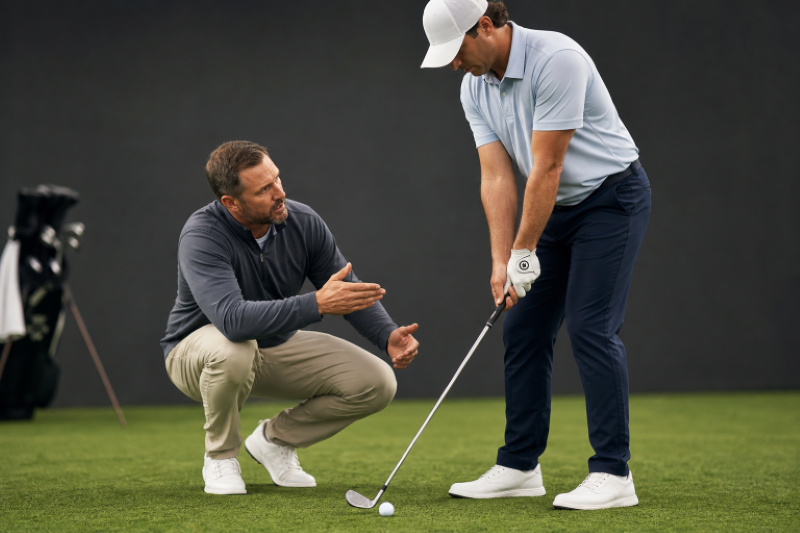
Bird Golf Academy centers its programs on private, individual instruction. The curriculum is shaped around the student’s current game, physical tendencies, goals, and playing habits instead of a preset lesson script. Instruction can include full-swing work, short-game practice, putting, mental-game coaching, and daily playing lessons.
Students work with PGA and LPGA professionals, including experienced teachers, award-winning professionals, and tour winners. This one-to-one format allows the instructor to see patterns that may be missed in a busy group setting, explain why a shot happens, and adjust the plan as progress develops.
How Does Bird Golf Academy Turn Practice Into On-Course Improvement?
1. Assessment: The instructor evaluates swing motion, ball flight, contact, putting, short game, and common on-course decisions.
2. Prioritization: Instead of changing everything at once, the golfer focuses on the few improvements most likely to affect scoring.
3. Skill development: Practice includes specific movements, drills, and shot patterns with immediate feedback.
4. Course transfer: During playing lessons, the golfer applies new skills to real lies, targets, recovery situations, and scoring decisions.
5. Review: The student leaves with an actionable practice plan and, where included with the selected program, the option for remote instructor follow-up.
Can Bird Golf Academy Help Golfers Lower Their Handicap?
It can help golfers develop the skills and decision-making that lead to lower scores, but a reputable golf school cannot promise a specific handicap reduction for every student. Improvement also depends on starting ability, physical capacity, practice consistency, play frequency, and course difficulty.
- Inconsistent contact: Personalized swing assessment and focused drills can improve strike quality and tighten shot dispersion.
- Weak short game: Chipping, pitching, bunker, and putting instruction can help create more up-and-down opportunities and reduce three-putts.
- Poor course management: On-course guidance can reduce unnecessary penalties, risky targets, and avoidable big numbers.
- Range-to-course disconnect: Daily playing lessons help golfers practice decisions under normal playing conditions.
Tracking results through a recognized handicap gives golfers a clearer measure of progress than relying on a few memorable rounds. The USGA’s overview of average golfer handicaps and scores also provides useful context for players setting practical improvement goals.
What Does Bird Golf Academy Teach Beyond the Golf Swing?
Scores are shaped by far more than a technically sound full swing. Bird Golf Academy instruction can address the details that influence every hole, including:
- Pre-shot routines and confidence under pressure.
- Club selection and target selection.
- Distance control with wedges and putts.
- Short-game shot choice around the green.
- Putting speed, green reading, and strategy.
- Recovery shots and how to limit damage after a mistake.
- Mental game habits that help golfers reset after a poor hole.
Where Can Golfers Attend a Bird Golf Academy Program?
Bird Golf Academy operates at more than 25 resort destinations in the United States and internationally. Options include Arizona locations such as Phoenix and Sedona; California programs in Solvang, Palm Desert, Napa Valley, and Borrego Springs; and Florida destinations including Boca Raton, Palm Coast, Bonita Springs, Punta Gorda, and Howey-in-the-Hills.
Additional choices include Texas, the Carolinas, Colorado, Minnesota, Nevada, New Jersey, New York, Oregon, Pennsylvania, Vermont, and Wisconsin. International programs are available in Ireland, Spain, the Dominican Republic, and the United Kingdom. A destination can be selected based on travel preferences, climate, resort amenities, or the type of course conditions a golfer wants to learn on.
How Should Golfers Choose the Right Program?
- Define the main goal, such as lowering a handicap, preparing for competition, or building a reliable foundation.
- Identify the largest scoring issue, whether it is driving, approach play, short game, putting, strategy, or confidence.
- Choose a destination that fits travel needs and preferred playing conditions.
- Compare program lengths to allow enough time for instruction, practice, and playing lessons.
- Ask about the instructor’s experience and teaching fit.
- Create a post-school practice plan before returning home.
Who Can Benefit From Bird Golf Academy?
Bird Golf Academy can suit beginners seeking structure, intermediate players stuck at the same handicap, experienced golfers pursuing more consistent scoring, tournament-minded players, couples, small groups, and travelers who want to combine a resort stay with meaningful instruction. Corporate groups may also benefit from a customized golf-focused experience.
Frequently Asked Questions
Does Bird Golf Academy offer private golf instruction?
Yes. Its programs emphasize private, individualized instruction tailored to the golfer’s goals and current game.
Does Bird Golf Academy include on-course lessons?
Yes. Playing lessons are central to the approach, helping students apply swing changes, course strategy, and mental-game skills during real rounds.
Can beginners attend?
Yes. Programs can be customized for beginners, returning golfers, experienced amateurs, and competitive players.
In Summary
Golfers who want lasting improvement need more than generic range drills. Bird Golf Academy combines private instruction, experienced professionals, resort destinations, and on-course coaching to help players connect technical changes with smarter scoring decisions. The best next step is to define the part of the game that costs the most shots, review current program details, and choose an experience that supports long-term improvement.
You may also like:
The Art of Doing Business on a Golf Course: How to Impress Your Clients and Seal the Deal