Click here to get this post in PDF
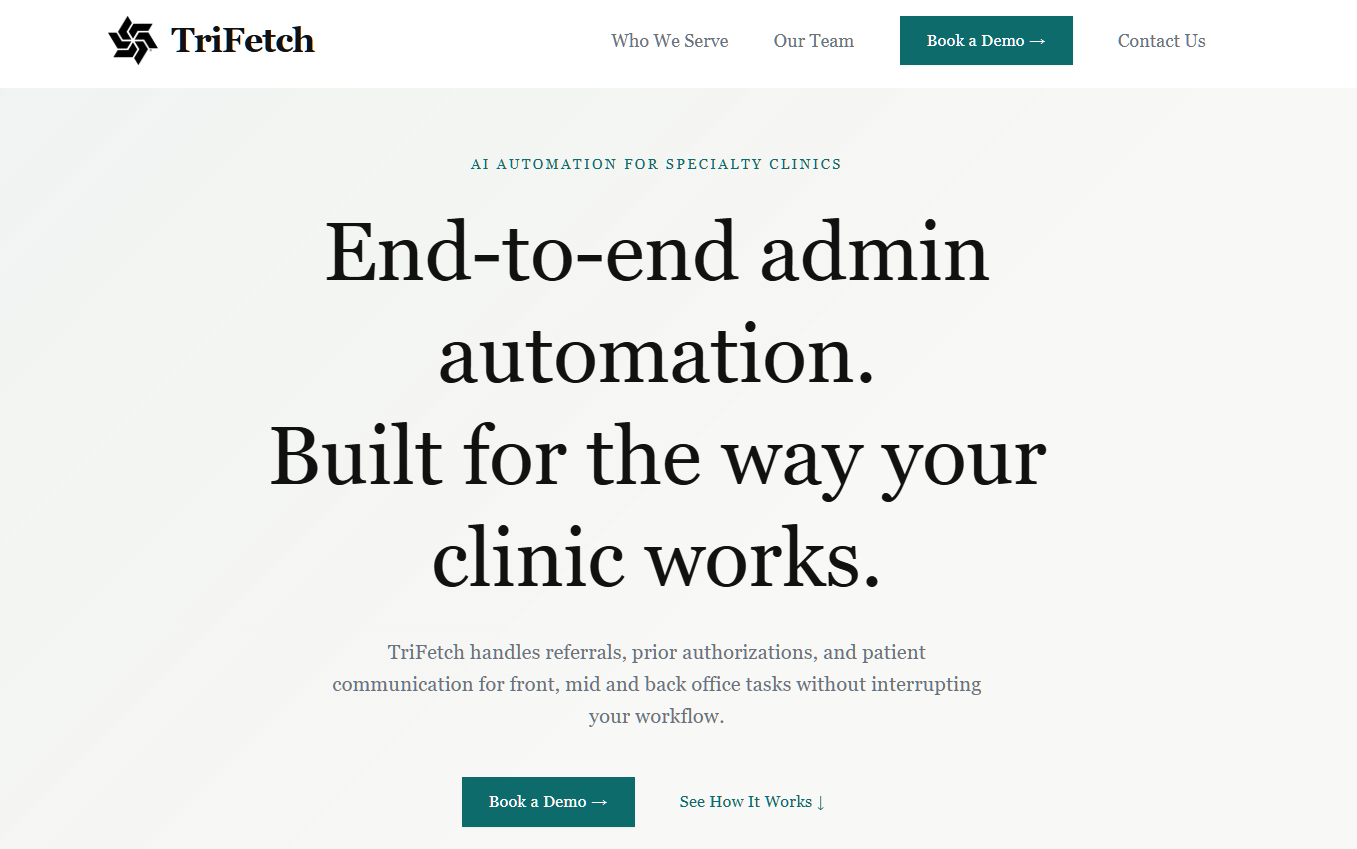
TriFetch is building an end-to-end automation layer for independent specialty clinics, covering patient calls and scheduling, referral processing, and prior authorizations. The company is running active pilots across California and aims to help clinics reduce administrative burden so staff can spend more time on care.
San Francisco, CA – April 27, 2026; In a specialty clinic, the phone rarely stops ringing. Referrals arrive in bursts, prior authorizations stall in payer portals and staff juggle paperwork while patients sit on hold. Independent clinics have been patching these problems with more headcount for decades, even as labor costs rise due to a shortage of highly specialised workers and burnout deepens. TriFetch was built to take that administrative weight off the clinic. By automating the three workflows that dominate clinic operating costs: patient calls, referral processing, and prior authorization, TriFetch helps clinics save on 50%+ of administrative costs while also increasing revenue. This can translate into 1m+ savings for a mid-size practice.
Today, TriFetch announced a $1.9 million pre-seed round led by Nexus Venture Partners with participation from angels from Google, Hipprocratic, Mercor, MIT to scale its automation platform for the front, mid, and back office of specialty care.
The pressure TriFetch is targeting is structural. Independent clinics face the same administrative load as large health systems with a fraction of the staff. A single prior authorization can take 45 minutes and referral coordination often means hours on hold. Patient calls pile up while the front desk triages between the waiting room and the phone line and those left unanswered go to an inbox with hundreds of unread messages.
“Clinics are doing everything they can to keep up, but the administrative workload keeps expanding,” said Varuni Sarwal, CEO and co-founder of TriFetch. “We built TriFetch to plug into how clinics already run and take the tasks staff dread the most off their plate, calls, referrals, and prior auth, so teams can focus on the parts of care that require the human touch.”

TriFetch automates the three workflows that eat the most staff time. Its multilingual voice agent handles patient calls end to end – inbound inquiries, outbound scheduling, and follow-ups. Its referral engine routes and processes referrals, verifies eligibility, and books patients with humans in the loop. And its prior auth automation submits and tracks requests so paperwork delays never push costs onto patients. The platform plugs directly into how a clinic already runs, with no EHR migration or retraining required. “Clinics don’t need more software where every new tool adds another tab, another login, another thing to learn; they need less friction. TriFetch integrates as the connective tissue of a clinic’s existing operations, adapting to the clinic’s ecosystem and not the other way around,” says co-founder and COO Rosemary He, who is leading the product team.
Cofounders Varuni Sarwal and Rosemary He met at UCLA while completing their PhDs in Computer Science, where they worked at the intersection of AI and healthcare. Varuni’s research applied machine learning to tabular EHR to predict depression and sepsis while Rosemary built computer vision models to predict Alzheimer’s progression in longitudinal 3D medical images. After publishing in top venues like Nature and ICML, the contrast they saw from the inside was hard to ignore: while AI was compounding at the frontier, most specialty clinics still ran on fax, phone trees, and manual paperwork. They built TriFetch to bring that capability into specialty care, and have taken a forward-deployed approach, embedding alongside clinic teams until the system runs end-to-end.
Dhruv Miyani, Founding Engineer at TriFetch, added: “The development of browser-use agents has changed what’s possible in healthcare automation. We can now build deeply customised workflows across many specialties that navigate EMR systems just like a human staff member.”
TriFetch is currently running multiple active pilots with specialty clinics across California. In an ophthalmology clinic, the doctor and his staff are being overtaken by phone calls and prior authorizations while trying to deliver the highest quality of care to his patients. In a cardiology clinic, staff have been overwhelmed by patient inquiries and internal routing needs.
In a GI practice, two staff members work full-time processing up to 100 referrals a day and calling patients to schedule them. TriFetch handles that workflow end-to-end, freeing roughly 16 hours of staff time a day and returning more than $200,000 a year to the clinic. For a mid-size specialty practice, that range of recovered costs and captured revenue can run anywhere from $500,000 to $1.4 million a year.
Dr. Shashi Ganti, Ophthalmologist, Cal Retina MD added: “Clinics up and down the US are facing the same administrative headache. Working with TriFetch, we’ve been able to relieve our staff from managing patient calls and scheduling: freeing them up from hundreds of voicemails and phone calls to focus on the patients in front of them. AI can be incredibly powerful when adopted safely, and I can’t think of a better team to trust with that in my clinic.”
As AI adoption accelerates in healthcare, most tools either target large health systems, solve a single narrow workflow, or are EMR-specific. TriFetch is the first unified, EMR-agnostic automation layer purpose-built for independent clinics that can be customized across specialties and locations, deploying alongside existing systems (NextGen, eCW, Athena, and others) in weeks, not quarters, reducing the need for clinics to stitch together multiple vendors to keep their operations running.
Jishnu Bhattacharjee, Partner at Nexus, commented: “Varuni and Rose are deep domain experts in healthcare AI. Healthcare administrative workflows represent one of the largest untapped opportunities for AI, and the Trifetch team is uniquely positioned to unlock it. They combine deep AI capabilities with real-world clinical understanding to build what we believe can become a category-defining company in healthcare AI. We are excited to partner with Trifetch and support them on this journey”, said calls, referrals, and prior authorization for specialty clinics are the starting point. Over time, TriFetch plans to build the first AI-native operating layer for healthcare systems, expanding nationwide from independent specialty clinics into multi-specialty groups, primary care, and hospital-owned networks, deepening EHR integrations, and connecting the tools clinics already use to the workflows that keep care moving. The goal: less time on paperwork, more time with patients.
TriFetch is guided by a founding cohort of 10+ strategic advisors drawn from operators inside the country’s leading health systems, including former NextGen co-founder Tim Eggena, senior leaders from Sutter Health, Johns Hopkins, Mayo, UW Health, Revere Health, Springfield Clinic, and UChicago Medicine. The cohort reflects TriFetch’s operator-first approach: the people who have run the workflows TriFetch automates are the same people helping shape the product.
About TriFetch

TriFetch is an AI automation platform built for independent clinics and multi-specialty groups, automating the workflows that consume the most staff time: patient calls and scheduling, referral processing, and prior authorizations. Through a unified system that integrates as the connective tissue across a clinic’s existing operations, TriFetch customizes the software to how the clinic already runs, with no EHR migration or staff retraining required.
Founded by Varuni Sarwal and Rosemary He, both PhDs from UCLA with backgrounds in machine learning and medical AI, TriFetch takes a forward-deployed, clinic-first approach to building technology that works across specialties, EMRs, and locations. For more information, visit https://trifetch.ai/ follow via Linkedin.
About Nexus Venture Partners
Nexus Venture Partners is a leading early-stage venture capital firm partnering with extraordinary entrepreneurs building product-first companies. With over $3.2 billion funds under management, Nexus operates as one team across the U.S. and India. Nexus companies include Postman, Apollo.io, Zepto, Giga, MinIO, Rapido, Fingerprint, Turtlemint, Tensorwave, Firecrawl, Neuron7.ai, Neysa, Observe.ai Daloopa, Hasura, Druva, Ultrahuman and Nx.For more information, visit www.nexusvp.com
Also read:
Mosaic SoC raises $3.8M to bring real-time spatial intelligence to every consumer device
Image source: trifetch.ai