Click here to get this post in PDF
The Role of Digital Marketing and Online Visibility in Modern Business

In July 2026, the digital world is more than just a marketplace; it’s the foundation of modern business. For any brand, being visible online is no longer an option, but a core requirement for survival and growth. We see around $8 out of every $10 spent on marketing today going toward digital efforts, clearly showing just how vital our online presence has become.
Web users heavily rely on search engines to find information, products, and services. With most internet use now happening on smartphones, being easily found on mobile devices is critical. However, the landscape continues to evolve rapidly. The emergence of generative AI search engines is changing how consumers discover brands.
No longer is it just about appearing in a list of search results. Now, brands must aim to be directly mentioned, cited, and even recommended within AI-generated answers. Successfully navigating this complex environment requires focused marketing systems that integrate various tactics to create a cohesive and powerful online presence.
This extensive guide will show you how to enhance your brand’s online visibility in this dynamic environment. We will cover the fundamentals of digital marketing, including SEO and PPC, and explain how these can be combined for maximum reach. Crucially, we will also explore the new challenges and opportunities presented by AI visibility, offering practical steps to ensure your brand stands out.
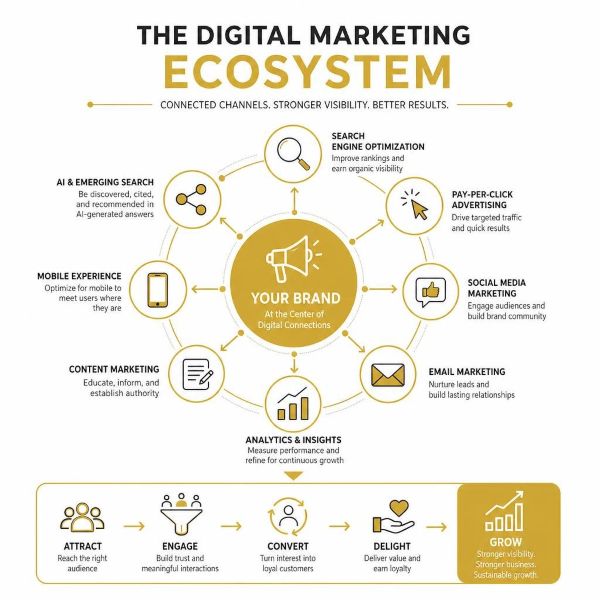
In today’s interconnected world, a brand’s digital footprint directly correlates with its potential for success. Digital marketing isn’t just a channel; it’s the ecosystem where brand awareness is forged, customer acquisition thrives, and business growth is accelerated. With a majority of web users relying on search engines for information retrieval, and most internet penetration now originating from smartphones, our online presence is paramount.
Consider the journey of a modern consumer: from the initial spark of a need to the final purchase decision, digital touchpoints are everywhere. They search for solutions, read reviews, compare products, and engage with brands online. If our brand isn’t visible during these critical moments, we risk losing potential customers to competitors who are. Online visibility ensures our brand is not just seen, but actively engaged with, fostering trust and driving tangible business outcomes.
Defining Online Visibility and Its Commercial Value
Online visibility, at its core, refers to how prominently and frequently our brand appears across various digital channels. It’s about capturing a significant “attention share” in the crowded online space. This goes beyond mere presence; it’s about being discoverable, authoritative, and trustworthy wherever our target audience looks.
The commercial value of strong online visibility is immense. It directly impacts brand equity by building recognition and credibility. It expands our market share by reaching new audiences and reinforces consumer trust, which is vital for long-term customer relationships. When our brand consistently surfaces in relevant searches, social feeds, and AI-generated answers, we establish ourselves as a reliable authority. This continuous exposure across multiple digital touchpoints translates into increased leads, higher conversion rates, and ultimately, sustainable business growth.
The Core Pillars of Search Engine Optimization
Search Engine Optimization (SEO) has been a cornerstone of digital marketing since its emergence around 1991. It’s the process of optimizing our online content to improve its ranking in search engine results pages (SERPs) for organic, unpaid traffic. Understanding how search engines work is fundamental to effective SEO. Google, for instance, operates on a three-stage process:
1. Crawling: Search engine bots (spiders) discover new and updated web pages by following links.
2. Indexing: The information gathered by crawlers is analyzed, understood, and stored in a massive database, creating an index of the internet.
3. Serving Results: When a user enters a query, the search engine retrieves the most relevant and authoritative pages from its index and ranks them.
To influence these stages, we focus on three main types of SEO:
- Technical SEO: This ensures search engines can efficiently crawl and index our website. It involves optimizing site speed, mobile-friendliness, site architecture, and using structured data (like Schema markup) to help search engines understand content better. Issues here can prevent our site from even being considered for ranking.
- On-Page Optimization: This involves optimizing the content and HTML source code of individual pages to rank higher and earn more relevant traffic. Key elements include keyword research, optimizing titles, meta descriptions, headings, image alt text, and ensuring high-quality, relevant content that satisfies user intent.
- Off-Page Authority: This refers to actions taken outside of our website to impact rankings. The most significant factor is building high-quality backlinks from authoritative sites, signaling to search engines that our content is trustworthy and valuable. Other aspects include brand mentions, social signals, and online reputation management. These three pillars work synergistically to improve our organic search rankings and overall online visibility.
Integrating Organic and Paid Search Strategies
While SEO focuses on earning organic visibility over time, Pay-Per-Click (PPC) advertising offers immediate, targeted exposure. Both are powerful tools, but their true potential is unlocked when integrated strategically.
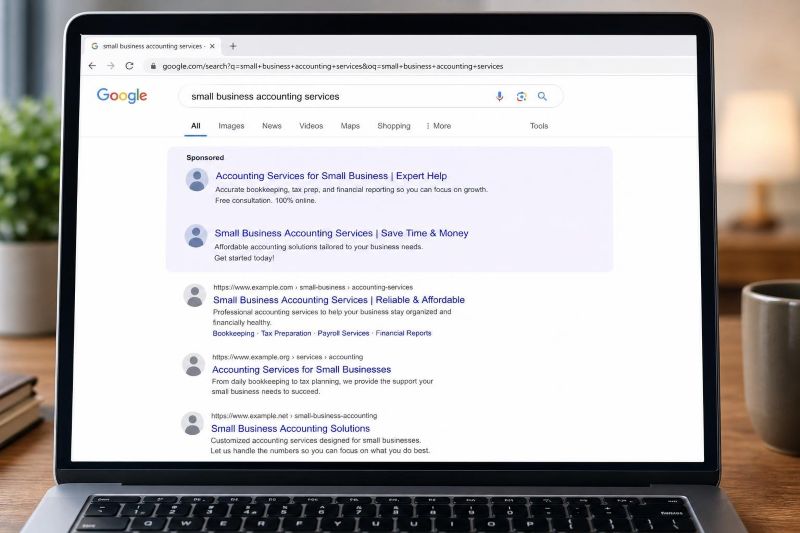
Search Engine Marketing (SEM) encompasses both SEO and PPC. Historically, these were often treated as separate silos, managed by different teams with distinct goals. However, in July 2026, we understand that a unified approach to SEM is crucial for maximizing brand dominance and optimizing budget allocation. By combining insights and efforts, we can achieve comprehensive search engine coverage, ensuring our brand is visible across all relevant search results.
SEO vs. PPC: Fundamental Differences and Mechanics
Understanding the core differences between SEO and PPC is vital for strategic integration:
Feature Search Engine Optimization (SEO) Pay-Per-Click (PPC) Cost Model “Free” (requires resource investment in time, content, technical) Paid (cost per click, impression, or conversion) Speed of Results Slower (weeks to months for significant impact) Immediate (ads appear as soon as campaigns launch) Traffic Type Organic, earned Paid, bought Sustainability Long-term asset, continues to drive traffic once ranked Stops when budget runs out or campaign is paused Control Indirect (influence algorithms, don’t control rankings directly) Direct (control ad copy, targeting, budget, bidding) Trust Factor Often perceived as more credible due to organic ranking Clearly identified as an advertisement, but highly targeted Conversion Rates Can be very high due to user intent and organic trust Can be high due to precise targeting and compelling ad copy SEO is a budget-friendly, organic strategy that builds long-term authority and sustainable traffic. It requires ongoing effort in content creation, technical optimization, and link building. PPC, on the other hand, provides instant visibility for specific keywords, allowing us to target audiences with precision and drive immediate traffic. While it incurs a cost per click, it offers unparalleled control over messaging and targeting, making it excellent for testing, seasonal campaigns, and rapid scaling.
Integrating SEO and PPC for Unified Digital Marketing and Online Visibility
The real power emerges when we integrate SEO and PPC, treating them as complementary forces rather than competing tactics. This synergy allows us to maximize our online visibility and significantly improve our return on investment (ROI).
One key integration point is keyword data sharing. Insights from PPC campaigns, such as which keywords drive the most conversions or have the highest click-through rates, can inform our SEO content strategy. Conversely, organic keyword rankings can highlight opportunities for PPC campaigns where we might not yet rank organically, or where we want to dominate the entire search results page.
This combined approach enables comprehensive search engine coverage. For highly competitive keywords, we can use PPC to secure top positions while our SEO efforts work to earn organic rankings. For long-tail keywords, where PPC might be too expensive, SEO can capture valuable niche traffic. By analyzing both organic and paid performance, we can identify gaps and opportunities, ensuring our brand is visible for every relevant search query.
Integrating these strategies is about creating truly focused marketing systems. These systems leverage data from both channels to refine audience targeting, optimize ad copy based on top-performing organic content, and even test new keyword ideas quickly with PPC before investing heavily in SEO content. This holistic view ensures that every marketing dollar contributes to a stronger, more visible online presence and a higher overall campaign ROI.
The Rise of AI Visibility and Generative Search
The digital landscape is undergoing another profound transformation with the advent of generative AI. In July 2026, AI-generated answers are increasingly replacing traditional search results pages, leading to a phenomenon we call “zero-click searches.” When users ask AI search engines like ChatGPT, Gemini, or Perplexity a question, they often receive a synthesized answer directly, rather than a list of links to click through.

This shift fundamentally alters how our brands are discovered. AI systems combine their vast training data with live web retrieval using Retrieval-Augmented Generation (RAG) to compose these answers. Our goal is no longer just to rank on a SERP, but to be explicitly mentioned, cited, and even recommended within these AI-generated responses. This new paradigm introduces the concept of AI visibility, driven by factors like entity recognition and the ability of AI to understand and trust our brand’s information.
Understanding AI Visibility and Generative Engine Optimization
AI visibility measures how often and how prominently our brand appears in AI-generated answers across modern AI search engines. It’s a critical new frontier that demands a specialized approach: Generative Engine Optimization (GEO). GEO is the practice of optimizing our brand and content to be recognized, cited, and recommended by generative AI systems.
This involves several key considerations:
- Conversational Queries: AI systems excel at understanding complex, conversational queries. Our content needs to be structured to directly answer these questions, often in a concise and clear manner, similar to how a human would explain it.
- Machine Readability: AI crawlers, like GPTBot and ClaudeBot, operate differently than traditional search engine crawlers. They may not execute JavaScript, meaning content rendered client-side can be invisible to them. Our content needs to be easily parsed from the raw HTML.
- Structured Data: Implementing Schema.org markup (e.g., Organization, Product, FAQPage) is more crucial than ever. This provides explicit signals to AI models about the entities, facts, and relationships on our pages, reducing ambiguity and improving understanding.
- Brand Recommendations: AI systems are increasingly making and influencing purchasing decisions autonomously. Being recommended by an AI carries immense persuasive weight, akin to a trusted referral. This makes online reputation management even more vital, as AI models will factor in overall sentiment and authority signals when making recommendations. Our brand’s online reputation, built through consistent positive mentions and credible information, directly influences its potential for AI recommendation.
Key Metrics for Measuring Brand Presence in AI Answers
Measuring AI visibility requires a different set of metrics than traditional SEO. Since the goal is to be mentioned, cited, or recommended within an AI-generated answer, we need to track these specific outcomes:
- Visibility Score: This is a composite index that combines how often our brand is mentioned, how prominently it’s positioned, and how consistently it appears across a defined set of prompts and AI engines. It provides a holistic view of our brand’s overall presence.
- Share of Voice: This metric indicates the percentage of AI-generated answers where our brand is mentioned compared to competitors for a specific set of queries. It helps us understand our competitive standing in the AI answer space.
- Citation Share: Citations are the sources an AI system links to or names when it composes an answer. This metric tracks how often our website or content is cited by AI models, signaling our authority on a topic and providing a direct path for users to our site.
- Brand Mentions: Beyond direct citations, we track how often our brand name, products, or services are mentioned within the synthesized text of AI answers, even without a direct link.
- Source Diversity: This metric assesses the variety and authority of the sources that AI engines use to generate answers about our brand or industry. A diverse and authoritative source profile signals greater trust to AI models.
Continuously monitoring these metrics helps us understand our brand’s performance in the generative AI landscape and informs our GEO strategies.
A 90-Day Playbook for Enhancing AI Search Presence
Adapting to the AI search revolution doesn’t require an overhaul of our entire marketing department or a massive budget. For lean teams and founders, a focused, agile 90-day roadmap can yield significant results. This playbook prioritizes actionable steps to build a machine-readable foundation, create extractable content, and amplify our brand’s authority in the eyes of AI systems.
This execution roadmap is designed to be efficient, allowing us to make tangible progress within a quarter, focusing resources where they will have the greatest impact on our AI visibility.
Phase 1: Building the Machine-Readable Foundation
(Days 1-30) The first month is dedicated to ensuring AI systems can effectively crawl, understand, and trust our website’s fundamental information.
1. Schema Markup Implementation: We must implement comprehensive Schema.org markup (e.g., Organization, Product, FAQPage, Article) on key pages. This structured data explicitly tells AI models about the entities on our site, their relationships, and key facts, reducing ambiguity.
2. Robots.txt Optimization: We need to audit our robots.txt file to ensure we are not accidentally blocking search-specific AI crawlers (like OAI-SearchBot) while trying to restrict training bots. Differentiating crawler policies can be crucial.
3. Raw HTML Verification: AI crawlers often don’t execute JavaScript. We must verify that all critical content, pricing, and calls to action are visible in the raw HTML source code (not just through browser developer tools). Server-side rendering (SSR) is essential for dynamic content.
4. Implementing llms.txt: The emerging llms.txt standard, proposed in late 2024, provides a token-efficient markdown map of our site’s most important content directly to Large Language Models (LLMs). Implementing this can bypass heavy HTML navigation and scripts, making our core content instantly accessible and understandable to AI. This is a key component of effective AI search optimization.
Phase 2: Creating Extractable and Conversational Content
(Days 30-60) Once the technical foundation is solid, the next phase focuses on optimizing our content for AI retrieval and recommendation.
1. Semantic Chunking & Direct Answers: We should structure our content using semantic chunking, ensuring each section or paragraph contains one core idea. Crucially, we must state direct answers to potential user questions early in the content, ideally in the first paragraph of a section.
2. Question-Led Headings: Our headings (H2s, H3s) should reflect actual questions our target audience might ask AI systems. This makes our content highly legible for AI models looking for specific answers.
3. Original Research: Publishing original research based on customer surveys, client work patterns, or public data benchmarks can establish our brand as a unique authority. AI systems value novel insights and will often cite sources that provide unique data.
4. Comparison and Decision-Stage Content: Create honest comparison content that pits our products/services against competitors. AI models are often asked to recommend “best” solutions or compare options. Providing this information directly helps us appear in these crucial decision-making prompts.
Phase 3: Amplifying Authority and Measuring Results
(Days 60-90) The final phase is about building external trust signals and continuously monitoring our performance.
1. Digital PR for Trusted Citations: Actively pursue digital PR opportunities to earn mentions and links from trusted, diverse third-party domains. AI systems heavily rely on the wider web’s consensus to determine authority. Securing placements on reputable sites increases our chances of being cited.
2. Internal Linking for Topical Authority: Build comprehensive topical clusters with strong internal linking. This signals to AI models our expertise and depth of coverage on specific subjects, reinforcing our topical authority.
3. Self-Reported Attribution: Add “AI search or chatbot” as an option to our “how did you hear about us” attribution fields. This helps us track the real-world impact of our AI visibility efforts on lead generation and customer acquisition.
4. Performance Tracking & Iteration: Continuously monitor our AI visibility metrics (Visibility Score, Share of Voice, Citation Share) using specialized tools. AI answers are non-deterministic and can change frequently, so ongoing tracking and agile iteration are essential to maintain and improve our presence.
Emerging Trends and Ethical Challenges in Modern Search
The digital marketing landscape is in constant flux, driven by technological advancements and evolving user behavior. Beyond AI visibility, several other trends continue to shape how we approach online visibility, alongside critical ethical considerations.
Future-Proofing Your Digital Marketing and Online Visibility Against AI Disruption
To future-proof our digital marketing, we must embrace adaptability and continuous learning. Key trends and strategies include:
- E-E-A-T Signals: Google’s emphasis on Experience, Expertise, Authoritativeness, and Trustworthiness (E-E-A-T) is more critical than ever. AI models also prioritize these signals, favoring content from credible sources. We must actively demonstrate our brand’s E-E-A-T through author bios, case studies, testimonials, and transparent information.
- Brand Consistency and Entity Clarity: Ensuring a consistent brand name, description, and core facts across all web platforms strengthens entity recognition. AI systems need to unambiguously identify who we are, what we do, and how our various digital assets relate. Semantic triples (subject-predicate-object statements) within our content can further aid this clarity.
- Voice Search Optimization: With the proliferation of smart speakers and voice assistants, optimizing for conversational, natural language queries is crucial. This involves understanding how users speak their queries and structuring content to provide direct, concise answers.
- Mobile-First Indexing and User Experience (UX): Most internet penetration is from smartphones, making mobile optimization non-negotiable. Google’s mobile-first indexing means the mobile version of our site is the primary one used for ranking. Fast page speeds, intuitive navigation, and responsive design are paramount for both users and search engines.
- Technological Adaptation: Staying abreast of algorithm updates and emerging technologies is vital. This includes understanding how AI models are trained, how they retrieve information, and anticipating future changes in search behavior.
Ethical Considerations and Common Pitfalls in Digital Strategy
As marketers, we hold a responsibility to uphold ethical standards while striving for online visibility. Ignoring these can lead to severe consequences, including search engine penalties and reputational damage.
- Search Engine Penalties: Engaging in “black hat” SEO tactics, such as keyword stuffing, cloaking, or buying low-quality links, can result in manual or algorithmic penalties, severely impacting our rankings and visibility. We must always adhere to “white hat” practices that prioritize user experience and genuine value.
- Artificial Content Inflation: While AI can assist in content creation, relying solely on AI-generated content without human oversight, fact-checking, and unique insights can lead to bland, unoriginal content that fails to resonate with users or establish authority with AI models. We should focus on quality over quantity.
- User Privacy and Data Transparency: With increasing concerns around data privacy, marketers must be transparent about data collection and usage. Adhering to regulations like GDPR and CCPA is not just a legal requirement but a fundamental aspect of building trust with our audience.
- Bias in AI Systems: AI models can inherit biases from their training data, potentially leading to unfair or inaccurate representations of brands. While not directly controllable, understanding this risk encourages us to contribute diverse, high-quality information to the web.
Navigating these challenges requires a commitment to integrity, focusing on creating genuine value for users, and building a sustainable, trustworthy online presence.
Frequently Asked Questions
What is the difference between retrieval and recommendation in AI search?
In AI search, retrieval refers to the AI system’s ability to find and extract relevant information from our content. It means our brand’s information is accessible and understandable to the AI model. Recommendation, however, goes a step further. It means the AI trusts our brand enough to actively suggest it as a solution or an authoritative source, often without prompting. This implies a higher level of trust signals and model training that positions our brand as a preferred option. While retrieval ensures visibility, recommendation drives direct influence and purchasing decisions.
How do technical SEO issues affect AI crawlers?
Technical SEO issues can severely impact AI crawlers’ ability to access and understand our content. For instance, if our website relies heavily on JavaScript for rendering critical content, and that JavaScript isn’t server-side rendered, AI crawlers that don’t execute JavaScript (like GPTBot or ClaudeBot) will see a blank or incomplete page. This makes our brand effectively invisible to them. Poor site architecture, slow page speed, or incorrect robots.txt configurations can also hinder AI crawlers, preventing them from indexing our content and reducing our chances of appearing in AI-generated answers.
Why is mobile optimization critical for modern search rankings?
Mobile optimization is critical because most internet users access the web via smartphones, and search engines like Google employ mobile-first indexing. This means search engines primarily use the mobile version of our website for indexing and ranking. If our site isn’t mobile-friendly – if it’s slow to load, difficult to navigate on a small screen, or has broken elements – it will negatively impact user experience. This poor user experience translates into lower search rankings, reduced organic traffic, and ultimately, diminished online visibility, regardless of how good our desktop site might be.
Conclusion
In July 2026, the journey to enhancing online visibility is more dynamic and complex than ever before. We’ve explored the fundamental importance of digital marketing, the synergistic power of integrating SEO and PPC, and the transformative impact of AI visibility. From understanding the core pillars of organic search to navigating the nuances of generative AI, a strategic approach is paramount.
Our ability to thrive in this evolving landscape hinges on continuous optimization, a commitment to ethical practices, and a readiness to adapt to new technologies. By building a machine-readable foundation, crafting extractable and conversational content, and actively amplifying our brand’s authority, we can ensure our brand is not just seen, but heard, cited, and recommended across all digital touchpoints. The goal is to establish a future-ready marketing strategy that secures lasting brand authority and ensures our online presence remains robust and influential.
You may also like:
Improve Your Brand Visibility and Reach Online with Digital Marketing
Strategic Guest Posting Solutions: Transforming Your Online Visibility