Click here to get this post in PDF
The Evolution of Digital Creativity and Marketing

In the dynamic digital landscape of April 2026, capturing audience attention is more challenging than ever. With Canadian consumers spending an average of 5.4 hours daily on digital media, simply existing online isn’t enough to cut through the noise. Traditional marketing alone struggles to leave a lasting impression.
This is where the powerful combination of Digital Creativity and Marketing becomes our essential edge. It’s the art of standing out, engaging deeply, and inspiring action in a crowded digital world.
This extensive guide will explore how we can fuse artistic innovation with strategic marketing principles and advanced AI tools to build truly impactful digital presences. We will delve into balancing data insights with creative flair, understanding the vital role of independent creators, and leveraging technology to make our brands unforgettable. For businesses seeking tailored strategies to empower their online visibility, such as comprehensive Real estate marketing solutions, understanding this synergy is key.
The journey of digital creativity in marketing is a fascinating chronicle of adaptation and innovation, stretching from the rudimentary banner ads of 1994 to the immersive, AI-driven experiences we see in April 2026. Initially, the digital realm was a wild west, with the first banner ad appearing in October 1994, marking the dawn of online advertising. These early efforts were often static and simple, limited by nascent internet infrastructure and bandwidth. However, the landscape began to shift dramatically with the UK broadband launch in 2000, bringing faster internet speeds that paved the way for richer, more interactive content.
The Flash era that followed was a golden age for digital creativity, allowing for animated, engaging, and often groundbreaking advertisements. Flash enabled marketers to move beyond static images, incorporating video, sound, and interactive elements that captivated audiences. This period demonstrated the power of creative digital advertising to build brand engagement, recalling iconic campaigns like the Guinness surfer ad or the memorable Levi’s commercials. However, this era also saw its challenges, with the eventual 2011 HTML5 transition, largely driven by Apple’s decision to drop Flash support on its mobile devices, forcing a new wave of creative adaptation.
Today, we navigate a complex ecosystem where programmatic advertising, while efficient for targeting, has often been criticized for reducing creativity to persistent retargeting, sometimes likened to a dog obsessively chasing a ball. The challenge now is to reintroduce genuine creativity into these automated systems. By embracing contextual targeting and understanding the nuances of Digital language creativity, we can ensure our messages resonate deeply with audiences. This involves a deliberate pattern disruption strategy to break through the pervasive digital noise in increasingly saturated landscapes. With consumers often giving digital ads only a 3-second attention hook, the imperative for originality and impactful creative is higher than ever. Agencies like Virality Creative: Southern California Digital Marketing Agency understand this need, focusing on campaigns that inherently spread due to their compelling nature.
Historical Tech Shifts and Ad Performance
The evolution of digital advertising is intrinsically linked to technological advancements. Early attempts at interactivity saw the use of Java applets, which allowed for rudimentary animations and user engagement within web pages. As bandwidth improved, specialized platforms like Eyeblaster and Tangozebra emerged, enabling the delivery of rich media formats that were previously unimaginable. These tools allowed for complex Flash-based advertisements, expanding creative possibilities beyond simple banners and pop-ups.
The shift to HTML5 was a pivotal moment, ushering in an era of mobile-first creative. Marketers had to rethink design and user experience for smaller screens and touch interfaces, prioritizing responsiveness and seamless integration across devices. This transition wasn’t just about technology; it was about adapting creative strategies to new consumption patterns. While some argue that programmatic advertising, with its focus on data and real-time bidding, has inadvertently stifled creativity by prioritizing efficiency over originality, the underlying technologies continue to offer immense potential. The key lies in leveraging these tools to deliver rich, interactive creatives that are contextually relevant and engaging, rather than merely repetitive. For instance, creative agencies like Kreativ Marketing – Digital Marketing Grand Rapids, Michigan focus on crafting compelling digital experiences that leverage modern tech.
Why Originality Surpasses Standard Content in 2026
In April 2026, the digital landscape is a vast ocean of content, making originality not just a desirable trait but a commercial imperative. Standard, uninspired content quickly drowns in this sea of information, failing to capture the fleeting attention of consumers. The human brain is hardwired for novelty bias, meaning we are naturally drawn to what is new, surprising, and different. This psychological principle underscores why creative, original content has a disproportionate impact.
True originality fosters emotional resonance, which is the bedrock of strong brand equity. When content evokes genuine emotion – whether it’s humor, inspiration, empathy, or awe – it creates a deeper connection with the audience, moving them beyond passive consumption to active engagement and loyalty. This is how brands truly stand out.
Furthermore, user-centric SEO in 2026 increasingly rewards high-quality, original content that provides genuine value and engagement. Google’s algorithms are sophisticated enough to recognize and prioritize content that resonates with users, leading to better rankings and organic visibility. This means that creative storytelling, visually appealing formats, and unique problem-solving approaches are no longer just “nice-to-haves” but essential components of an effective SEO strategy. Companies like Creativity Springs: Digital Marketing Agency and Consulting understand that creativity is the engine for distinctive brand narratives. Our approach to Expert Content Marketing For Local Business also emphasizes that compelling, original content is vital for local businesses to build authority and connect with their community.
Balancing Data Insights with Creative Innovation
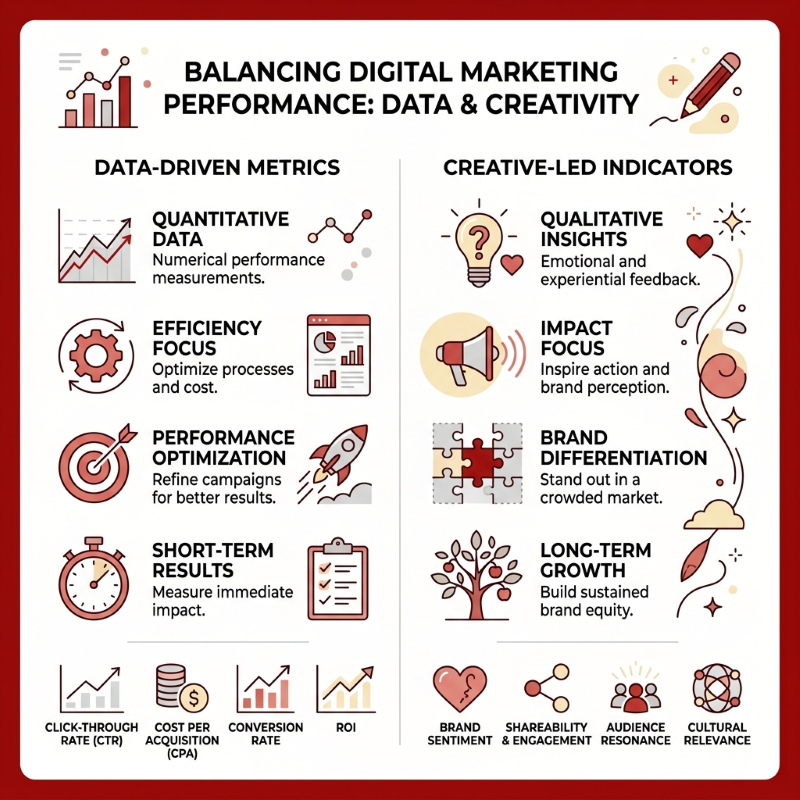
The modern digital marketer operates at the intersection of art and science, constantly balancing the analytical rigor of data insights with the imaginative spark of creative innovation. It’s a symbiotic relationship where data provides direction, and creativity brings that direction to life. While data-driven metrics like Click-Through Rates (CTR) and Cost Per Acquisition (CPA) offer invaluable insights into campaign performance, they don’t tell the whole story. Creative-led indicators such as Brand Sentiment, Shareability, and emotional engagement are equally crucial for long-term success.
The best digital marketers are not just data-savvy; they are also deeply intuitive. Human intuition, often informed by years of experience and cultural understanding, allows us to interpret the “why” behind the data. Algorithms can show us what is working, but creativity helps us understand why it matters to people. This blend of analytical and imaginative thinking transforms marketing from a series of tactical executions into a strategic input that drives genuine growth. As a leading Digital Marketing Consulting Provides Actionable Intelligence, we emphasize that data should inspire creativity, not stifle it.
Creativity, when informed by data, becomes one of the most efficient growth levers available to a marketing team. It allows us to expand demand for products and services, rather than merely capturing existing intent. This requires marketers to move beyond purely performance-based metrics and embrace a more holistic view of campaign effectiveness. By understanding audience behavior through data and then crafting compelling narratives and experiences, we can build campaigns that resonate deeply. Expert Affordable Marketing Analytics ensures that while we scrutinize the numbers, we never lose sight of the human element. Agencies like Coast Creative – San Diego Social Media & Marketing and Joyco Digital | Best Bellingham Digital Marketing Agency exemplify this balance, integrating data-driven strategies with innovative creative approaches to achieve outstanding results for their clients.
Enhancing Digital Creativity and Marketing in B2B Sectors
B2B marketing has often been perceived as a dry, feature-focused domain, but this notion is rapidly changing in April 2026. The principles of digital creativity are just as vital, if not more so, in the B2B landscape. Traditional B2B approaches often fall into the “feature dumping” pitfall, overwhelming potential clients with technical specifications without connecting to their emotional needs or business challenges. This leads to a lack of engagement and missed opportunities.
Instead, B2B marketers are increasingly adopting storytelling to build emotional connection and foster genuine relationship building. Even in a professional context, people respond to narratives that highlight problems, offer solutions, and demonstrate real-world impact. Visual infographics can distill complex data into easily digestible and shareable content, while interactive quizzes or surveys can engage prospects in a personalized way, gathering valuable insights while providing value. For example, a university’s Communications & Public Information Office | South Seattle College might use creative digital campaigns to highlight student success stories or innovative research, appealing to prospective students and partners on an emotional level. By focusing on the human element and demonstrating how solutions address real pain points, B2B brands can create memorable and impactful campaigns that drive conversions and build lasting partnerships.
The Power of Constraints in Creative Briefing
It might seem counterintuitive, but often, constraints can be the most potent catalyst for creative brilliance. In digital marketing, this principle is particularly evident in the art of creative briefing. An “open brief” that offers unlimited freedom can sometimes lead to diluted, unfocused work. Conversely, a tight brief, precisely defining the problem, target audience, and desired outcome, forces strategic clarity and innovative problem-solving.
When marketers face limited budgets or specific channel requirements, they are compelled to think more deeply, finding ingenious ways to achieve maximum impact with minimal resources. This often results in a single clear message that cuts through the noise, rather than a “spray and pray” approach that tries to be everything to everyone. The discipline of crafting a concise brief is, arguably, one of the most undervalued skills in marketing today. It compels teams to identify the single most important thing a campaign needs to achieve, leading to more focused, effective, and ultimately, more creative solutions. By embracing these limitations, we can avoid the common pitfalls outlined in our guide on Local Business Internet Marketing 7 Mistakes Youre Making And How To Fix Them, ensuring every creative effort is purposeful and impactful.
The Role of AI and Independent Creators in 2026

The year 2026 marks a pivotal moment where Artificial Intelligence and independent creators are not just influencing but actively shaping the landscape of digital creativity and marketing. AI, particularly generative AI tools like DALL-E for image generation and ChatGPT for text, has moved beyond novelty to become an indispensable collaborator in the creative process. These tools empower marketers to rapidly ideate, prototype, and refine content at an unprecedented scale. For any organization looking to accelerate their creative output and explore new frontiers, truly Unleashing digital creativity with AI is becoming a strategic imperative.
This isn’t about AI replacing human creativity, but rather fostering a new era of collaborative intelligence. AI can analyze vast datasets to identify trends, predict consumer preferences, and even generate hyper-personalized content variations, allowing human marketers to focus on strategy, emotional storytelling, and cultural nuance. The result is campaigns that are both data-informed and deeply human. Educational programs, such as the Graduate Certificate in Digital & Social Media Marketing – UA Online, are increasingly integrating AI tools into their curriculum to prepare the next generation of hybrid marketers.
Simultaneously, the creator economy continues its explosive growth, with independent creators and influencers playing an increasingly central role in digital campaigns. Brands are partnering with these individuals not just for their reach, but for their authentic brand voice, unique perspectives, and ability to connect with niche audiences in a way that traditional advertising often cannot. These collaborations bring a fresh, genuine, and often viral element to marketing efforts. Our strategies for Affordable Social Media Management For Business frequently involve leveraging these independent voices to build community and trust. By combining the efficiency and analytical power of AI with the authentic connection of independent creators, marketers in 2026 can craft campaigns that are both scalable and deeply resonant.
The Future of Digital Creativity and Marketing with AI
The conversation around AI in digital marketing often revolves around “augmentation vs. replacement.” In April 2026, it’s clear that AI serves primarily as an augmentation tool, enhancing human capabilities rather than rendering them obsolete. AI functions as an instrumental resource, providing marketers with unparalleled power for idea exploration. It can quickly generate countless variations of ad copy, visual concepts, or campaign themes, allowing human teams to select, refine, and imbue them with the emotional depth and strategic intent that only humans possess.
AI also aids in deconstructing creative processes. By analyzing successful past campaigns, AI can identify patterns and elements that contributed to their effectiveness, offering insights that can inform future creative endeavors. However, this powerful alliance comes with responsibilities. Ethical AI implementation is paramount, addressing concerns around data privacy, potential algorithmic bias, and the challenge of maintaining human authenticity. Rigorous human oversight is essential to ensure that AI-generated content aligns with brand values, resonates culturally, and avoids unintended consequences. For instance, while AI can assist in generating website layouts, the ultimate aesthetic and user experience design of an Effective Affordable Web Design Services still requires human creativity and understanding of brand identity.
Emerging Tools Elevating the 2026 Creative Landscape
The rapid pace of technological innovation continues to elevate the possibilities for digital creativity in 2026. Platforms like Pinterest, for example, have seen their ad reach expand by an impressive 775,000 users in early 2025, indicating a growing appetite for visually rich and inspiring content. This expansion highlights the importance of platforms that blend commerce with creative discovery, offering unique opportunities for advertisers.
Beyond social platforms, emerging technologies are transforming how we create and experience digital content. Augmented Reality (AR) integration is moving beyond novelty, allowing brands to create immersive experiences that bridge the digital and physical worlds. Imagine trying on clothes virtually, visualizing furniture in your home, or interacting with product features in 3D – all powered by AR. Real-time optimization tools, fueled by AI and machine learning, enable dynamic content adjustments based on user behavior, ensuring that the most effective creative is always being served.
Furthermore, advancements in areas like motion capture and data sonification are opening new avenues for sensory-rich creative. Motion capture allows for highly realistic animations and virtual experiences, while data sonification translates complex datasets into auditory experiences, offering novel ways to engage audiences. These tools, often leveraged by a Paid Digital Advertising Agency, are not just about flashy effects; they are about creating deeper, more memorable connections with consumers in an increasingly competitive digital space.
Measuring Success and Avoiding Performance Pitfalls
Measuring the effectiveness of digital marketing campaigns in April 2026 requires a nuanced approach that transcends simple performance metrics. While Return on Investment (ROI) remains a cornerstone, true success encompasses both immediate conversions and long-term brand building. The Canadian digital marketing market, valued at USD 14.01 billion in 2024 with a projected 13.45% compound annual growth rate, underscores the immense financial stakes involved. This growth also fuels demand, with 860,000 open opportunities in digital marketing, ranking it as LinkedIn’s sixth most in-demand job. This booming industry demands a sophisticated understanding of how creative efforts contribute to overall business objectives.
To avoid stifling risk-taking, we must adopt a holistic measurement framework that combines traditional performance data with brand health indicators. Metrics such as brand awareness, consideration, and preference are crucial for understanding the long-term impact of creative campaigns. An over-reliance on immediate attribution models can lead to short-sighted decisions, as creative work often builds demand over time rather than just capturing existing intent. A truly What Is Holistic Digital Marketing approach recognizes that a campaign’s success isn’t solely defined by clicks or conversions, but also by its ability to shape perception and foster loyalty, which is also a key component of Professional Affordable Reputation Management. By setting clear objectives for both short-term performance and long-term brand impact, and by giving creative ideas sufficient time to resonate, we can foster an environment where innovation thrives without sacrificing accountability.
Leadership and Organizational Culture
Fostering creativity within marketing teams is not solely the responsibility of creative directors; it requires strong leadership buy-in and a supportive organizational culture. Leaders must champion the value of creativity as a strategic imperative, not just a “nice-to-have.” This involves allocating resources, providing psychological safety for experimentation, and encouraging risk-taking without fear of immediate failure.
Cross-collaboration is another critical element. By bringing together individuals from diverse disciplines – data analysts, content strategists, designers, and sales teams – organizations can spark new ideas and perspectives that lead to truly innovative campaigns. A culture that embraces diversity of ideas and encourages open dialogue will naturally generate more creative solutions. Furthermore, establishing a testing culture where ideas are prototyped, measured, and refined, rather than simply launched and forgotten, is vital. This iterative process allows teams to learn from both successes and failures, continuously improving their creative output. For Digital Marketing Services For Small Business, building this kind of internal culture can be a significant competitive advantage.
Common Pitfalls in Creative Integration
While the integration of creativity and performance metrics is essential, marketers must be wary of common pitfalls that can undermine their efforts. One significant trap is an over-reliance on attribution models that favor the bottom-of-the-funnel activities. These models often fail to credit the creative work that built initial awareness and consideration, leading to a short-termism bias where only immediately measurable results are valued.
Another pitfall is “optimizing to death.” In an attempt to maximize performance, creative assets can be endlessly tweaked and A/B tested until they lose their original spark and emotional impact. This often results in safe decisions that are statistically sound but creatively bland, failing to cut through the noise. Ignoring cultural nuance, especially when scaling campaigns globally, is another critical error. What resonates in one market might fall flat or even offend in another. Effective Effective Google Ads Management and Expert Affordable Local Seo Service require an understanding that creative elements must be culturally sensitive and locally relevant to truly connect with audiences. Balancing data-driven optimization with creative integrity requires a delicate touch and a commitment to protecting the core idea.
Frequently Asked Questions about Digital Creativity and Marketing
Why does creativity remain essential in data-driven digital marketing?
In a world increasingly dominated by algorithms and data, creativity provides the indispensable “why” behind human action. While algorithms excel at identifying patterns and optimizing for existing demand, creativity is what generates new demand, sparks emotional connections, and differentiates a brand in a crowded marketplace. It’s the unique voice, the compelling story, and the unexpected idea that captures attention and fosters loyalty. In a global digital market projected to swell to three-quarters of a trillion dollars by 2026, creativity is the ultimate competitive advantage, allowing brands to stand out and resonate on a deeper, more human level.
How does AI augment rather than replace human creativity?
AI acts as a powerful collaborator and enabler, not a replacement, for human creativity. It serves as a catalyst for idea exploration, rapidly generating concepts, visuals, and copy variations that humans can then refine and infuse with emotional intelligence and strategic intent. AI also acts as an instrumental resource for efficiency, automating repetitive tasks and analyzing vast datasets to inform creative direction. However, AI lacks the emotional depth, cultural nuance, lived experiences, and intuitive leaps that are fundamental to truly original storytelling and authentic brand identity. Human oversight remains critical to ensure ethical considerations, prevent algorithmic bias, and maintain the unique, irreplaceable human touch in marketing.
How should creative effectiveness be measured without stifling risk?
Measuring creative effectiveness requires a balanced approach that acknowledges both immediate performance and long-term brand impact. Instead of solely focusing on short-term attribution models, marketers should combine performance data (e.g., CTR, conversions) with brand health indicators (e.g., awareness, consideration, preference, sentiment). Crucially, establish a “minimum exposure threshold” before making optimization decisions. This allows creative ideas sufficient time to resonate with audiences and build momentum, preventing premature conclusions based on early, potentially misleading data. By agreeing on success metrics upfront and fostering a culture that encourages calculated risk-taking and learning from experiments, we can measure effectiveness without stifling the creative spirit.
Conclusion
As we navigate the complexities of April 2026, it’s clear that the future of digital marketing belongs to those who master the delicate yet powerful integration of technology and imagination. The days of siloed data analysis and purely artistic endeavors are behind us. Instead, we embrace a holistic approach where AI serves as a creative partner, independent creators amplify authentic messages, and data insights fuel innovative storytelling.
This synergy is not merely about staying relevant; it’s about building a strategic advantage that allows brands to cut through the noise, connect deeply with audiences, and drive measurable growth. By fostering a culture that values both analytical rigor and creative daring, we can future-proof our digital presence and ensure our messages resonate in an ever-evolving landscape.
To further empower your digital strategy and unlock your brand’s full potential, explore our comprehensive services at https://ignitelocal.com/what-we-do/. Discover where your online presence stands with a free web presence analysis, or visit our main site for more insights: https://ignitelocal.com/.
You may also like:
CapCut Shares Updates on Dreamina Seedance 2.0 Mini and the Future of AI Video Creation