Click here to get this post in PDF
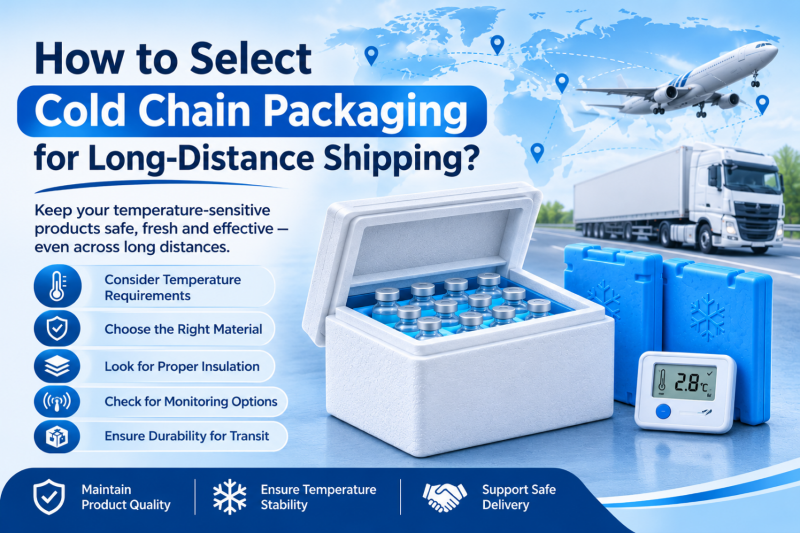
Shipping temperature-sensitive products over long distances requires the right mix of insulation, cooling materials, and temperature monitoring. Medicines, vaccines, medical supplies, dairy products, and perishable foods can be harmed by temperature changes while being transported. Delays in moving items between warehouses and changes in weather can make these dangers worse.
Cold chain packaging for long-distance shipping must be chosen based on the product’s temperature, the length of the trip, how well the packaging maintains temperature, and how the package is handled. Choosing a solution that uses cooling materials and a temperature monitoring data logger can help a company maintain product quality, reduce spoilage, and make shipments more reliable.
Why is Choosing the Right Cold Chain Packaging Important for Long-Distance Shipping?
Cold chain packaging that fits the job protects products while they travel. Cold chain packaging shields products from temperature changes and helps deliver them reliably to many places.
- Maintaining product quality and safety: Keeping product quality and safety is a job of chain packaging. Cold chain packaging keeps products inside the required temperature range. For example, vaccines and medicines must stay in controlled conditions, and dairy products need the right temperatures to stay fresh and safe.
- Reducing spoilage and product loss: Reducing spoilage and product loss is another benefit of cold chain packaging. Cold chain packaging uses insulation and cooling materials to lower temperature‑related damage to food, pharmaceuticals, and other sensitive goods.
- Supporting pharmaceutical and food supply chains: Cold chain packaging supports pharmaceutical and food supply chains. Healthcare providers depend on chain packaging for medicines, vaccines and diagnostic samples while food distributors rely on it for dairy, meat, seafood and other perishables.
- Improving shipment reliability: Improving shipment reliability is another advantage of chain packaging. Long‑distance deliveries may have delays and many handoffs. Cold chain packaging offers protection along the route when used with proper handling procedures.
For example, vaccine shipments often need containers and phase‑change materials. Dairy deliveries need chain packaging that keeps the correct chilled conditions. The best cold chain packaging for shipping depends on the product’s temperature requirements, expected transit duration, and transportation route. Cold chain packaging for long distance shipping may include single-use insulated shippers, reusable cold chain boxes, and PCM-based packaging designed to support different shipping needs and maintain the required temperature throughout transit.
7 Factors to Consider When Selecting Cold Chain Packaging
1. Understand the Required Temperature Range
Start by checking what temperature range your product needs. Every product is different. If the temperature is too high or too low it can ruin the product.
Think about things like medicines, vaccines, lab samples, frozen food, or dairy. Each one might need a kind of cold packaging. Look at the product’s storage instructions and any rules for shipping. Then choose a cold packaging system that keeps the product at the temperature. Make sure it doesn’t get too hot or too cold during shipping.
2. Calculate the Total Transit Time
How long the package will be in transit matters. You need to think about the trip. From when it leaves the warehouse to transportation, any stops in warehouses, customs, and finally delivery.
For trips, don’t just go by the estimated delivery time. Plan for delays. A medicine shipment that takes days may need more cooling power or better insulation than one that goes just a few hours. Pick packaging that can hold the temperature for the whole trip plus a little extra time as a safety buffer.
3. Evaluate Insulation Performance
Good insulation slows down heat from getting into the package. Common materials used are expanded polystyrene (EPS), polyurethane (PU), and vacuum-insulated panels (VIPs).
When you’re comparing options, check how well each one blocks heat, how thick the insulation is, how strong the container is, how much space is inside for your product, and how well it holds up during handling.
For example, if you’re shipping through areas, you’ll probably need better insulation than if you’re shipping through cooler places. Remember insulation alone isn’t enough. You also need to think about the coolant you’re using and the product itself. The whole system must work together to keep the temperature stable.
4. Choose the Right Coolant or Phase Change Material (PCM)
Coolants keep the inside of the packaging at the desired temperature. Common coolants are gel packs and phase change materials chosen for the temperature needed. PCMs. Release heat when they change phase, and they keep the conditions when you pick the right one and prepare it correctly.
Think about the coolant’s operating temperature, how much you use, where you put it, and how you prepare it. For instance refrigerated pharmaceutical shipments may need a coolant setup than food deliveries. Using the coolant can cause the temperature to swing too much or cause unwanted freezing. When selecting cold packaging for shipping, follow the supplier’s instructions and test the complete packaging system before regular shipments to help maintain the required temperature throughout transit.
5. Select Single-Use or Reusable Packaging
Single-use cold chain packaging works well for one-way deliveries when it is hard to collect and return containers. It can help you ship to places or places that do not have a return system. Reusable cold chain shippers are built for pharmaceutical and healthcare deliveries. They can save money if a business sends shipments and has a return system.
Reusable cold chain boxes are good for delivery between warehouses, labs, and health facilities. Look at the cost to buy, clean, maintain, replace, and return before you choose the option that fits your supply chain best.
6. Consider Product Size, Weight and Protection
Packaging must hold the payload safely. Still leave room for insulation and cooling materials. If the container is too big, shipping costs go up. If it is too small, the product may not be protected well. There might not be enough space for coolants.
Look at the size of the payload, the weight, how fragile it is, whether it needs to be stacked, and how it will be handled during transport. Small diagnostic shipments often need insulated containers. For food or medicines, insulated pallet shipping may be better.
Choosing the setup means balancing thermal performance, physical protection, and how efficiently the shipment moves.
7. Check Temperature Monitoring and Tracking Requirements
Temperature monitoring lets companies check if products stayed within the needed temperature range during delivery. Data loggers record temperature readings. These records can be reviewed after delivery. Used to look into any temperature problems.
Depending on the shipment, companies might need to use reusable or wireless monitoring devices.
Think about how readings are taken, the temperature range needed, how long the monitoring lasts, alarm features, and reporting needs. Monitoring supports chain packaging but does not take the place of good insulation, properly conditioned coolants or correct handling.
Which Type of Cold Chain Packaging is Best for Long-Distance Shipping?
The best option depends on the product, required temperature range, transit duration, and transportation conditions.
| Packaging type | Typical application |
| Single-use insulated shippers | One-way pharmaceutical and healthcare deliveries |
| Reusable cold chain shippers | Repeated temperature-sensitive shipments |
| Reusable cold chain boxes | Recurring distribution with return logistics |
| PCM-based packaging | Shipments requiring a defined temperature range |
| Insulated pallet shippers | Bulk shipments and large-scale distribution |
Single-use insulated shippers are useful when packaging cannot be returned economically. Reusable shippers and boxes suit regular distribution networks with established collection and maintenance procedures. PCM-based systems are suitable when the coolant can be matched to the required temperature range, while insulated pallet shippers support larger payloads.
Ultimately, select a system based on validated hold time, payload size, route conditions, and handling requirements rather than packaging type alone.
How to Validate Cold Chain Packaging Before Shipping?
Packaging validation helps confirm that the complete system can keep the temperature under realistic shipping conditions. For cold chain packaging for long distance shipping, testing should evaluate the container, insulation, coolant, payload, assembly procedures, and expected transit duration to ensure reliable temperature control throughout the journey.
Key Validation Checks
- Confirm temperature performance: Verify that packaging keeps the required temperature during the journey even if there are delays.
- Check conditions: Look at how packaging works in cold environments that reflect real shipping.
- Check coolant conditioning: Follow the set steps for preparing, placing, and assembling gel packs or phase change materials.
- Check temperature logger data: Set acceptance limits and look into any recorded temperature drops or rises.
- Document results: Keep test records, packaging instructions, and shipment handling steps on file.
Validation requirements vary by product, industry, and applicable regulations. Pharmaceutical shipments may require additional qualification, testing, and documented quality controls. When selecting cold packaging for shipping, consult your quality team and packaging supplier to establish an appropriate testing plan that verifies temperature performance under expected transportation conditions. Data loggers for cold chain temperature and humidity can help record environmental conditions during transit and provide data to support shipment monitoring and performance evaluation.
How to Choose a Reliable Cold Chain Packaging Supplier?
A dependable cold chain packaging supplier must grasp your shipment needs. Offer cold chain packaging choices that come with clear technical details.
Think about these factors before you decide:
- Product range and customization: Search for single‑use chain packaging, reusable shippers, cold chain boxes, and matching cooling materials that fit your product.
- Performance and testing support: Ask for data on how well the cold chain packaging maintains temperature and any testing or validation help.
- Material quality: Check the insulation quality, how strong the container is, and whether the maker makes each unit the same.
- Monitoring compatibility: Make sure the cold chain packaging can use the temperature data loggers and cooling solutions.
- Technical support and lead times: Look at how much product support the supplier gives, how long delivery takes, and if they can handle repeat orders.
Allwin Cold Chain Solutions supplies single‑use packaging, reusable cold chain shippers, PCM chill pads, temperature data loggers and reusable cold chain boxes. These cold chain packaging options can help in pharma, healthcare, food, dairy, and other temperature‑sensitive supply chains.
Tell the supplier your product details, the target temperature range, the size of the load and how long the trip will take so they can pick the cold chain packaging configuration.
Conclusion
Choosing the cold chain packaging for long-distance shipping needs careful thought about temperature range, how long the trip lasts, insulation, the coolant used, protecting the load, and monitoring needs. Businesses should look at single‑use and reusable chain packaging options and test the whole system in real shipping conditions.
Before picking packaging for shipping, look at your product details and the route you will use. Working with a packaging supplier can lower temperature losses, keep your product quality safe, and give you steadier deliveries.
You may also like: Your Guide to Chilled Food Packaging Solutions
Image source: Allwin Cold Chain Solutions