Click here to get this post in PDF
Enterprise IT is not merely a technical service provided in the background anymore, in an environment where cyberattacks, cloud migration, increasing data volume, and resilience pressures exist. This is precisely what Shahid Hussain conveys in his framework, Foundations to Frameworks Road Map: Building IT Infrastructure from Scratch to Success. His framework serves as a useful and relevant guide explaining how resilient infrastructure and robust security could be used to develop stable, resilient, and flexible digital platforms.
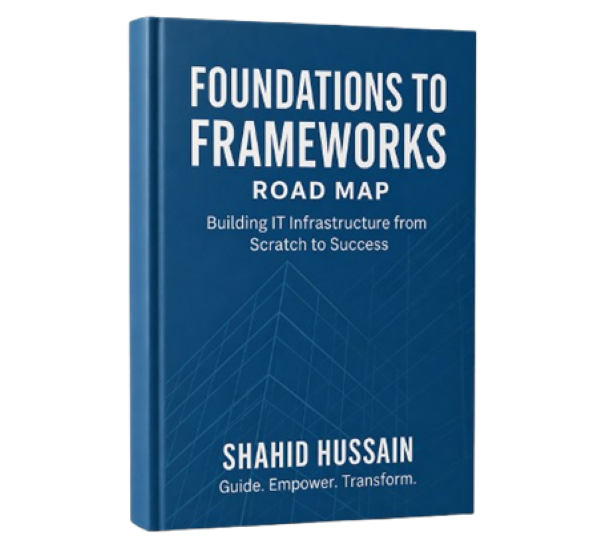
A Framework Built for Today’s IT Challenges
The framework is particularly relevant because of its relevance at the current time. Contemporary enterprises are facing a highly dynamic environment driven by AI, cloud computing, cybersecurity issues, and the continuous need to update their infrastructure without impacting operational stability. The book addresses this issue by illustrating that future-proofing information technologies cannot be achieved solely by using the latest technology solutions. It requires robust fundamentals.
This approach makes the framework particularly strong in terms of content. Given the highly competitive nature of the market, where most enterprises are keen to embrace contemporary technological concepts, Hussain’s book highlights the significance of solid foundations in ensuring successful development in the long run. In other words, the book is highly relevant to both business and technology professionals who wish to avoid costly errors.
A Practical Roadmap, Not Just Theory
Another major strength of the framework lies in its structured approach. Unlike most frameworks, where the reader is bombarded by highly conceptual information, this one follows a logical flow from fundamentals to advanced frameworks. From reading the contents, it is evident that there is a carefully crafted process involving an understanding of the fundamentals, development of a sound foundation, transition from foundation to framework, implementation, evaluation, customization, application in industry, leadership, communication, innovation, and new frameworks.
This makes the framework useful to a wide spectrum of readers. It may be used by professionals involved in developing infrastructure, leaders seeking to improve enterprise systems, and managers looking to align their IT strategy with their business plans. The framework is made more practical by virtue of the fact that it contains diagrams, checklists, procedures, and lessons.
Why the Framework Matters to IT Leaders and Organizations
In addition to this, the framework is not only concerned with the technical aspect of IT leaders. In other words, Enterprise IT is viewed by the author as an enabler of business. According to the philosophy presented by Hussain, topics like risk management, cost efficiency, scalability, compliance, ethics of AI, and planning in the absence of external pressures are discussed. These are exactly the things that organizations need to have in order to protect themselves while continuing to grow.
In terms of organizational benefits, this framework provides many options for the readers. Thanks to a deeper understanding of how the infrastructure can be designed and governed, enterprises will face lower risks in terms of security breaches, downtimes, poor infrastructure, and high costs associated with infrastructure reconstruction.
Turning Enterprise IT Into Strategic Advantage
One of the key features that makes this framework unique is the author’s approach to the problem of placing enterprise IT into the strategic rather than purely technological context. According to Hussain, choices regarding infrastructure affect organizational confidence regarding expansion and its ability to embrace changes safely, as well as its response to unpredictability.
These considerations are crucial given the current state of affairs in terms of information technology development. Contemporary enterprises require systems that will be both sufficiently protected against external attacks and resilient to maintain their operations despite any challenges, while possessing the necessary level of flexibility to adapt to cloud computing and AI-related technologies.
The Framework’s Impact on Society
Not only does the framework offer practical guidance for IT professionals within corporations, but its value also extends to society at large. Its social impact will be seen through the systems that the framework enables organizations to create. The more secure and reliable their digital infrastructure becomes, the more positive the impact on their employees, customers, partners, and the general population.
IT professionals will benefit from having tools that can enable them to create systems that will provide protection, resilience, security, and innovation. These topics are highly relevant in a globalized economy where technology plays a vital role in everything from banking, education, health care, government services, and commerce. As such, the framework contributes to building stable IT ecosystems.
Moreover, the framework is valuable in educating people. Its intended audience includes both senior IT professionals and newcomers. By structuring difficult-to-understand material, the framework makes it easier to learn about complex digital infrastructure systems. As a result, future IT leaders will have the skills to create new systems, thus contributing to technological advancement.
A Valuable Resource in a Fast-Evolving Landscape
What makes the Foundation to Frameworks Road Map appealing is its relevance, clear vision, and practicality. The framework relates to modern realities while maintaining the focus on the timeless principles. It considers today’s technology and risks, yet it promotes discipline, flexibility, and well-thought-out decisions in approaching them.
It must be said that this compilation by Mr. Shahid is not just another textbook on technology. Instead, it is a business-oriented framework for creating enterprise IT that will ensure stability and development of an organization. In the era when companies need stable and resilient systems. Shahid Hussain’s framework makes a convincing point that investing in IT infrastructure is among the best choices any business can make.
Also read:
AI is Changing Managed Services and Here’s What Mid-Market Business Leaders Should Expect Next
Essential Things You Should Know About Jobs in Information Technology
Image source: Shahid Hussain