Click here to get this post in PDF
Space is building a distributed filesystem that lets humans and agents instantly access and work across petabytes of live data while using zero local disk space.
San Francisco, CA – August 25, 2026: Cloud storage was supposed to make computers feel limitless. Yet workflows remain constrained by the disk inside each device. The cloud gave data another place to live, but not a better way to reach it.
People are still forced to upload, download, sync, duplicate, and search for files before work can begin. Agents face an even larger bottleneck: data must often be copied, ingested, indexed, or uploaded into a separate tool before an agentic workflow can be unlocked.
Space was built around a different idea: every application, person, and agent should be able to work from the same live filesystem, with data available the moment it is needed. If compute can become effectively unlimited in the cloud, storage should work the same way.
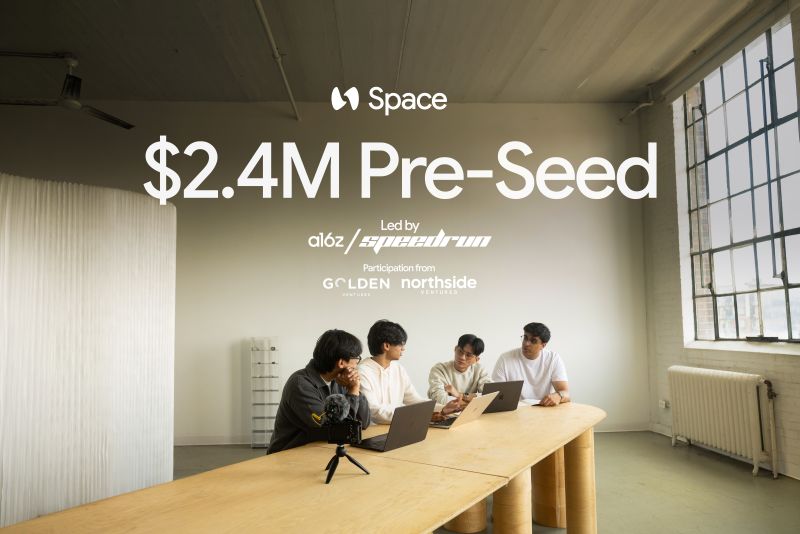
Today, Space announced a $2.4 million pre-seed round led by a16z Speedrun, with participation from Golden Ventures, Northside Ventures, and a dozen angel investors with backgrounds across prosumer and enterprise software such as Parsec, Sentry, Stan, Superwhisper, and Modem.
Space is building an AI-native distributed filesystem that collapses the cloud and local drive into one shared data layer. It allows applications, teammates, and agents to access the same live files as if they were stored locally, without full-file downloads, duplicated copies, or application-specific integrations.
The cloud solved storage. AI makes access the new bottleneck.
The industry has spent decades optimizing where data is stored, but the harder problem is making it instantly accessible to the people and agents that need it.
As companies manage increasingly large design files, codebases, datasets, media libraries, and machine-generated outputs across clouds, drives, and devices, traditional storage still requires data to be moved or copied before work can begin. Humans wait for transfers. Agents wait for ingestion pipelines, connectors, and duplicated context. Both are forced to organize their workflows around where data is stored, slowing progress, limiting collaboration, and increasing security risks.
Space is building a new access layer directly above the operating system, where every application, person, and agent can reach the same live data through the filesystem itself.
Space’s bet is simple: the next storage layer that unlocks the future should make files instantly usable where work already happens, within the native apps and agentic systems teams already use.
“Humans and agents are working across more data than any local disk can hold. They should not have to wait for files to be copied or ingested before work can begin,” said Jason Zhao, Co-Founder of Space.
“The filesystem is the layer shared by every application, device, user, and agent. Rebuilding it around live, distributed data makes every workflow above it faster,” said Arihant Bapna, Co-Founder of Space.
“The computer no longer needs to hold every file. It becomes a window into any file, wherever it lives and however large it is,” said Matthew Ao, Co-Founder of Space.
What Space is building: One filesystem for every application, person, and agent
Built directly above the operating system, Space makes cloud-hosted files behave like local ones. Files appear in Finder and open in existing native applications without a download or permanent local copy. When an application or agent requests data, Space streams only the exact byte ranges required, in real time, to complete the task.
That changes what cloud storage can feel like. A video editor can open a project larger than the computer in front of them without waiting. An architect can work on a building model whose assets stream only as the application needs them. A developer can work across an entire repository without storing it on a laptop. An agent can traverse an entire organization’s context through a shared filesystem and read only the portions of each file relevant to its task.
This is what sets Space apart from Dropbox, Box, and Google Drive. Those tools are built primarily around syncing entire files onto local devices or bringing workflows into web applications. Space lives at the file system layer, low enough that applications like Premiere, DaVinci, Blender, CAD tools, code editors, and AI agents and agentic applications can all work from the file system without a separate integration for every tool.
Most agentic tools today make users upload an entire file to a chatbot even when the task needs only one page, one frame, or one byte range. That is slow, expensive, and wasteful. Space gives teams and AI-native companies a filesystem their agents can navigate directly.
Space is currently in private beta, with roughly 100 users and teams onboarded, backed by an organic audience of more than 80,000 across platforms.
The Origin – Built from a company-wide problem
Space was founded by Matthew Ao, Arihant Bapna, and Jason Zhao after the same constraint followed them from individual work into operating a company. Zhao first encountered the problem after accumulating dozens of terabytes of footage across drives as he documented his life on YouTube over the last decade. At the trio’s previous company, it became an organization-wide bottleneck: the team moved terabytes of footage each month while scaling an aggressive organic growth strategy, losing hours to uploads and downloads, quality to compression, and entire workflows when someone left a drive at home.
In November 2025, the founding team built the first Space prototype. Months later, working out of Founders Inc. in San Francisco while raising their pre-seed round, demand grew faster than they could keep up, so they went all in toward a single bold vision: an AI-native filesystem that gives every computer infinite space and ultimately, an infinite computer unconstrained by the storage and compute of the physical machine.
“Space is disrupting one of the oldest assumptions in computing: a file has to exist on your device before you work with it,” said Jonathan Lai, General Partner at a16z. “Matt, Ari, and Jason are innovating with a new type of AI-native filesystem that can serve both human creators and AI agents with the same primitive: instant access to the exact data they need.”
What’s next
Space is beginning with teams whose workflows already exceed the limits of local disks across the video, marketing, and AEC industries. These industries are also at the forefront of adopting agentic workflows, where humans and agents must work across the same large volumes of live, unstructured data.
From there, Space will expand into AI-native companies and the world’s most data-intensive workflows, including media and entertainment, AI training-data infrastructure, computer vision, enterprise data systems, and world-model pipelines.
The filesystem is Space’s starting point. The longer-term vision is what the team calls the Space Computer, or the infinite computer: a world where the physical machine becomes a window into effectively unlimited storage and compute.
About Space

Space is building the AI-native filesystem for human creators and AI agents. Its distributed filesystem makes cloud-hosted data behave like local files inside existing applications, allowing every computer, teammate, application, and agent to work from the same live data without full-file downloads, duplicated copies, or application-specific integrations. Space was founded by Matthew Ao, Arihant Bapna, and Jason Zhao and is built by Space Computer, Inc.
Also read:
Lightsage raises $4M to build the growth stack for internet’software’s newest customer: AI agents
Alloy Robotics raises $8M to help engineers debug robot fleets with AI agents
Echovane raises $1M to make complex market research a done-for-you AI-native service
Image source: spacefs.com