Click here to get this post in PDF
Key Takeaways
- A vehicle payment is only one part of what a car will cost over time.
- Fuel, insurance, maintenance, repairs, fees, and depreciation can substantially change the better deal.
- Comparing vehicles over the same five-year period makes the decision clearer.
- The right choice should support both everyday transportation needs and a realistic monthly budget.
Why Total Cost Matters
The purchase price can create a misleading picture of affordability. Two cars with similar prices may have very different fuel use, insurance premiums, repair needs, and resale values. Buyers considering a major financial decision can learn more about planning for long-term needs, then apply the same forward-looking approach to a vehicle budget. Total cost of ownership offers a more complete way to compare options before signing paperwork. For example, a lower-priced truck may have a manageable payment but require more fuel and cost more to insure. A compact SUV with a slightly higher payment may still cost less per month once recurring expenses are factored in. Looking at the whole ownership picture helps prevent a vehicle from becoming a surprise expense.
Costs To Include In Your Estimate
A useful estimate includes fixed costs, variable costs, and the amount of value the vehicle is likely to lose. Your actual results will depend on where you live, your credit profile, annual mileage, driving history, coverage choices, and how long you expect to keep the car. The AAA driving cost calculator can help create a starting estimate based on a specific vehicle and location.
- Purchase price, down payment, trade-in value, and loan interest
- Sales tax, title charges, registration, and recurring local fees
- Insurance premiums and deductibles
- Gasoline, diesel, or home and public charging costs
- Routine maintenance, tires, and unexpected repairs
- Depreciation, or the difference between what you pay and what you can later sell or trade it for
Look Beyond The Monthly Payment
A low monthly payment does not automatically mean a low-cost car. Extending a loan can lower the payment while increasing the total interest. Taxes, dealer fees, optional protection products, and negative equity from a previous loan can also be rolled into financing.
- Use the same down payment when comparing vehicles.
- Use the same loan term whenever possible.
- Review the annual percentage rate and total amount financed.
- Calculate the full amount of interest over the loan.
- Ask for an itemized out-the-door price and separate optional products from required charges.
Compare Fuel And Insurance Costs
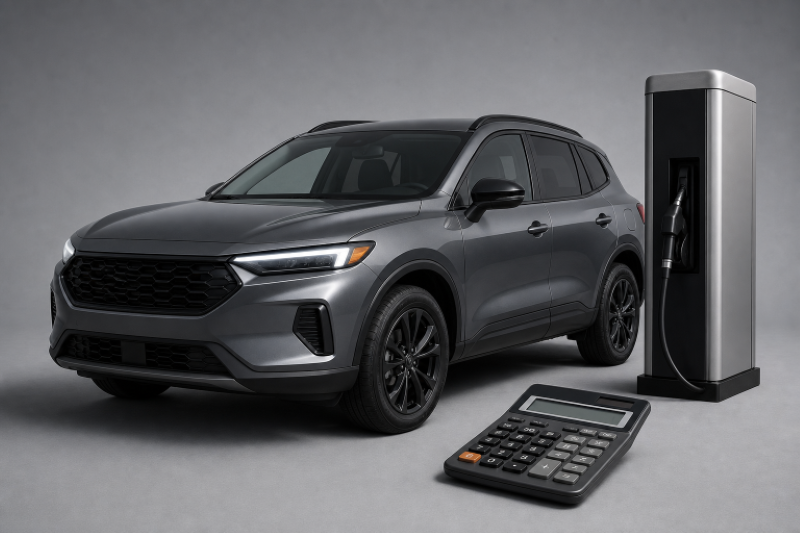
Fuel spending can create one of the largest differences between similar vehicles. For a gas-powered model, estimate annual fuel cost by dividing annual miles by miles per gallon, then multiplying by the expected average price per gallon. For an electric vehicle, divide annual miles by miles per kilowatt-hour and multiply by your local electricity rate. The EPA notes that ownership costs also include less obvious expenses such as fees, insurance, maintenance, repairs, and depreciation, not just the payment and fuel bill. Get insurance quotes before choosing a trim level. Vehicle size, repair complexity, safety equipment, theft risk, garaging location, age, and driving record can all affect the premium. Comparing quotes early is especially important when deciding between a new vehicle, a used vehicle, and a performance-oriented model.
Plan For Maintenance And Repairs
Scheduled maintenance includes oil changes, tire rotations, brake inspections, fluid services, and filter replacements. Unexpected repairs can involve tires, batteries, brakes, suspension components, sensors, cooling systems, or electronics. Newer vehicles may have warranty protection, but wear items and routine services may still be the owner’s responsibility. Review the owner’s manual, warranty terms, service records, and known maintenance needs for the exact model you are considering. Used-car buyers should arrange a pre-purchase inspection and keep an emergency repair fund. A low sticker price is less appealing if the vehicle immediately needs tires, brakes, or major mechanical work.
Account For Depreciation
Depreciation is the loss in value that occurs as a vehicle ages and gains mileage. It does not arrive as a monthly invoice, but it is still a real ownership cost when you sell or trade in the vehicle. A model with stronger resale demand may cost less to own than a cheaper alternative that loses value quickly. Estimate the likely resale value at the end of your planned ownership period. Consider expected mileage, condition, maintenance records, accident history, body style, powertrain, and local market demand. Keep in mind that resale estimates are not guarantees, especially if market conditions change.
Compare New And Used Vehicles
Potential Benefits Of A New Vehicle
- Current safety features and technology
- Full factory warranty coverage
- Lower repair risk during the first several years
- More control over color, trim, and equipment
Potential Benefits Of A Used Vehicle
- Lower purchase price and borrowing needs
- Less exposure to the earliest years of depreciation
- More choices within a fixed cash budget
- Potentially lower insurance costs for some models
Neither category wins in every situation. Condition, mileage, service history, interest rate, warranty coverage, and insurance quotes can matter more than whether the vehicle is new or used.
Use A Five-Year Cost Test
A five-year comparison gives buyers a practical view of total ownership costs without requiring overly detailed predictions. For each vehicle, add the down payment, taxes, fees, total loan payments, five years of fuel or charging, insurance, maintenance, repair reserve, registration, and recurring taxes. Then subtract the expected resale value and divide the result by 60. For a simple fictional comparison, Vehicle A may have a lower purchase price but higher five-year fuel, insurance, and repair costs. Vehicle B may cost more upfront but retain more value and require less fuel. The important number is the final five-year cost and its monthly equivalent, not any single line item.
Buyer Checklist
- Set a total monthly vehicle budget, not just a payment target.
- Request insurance quotes for every serious option.
- Estimate fuel or charging costs using your expected mileage.
- Compare loan terms, interest costs, and itemized out-the-door prices.
- Review warranty coverage, service schedules, and repair history.
- Check expected resale value and keep money available for emergencies.
- Compare at least two or three vehicles over the same ownership period.
Final Thoughts
The best vehicle is not always the cheapest one to buy or the one with the lowest monthly payment. It is the one that fits your daily needs while keeping fuel, charging, insurance, financing, maintenance, repairs, registration, and depreciation manageable. Buyers should also consider passenger space, cargo capacity, driving habits, and how long they expect to keep the vehicle. A lower-priced model may become more expensive over time if it has high operating or repair costs. Comparing the full cost of ownership before buying in 2026 can lead to a more confident decision, fewer unexpected expenses, and a budget that remains practical long after the keys are in hand.
You may also like: 3 Tips For Business Owners Who Want To Buy A Car