Click here to get this post in PDF
Demystifying Estate Planning Myths and Wealth Misconceptions

Many of us spend years building our finances, but fewer take the time to plan what happens next. Personal financial and estate planning might sound complex. But it’s truly about protecting what we’ve worked so hard for. It ensures our loved ones are cared for. This isn’t just for the wealthy; it’s a vital step for every individual and family. It helps secure their future.
In this extensive guide, we will explore the core components of an effective estate plan. This includes wills, trusts, powers of attorney, and tax strategies. We’ll also cover how to get started, choose beneficiaries, and keep our plan updated. Our goal is to help you create a personalized estate planning strategy that fits your unique situation.
The concept of estate planning often conjures images of vast fortunes and complex legal battles, leading many to believe it’s a concern only for the exceptionally wealthy. This is a significant misconception. In reality, personal financial and estate planning is a fundamental necessity for everyone, regardless of their current asset value or income level. It’s about ensuring your wishes are honored, your loved ones are protected, and your legacy is preserved.
One of the most common reasons people postpone estate planning is the belief that they don’t have enough assets to warrant it. However, statistics reveal a concerning trend: as of August 2026, data suggests that only about 24% of adults aged 18 and older have a will, and a mere 13% have established a living trust. This widespread oversight can lead to significant complications for families during an already difficult time. Without a clear plan, your estate—which includes everything you own, from your home and savings to personal belongings—could be subject to state intestacy laws. This means the government, rather than you, dictates how your assets are distributed, potentially overlooking your true intentions or leaving out individuals you wished to provide for.
Furthermore, neglecting to plan can result in lengthy and costly probate processes. Probate is the legal procedure through which a will is proven valid, and the deceased’s assets are identified, inventoried, appraised, and distributed. It can be a public, time-consuming, and expensive ordeal, eating into the very assets you intended for your heirs. By proactively engaging in personal financial and estate planning, we can streamline this process, minimize expenses, and ensure a smoother transition for our beneficiaries.
Taking an inventory of our assets is a crucial first step, but effective planning goes beyond just listing possessions. It involves a holistic approach to managing our finances and planning for the future. Understanding our financial standing, setting clear goals, and creating a budget are all integral parts of building a strong foundation for our financial legacy. For those looking to manage their money more effectively and set clear financial goals, exploring resources for personalized budgets and savings can be incredibly beneficial. This proactive financial management directly supports our estate planning efforts by clarifying what assets we have and how we want them to be used.
Estate planning is not just about death; it’s about life and ensuring that our financial well-being and personal wishes are respected, even when we can no longer express them ourselves. It’s an investment in peace of mind for ourselves and our families.

Essential Components of Personal Financial and Estate Planning

Building a robust personal financial and estate plan involves more than just a single document; it’s a foundational strategy encompassing various legal tools designed to manage our assets, protect our families, and ensure a seamless transfer of wealth according to our wishes. This comprehensive approach addresses both our lifetime needs and our post-mortem directives.
Core Documents in Personal Financial and Estate Planning
At the heart of any estate plan are several key documents, each serving a distinct purpose in guiding our financial and medical decisions.
Wills: A Last Will and Testament is arguably the most recognized estate planning document. It allows us to specify how our assets should be distributed after our death, name an executor to manage our estate, and, crucially, designate guardians for any minor children. Without a valid will, we are said to die “intestate,” meaning state laws will dictate asset distribution, often in ways that don’t align with our personal desires. This can lead to assets going to distant relatives, or even the state, rather than our intended beneficiaries. The estate will also likely undergo a public and potentially lengthy probate court process.
Trusts: Trusts offer a versatile alternative or complement to wills, providing greater control over asset distribution and often allowing assets to bypass probate. A trust involves three parties: the grantor (who creates the trust), the trustee (who manages the assets), and the beneficiaries (who receive the assets).
The primary distinction lies between revocable and irrevocable trusts:
- Revocable Living Trusts: These trusts can be altered, amended, or revoked entirely during our lifetime. We typically serve as the grantor and initial trustee, maintaining full control over the assets. Upon our death, the revocable trust automatically converts into an irrevocable trust. While they don’t offer immediate estate tax benefits or creditor protection during our lifetime, they are excellent for avoiding probate, maintaining privacy, and providing for incapacity.
- Irrevocable Trusts: Once established, an irrevocable trust generally cannot be changed or terminated without the consent of the beneficiaries. We relinquish control over the assets once they are transferred into the trust. This lack of control is precisely what gives irrevocable trusts their power: assets held in an irrevocable trust are typically removed from our taxable estate, offering significant estate tax advantages and protection from creditors. They are often used for specific purposes, such as charitable giving, special needs planning, or life insurance.
Here’s a quick comparison:
| Feature | Last Will and Testament | Revocable Living Trust | Irrevocable Trust |
| Effectiveness | Takes effect upon death (after probate) | Takes effect upon creation; can be changed/revoked | Takes effect upon creation; generally cannot be changed |
| Probate | Requires probate | Avoids probate | Avoids probate |
| Privacy | Public record during probate | Private | Private |
| Asset Control | Retain full control until death | Retain full control as trustee | Grantor relinquishes control over assets |
| Creditor Protection | No | No (during grantor’s lifetime) | Yes (assets protected from grantor’s creditors) |
| Estate Tax Benefits | Limited (relies on individual exemption) | No (assets still part of taxable estate) | Yes (assets removed from taxable estate) |
| Flexibility | Can be updated, but only takes effect after death | Highly flexible; can adapt to changing circumstances | Very limited flexibility once established |
Managing Beneficiaries, Guardianship, and Trusts
Beyond the legal documents, thoughtful consideration of who receives our assets and who cares for our dependents is paramount.
Choosing Beneficiaries: This involves designating individuals or entities to receive our assets. For accounts like life insurance policies, retirement accounts (401(k)s, IRAs), and annuities, beneficiaries are named directly on the account forms. These “beneficiary designations” often supersede a will, meaning the assets pass directly to the named beneficiaries without going through probate. It’s crucial to review and update these designations regularly, especially after major life events.
Naming a Guardian for Minor Children: For parents of minor children, this is arguably the most critical decision in estate planning. Within a will, we can name a legal guardian who would assume responsibility for our children’s care and upbringing if both parents pass away. This choice should be made with careful consideration of the guardian’s age, health, location, parenting style, and willingness to take on such a significant role. Without this designation, a court will appoint a guardian, which may not align with our preferences.
The Role of a Trustee and Distribution Control: When establishing a trust, we also appoint a trustee to manage the trust assets for the benefit of our beneficiaries. This can be an individual, a professional trustee, or a financial institution. Trusts are incredibly useful for controlling the timing and amount of financial distributions, particularly for young or minor beneficiaries who may not be ready to manage a large inheritance outright. For instance, a trust can specify that a child receives portions of their inheritance at certain ages (e.g., 25% at age 21, another 25% at 25, and the remainder at 30).
Special Needs Planning: For families with a loved one who has special needs, a special needs trust is an invaluable tool. It allows us to provide financial support without jeopardizing their eligibility for government benefits, such as Medicaid or Supplemental Security Income (SSI). The trust assets are managed by a trustee for the beneficiary’s supplemental needs (those not covered by government programs), ensuring their continued care and quality of life.
Strategic Steps to Execute and Maintain Your Estate Plan

Creating an estate plan is a significant achievement, but it’s not a one-time event. It’s an ongoing process that requires regular review and adjustment to remain effective. Our action roadmap includes not only initial setup but also strategic tax planning, incapacity protection, and a commitment to ongoing maintenance.
Tax Strategies in Personal Financial and Estate Planning
Minimizing potential estate taxes is a key objective for many, especially those with larger estates. While the federal estate tax exclusion amount is substantial, understand the strategies available to reduce taxable transfers. As of August 2026, the federal estate and gift tax exclusion amount is indexed annually for inflation, serving as a high threshold below which most estates will not incur federal estate tax. For reference, in 2023, this amount was $12.92 million per individual. However, the maximum federal estate tax rate remains at 40% for taxable transfers exceeding this exclusion.
Lifetime Gifting: One effective strategy is to engage in lifetime gifting. Each year, we can gift a certain amount to any individual without incurring gift tax or using up our lifetime exclusion. For instance, in 2023, the annual exclusion amount was $17,000 per donee, indexed annually for inflation. By making these annual exclusion gifts, we can gradually reduce the size of our taxable estate over time without impacting our lifetime exclusion amount. This strategy is particularly useful for gradually transferring wealth to future generations.
Charitable Donations: For those with philanthropic goals, charitable donations can also reduce estate tax liability. Direct bequests to qualified charities are generally exempt from estate tax. Furthermore, utilizing vehicles like donor-advised funds (DAFs) offers a unique advantage. When we contribute to a DAF, we receive an immediate federal income tax deduction in the year of the donation, even if the funds are granted to charities later. The assets contributed to the DAF are also removed from our taxable estate, effectively reducing its size while fulfilling our charitable wishes. This combines immediate tax relief with long-term philanthropic impact.
Trusts for Tax Planning: Certain types of irrevocable trusts are specifically designed for tax optimization. For example, a Grantor Retained Annuity Trust (GRAT) can transfer appreciating assets out of our estate with minimal gift tax implications, while a Charitable Remainder Trust (CRT) allows us to receive income for a period, with the remainder going to charity, providing both income and estate tax benefits.
Incapacity Protection and Powers of Attorney
Estate planning isn’t solely about what happens after we pass away; it’s equally about planning for potential incapacity during our lifetime. Who will make critical financial and medical decisions if we are unable to? This is where Powers of Attorney and Advance Directives become indispensable.
Financial Power of Attorney (POA): A financial POA allows us to appoint a trusted agent (an “attorney-in-fact”) to manage our financial affairs if we become incapacitated. This agent can pay bills, manage investments, file taxes, and handle other financial matters on our behalf. A “durable” POA remains effective even if we become incapacitated, which is crucial for continuous financial management. Without a financial POA, our family might have to seek court conservatorship, a process that can be expensive, time-consuming, and emotionally draining.
Medical Power of Attorney / Healthcare Proxy: Similar to a financial POA, a medical POA (or healthcare proxy) designates an agent to make healthcare decisions for us if we are unable to communicate our wishes. This ensures that our medical care aligns with our values and preferences.
Advance Healthcare Directive (Living Will): An advance directive, often called a living will, is a written statement outlining our preferences for medical treatment, especially regarding end-of-life care. This document provides clear instructions to our medical team and designated agent about life-sustaining treatments, pain management, and other critical decisions. Having these documents in place avoids difficult choices for our loved ones and ensures our voice is heard when we can no longer speak for ourselves.
Estate planning is truly as much about managing healthcare and financial decisions during lifetime incapacity as it is about asset distribution after death. It provides a roadmap for our care and financial well-being, offering peace of mind to us and our families.
Actionable Steps to Implement and Review Your Plan
Embarking on personal financial and estate planning can seem daunting, but breaking it down into actionable steps makes it manageable. The key is to start, gather information, and work with qualified professionals.
1. Gather Your Documents and Information: Begin by compiling a comprehensive list of all your assets (real estate, bank accounts, investment portfolios, retirement funds, life insurance policies, valuable personal property) and liabilities (mortgages, loans, credit card debt). Gather essential documents like property deeds, account statements, insurance policies, and birth certificates. This inventory forms the foundation of your estate.
2. Seek Professional Guidance: While online tools can help with basic wills, complex situations or significant assets often benefit from the expertise of an estate planning attorney and a financial advisor. They can help navigate state-specific laws, minimize taxes, and structure trusts tailored to your unique needs. Working with professionals ensures your documents comply with legal standards and effectively achieve your goals. For those seeking a comprehensive strategy, exploring resources for personalized estate planning can connect you with the right expertise.
3. Draft Your Core Documents: With professional guidance, create your Last Will and Testament, Powers of Attorney (financial and medical), and Advance Healthcare Directive. If appropriate, establish trusts to meet specific objectives like probate avoidance, asset protection, or controlled distributions.
4. Designate Beneficiaries and Guardians: Clearly designate primary and contingent beneficiaries for all accounts and policies. If you have minor children, formally name a guardian in your will.
5. Organize and Store Documents: Keep all original estate planning documents in a safe, accessible place, such as a fireproof safe or a bank safe deposit box. Provide copies or inform your executor, agents, and trusted family members about the location of these important papers. Consider creating a digital inventory of assets and passwords for online accounts.
6. Fund Your Trusts (if applicable): If you’ve created a living trust, remember to “fund” it by transferring ownership of assets into the trust’s name. A trust that isn’t funded is merely a document with no assets to manage.
7. Communicate Your Wishes: While difficult, discussing your estate plan with your executor, agents, and beneficiaries can prevent misunderstandings and ease their burden during a challenging time.
8. Regular Review and Updates: An estate plan is not static; it’s a living document that should evolve with your life. We recommend reviewing your entire estate plan every three to five years, or immediately following significant life events.
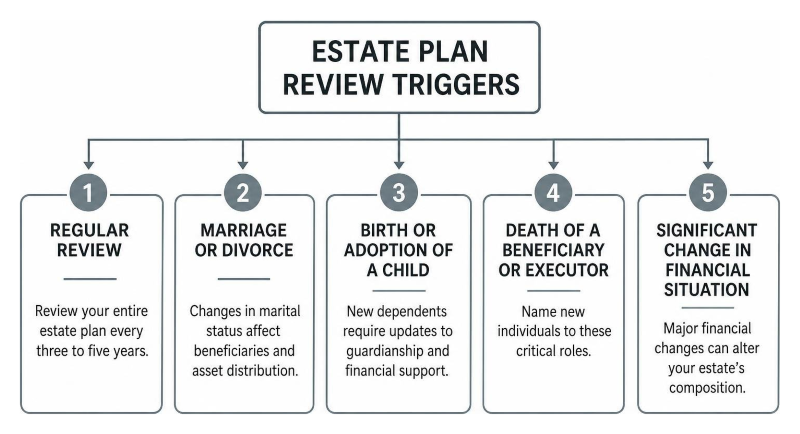
Major life events that should trigger an immediate review include:
- Marriage or Divorce: Changes in marital status have profound implications for beneficiaries and asset distribution.
- Birth or Adoption of a Child: New dependents necessitate updating guardianship provisions and financial support.
- Death of a Beneficiary or Executor: You’ll need to name new individuals to these critical roles.
- Significant Change in Financial Situation: A large inheritance, new business venture, or substantial debt can alter your estate’s composition.
- Relocation to a New State: Estate laws vary significantly by state, requiring adjustments to ensure your plan remains valid and effective.
- Changes in Tax Laws: Federal and state tax legislation can impact the effectiveness of your tax planning strategies.
- Purchase or Sale of Major Assets: Acquiring or divesting significant property or businesses warrants an update.
- Health Changes: A diagnosis of a serious illness might prompt a review of medical directives and financial planning for long-term care.
By taking these actionable steps and committing to regular reviews, we can ensure our personal financial and estate planning remains current, effective, and truly reflects our wishes for our future and the well-being of our loved ones.
You may also like:
The Legal and Financial Arrangements That Protect Business Wealth Across Ownership Transitions
6 Common Mistakes To Avoid While Estate Planning
Wills and Trusts: Understanding the Differences and Similarities