Click here to get this post in PDF
Before getting into rankings: if you’re still in the research phase figuring out who to talk to, Recode is worth a look. It’s built for exactly this — finding and comparing vendors that work in software modernization, application migration, and legacy transformation. Useful before you’re deep in vendor conversations.
On to the actual problem.
“We’ll modernize eventually. Maintenance is just the gap.” That gap runs five to fifteen years for most enterprises. Unpatched vulnerabilities, undocumented workarounds, changes nobody wrote down because the person who made them left in 2019. Running it badly costs more than doing it right.
Nobody gives conference talks about legacy maintenance. It just has to work.
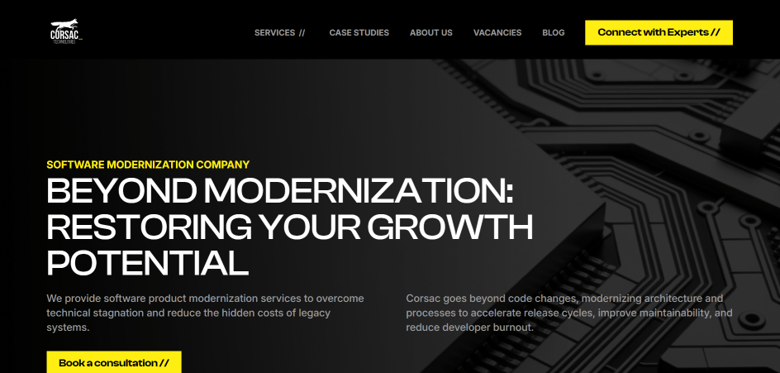
1. Corsac Technologies
Website: corsactech.com
Location: United States
Founded: 2007
Team size: 50–249
Start here if your codebase is the kind where nobody’s fully sure what’s in it anymore. Original developers gone. Documentation wrong. Integrations that just worked and nobody asked why.
Corsac Technologies uses AI-driven software modernization to accelerate legacy system analysis, dependency discovery, business logic extraction, and risk reduction during software maintenance and migration. Before any support work begins, the RAG architecture reads the actual code — not documentation, not stakeholder interviews — and produces a dependency graph, complexity heatmap, and tech debt audit.
The Multi-Agent Swarm runs on top of that. It identifies which components cause incidents when touched wrong, and which cause incidents when left alone too long. That changes how maintenance priorities get set. Not gut feel. Evidence.
A fix in one place breaks something undocumented somewhere else — that’s the pattern that makes legacy maintenance expensive. The dependency map is what prevents that from being a surprise.
SOC 2 Type II, HIPAA, PCI DSS, GDPR. Compliance doesn’t pause during maintenance. Corsac builds it in from the start.
Key differentiator: You know what the system contains before deciding what to touch.
2. Smartbridge
Website: smartbridge.com
Location: United States
Founded: 2003
Smartbridge has been at this since 2003. Technical debt doesn’t behave the same way in year two as it does in year twelve. The patterns that create expensive maintenance problems five years later aren’t obvious in the moment they’re introduced. You develop that recognition from watching it happen, not from reading about it.
Application support alongside cloud, analytics, and automation work in one practice. Relevant for enterprises running gradual modernization alongside ongoing maintenance — so the two tracks don’t operate from different playbooks with no coordination between them.
Key differentiator: Two decades of maintenance experience. Pattern recognition that comes from watching how decisions compound.
3. Reliqsy
Website: reliqsy.com
Location: United States
Founded: 2014
Reliqsy combines AI with hands-on software modernization and migration expertise. The AI-powered platform analyzes legacy code, extracts business logic, and accelerates refactoring — which in the maintenance context means the team actually understands what they’re supporting rather than guessing.
Dependencies, technical debt, and security risks mapped continuously. Not just at project kickoff. The real-time dashboard shows system health over time — the support team sees where things are deteriorating before they fail.
Every change goes through Pull Request review. SRE oversight. Automated rollback at 400ms if a maintenance update causes problems. That last part is rarer than it should be.
Key differentiator: Continuous visibility. Automated rollback on maintenance changes.
4. Insighture
Website: insighture.com
Location: Australia, Sri Lanka
Founded: 2016
Here’s the handoff problem: most modernization vendors hand you to a separate managed services team when migration ends. That team has no context on decisions made during the project. They rebuild from scratch.
Insighture keeps modernization and ongoing maintenance in the same practice. Australia and Sri Lanka delivery covers Asia-Pacific time zones without requiring multiple vendor relationships.
Key differentiator: The team that built it supports it.
5. Leobit
Website: leobit.com
Location: Ukraine, Poland
Founded: 2014
Post-modernization maintenance is the phase most projects underspecify. Something breaks in the new environment six months after cutover. Most modernization vendors are gone by then.
Leobit covers that phase. The in-house design studio handles front-end maintenance too — for legacy systems where the backend got updated but the UI still looks like 2009. That’s ongoing support rather than a separate project every time something needs changing.
Key differentiator: The engagement doesn’t end at cutover.
6. Inoxoft
Website: inoxoft.com
Location: USA, Poland, Ukraine
Founded: 2014
Enterprise maintenance contract minimums don’t work for SMBs. Inoxoft is one of the few that explicitly serves small and medium businesses without requiring enterprise-scale commitments.
Application support alongside web, mobile, and UX/UI work in one relationship. For SMBs where the legacy system and the product are tightly coupled, that beats managing three separate vendors.
Key differentiator: Maintenance that scales to SMB budgets and contract sizes.
7. Sombra
Website: sombra.tech
Location: Ukraine, Colombia
Founded: 2013
When the legacy system is also a data source for AI workloads, it has to run reliably for anything downstream to work. Sombra’s maintenance practice includes cloud engineering and AI/ML integration alongside traditional application support — which means they can handle both ends of that dependency.
Ukraine and Colombia covers European and Americas time zones at a price point below firms operating entirely from Western Europe or North America.
Key differentiator: Maintenance plus AI/ML integration. Relevant when legacy systems feed modern data pipelines.
How to Choose
Ask early: what happens when the person who knows this system leaves? Real maintenance capability means documentation practices, knowledge capture, transition planning. Staffing a support function is different.
Monitoring: proactive means you know before users report it. What are the actual alert thresholds? What triggers escalation? Real response time, not the SLA number on the contract.
Regulated industries: compliance built into maintenance, not audited after. Data residency, change management audit trails, access logging — these apply to ongoing support, not just deployment.
SMBs: ask what the minimum engagement looks like before you’re deep in evaluation. Enterprise-priced maintenance doesn’t scale down and most vendors won’t say that directly.
If you’re still building the shortlist, Recode (recode.it.com) is a useful tool for searching and comparing vendors by service type, geography, and specialization before you commit to conversations.
Also read: Top Award-Winning Design Agencies in 2027
Image source: Corsac Technologies