Click here to get this post in PDF
The Ansoff Matrix: Four Pillars of Business Growth and Marketing

For any business, sustainable growth is the ultimate ambition. But how do we move beyond simply hoping for expansion to strategically achieving it? It’s not just about increasing effort; it’s about implementing innovative, integrated marketing and media strategies at our core.
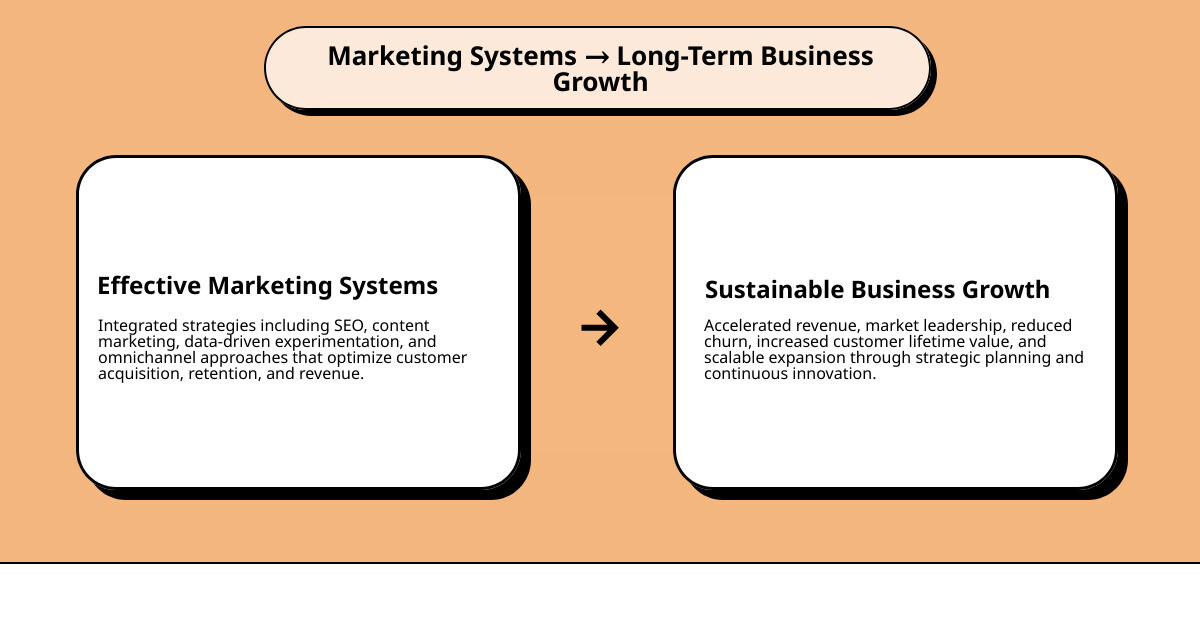
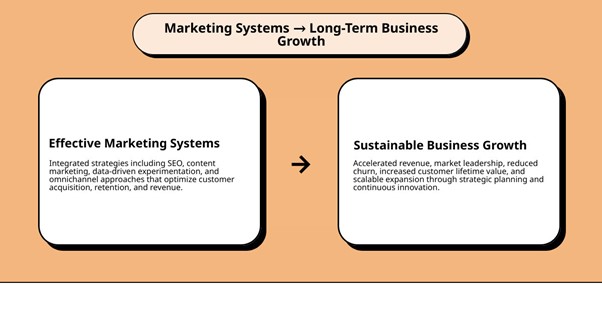
Consider the visual of a professional business scaling graph with a steady upward trajectory. Strategic planning, keen market dynamics, and intelligent media integration drive this. It signifies sustainable expansion and accelerated revenue. An infographic that explains how effective marketing systems drive long-term business growth perfectly illustrates this journey.
In this extensive guide, we will explore how businesses can unlock their full potential. We’ll start with foundational frameworks like the Ansoff Matrix, which helps us navigate various expansion paths from low to high risk. We will then dive into the science of growth marketing, contrasting it with traditional methods, and reveal how data-driven experimentation can yield remarkable results. Whether you’re focused on broad market expansion or specific needs like Contractor marketing and growth, we will cover essential strategies.
Join us as we examine practical tactics for scaling through organic channels, leveraging strategic partnerships, and balancing short-term gains with long-term vision. Our goal is to provide a clear roadmap to navigate the complexities of business expansion and marketing in today’s dynamic world.
When we talk about structured business growth, one of the most influential frameworks we turn to is the Ansoff Matrix, developed by H. Igor Ansoff in his seminal 1957 Harvard Business Review article, “Strategies for Diversification.” This matrix provides a clear model for strategic planning, helping us understand the risks and opportunities associated with different growth paths. It categorizes growth strategies based on whether a business is operating with existing or new products in existing or new markets.
The four core strategies of the Ansoff Matrix are:
- Market Penetration: Focusing on increasing sales of existing products within existing markets.
- Market Development: Introducing existing products into new markets.
- Product Development: Creating new products for existing markets.
- Diversification: Launching new products into new markets.
Each strategy carries a different level of risk, with market penetration being the lowest and diversification the highest. Understanding these distinctions allows us to manage risk effectively and choose the most appropriate path for our business’s current stage and objectives.
Here’s a quick overview of the Ansoff Matrix strategies:
Strategy Products Markets Risk Level Description Market Penetration Existing Existing Low Increasing market share in current segments through pricing or promotion. Market Development Existing New Medium Entering new geographic or demographic markets with current products. Product Development New Existing Medium: Developing new offerings for the current customer base. Diversification New New High Moving into entirely new industries or product lines, the riskiest path.
Deep Dive into Market Penetration Strategies
Market penetration is often the most logical starting point for businesses looking to scale without reinventing the wheel. It involves deepening your footprint within a market you already understand. This can be achieved through several tactical maneuvers. First, price adjustment is a standard tool; by offering competitive pricing or volume discounts, a business can lure customers away from competitors. Second, increasing promotional efforts—such as doubling down on digital advertising or enhancing social media presence—can increase brand salience. Third, improving the product’s utility or adding minor features can encourage existing users to use the product more frequently. For example, a SaaS company might introduce a “pro” tier with advanced reporting to increase average revenue per user (ARPU) among its current subscribers. This strategy is low risk because it leverages existing assets and knowledge, but it requires a high level of execution to win market share in a saturated environment.
The Mechanics of Market Development
When a business reaches a plateau in its primary market, market development offers a path forward. This strategy is about finding new “homes” for existing products. This could involve geographic expansion, such as a successful regional retail chain opening stores in a different part of the country or even internationally. Alternatively, it could include targeting a new demographic. For instance, a company that sells educational software to schools might pivot to sell the same software directly to parents for home use. Market development requires significant investment in market research and potentially a restructuring of the sales and marketing teams to address the nuances of the new audience. While the product is a known quantity, the market dynamics are not, which elevates the risk compared to simple penetration. Success here depends on the ability to adapt messaging to resonate with a new set of cultural or economic values.
Innovation through Product Development
Product development is the engine of growth for many technology-driven firms. It involves creating new offerings for the people who already buy from you. This strategy relies on strong customer relationships and a feedback loop that informs the R&D process. By understanding what your customers need next, you can develop products that solve their evolving problems. This might mean launching a complementary product—like a camera manufacturer starting to sell high-end lenses—or a completely new version of a core product. The risk here lies in the development process itself; there is always a chance that the new product won’t meet market expectations or will be delayed by technical hurdles. However, the advantage is that you are selling to a “warm” audience that already trusts your brand, which significantly lowers acquisition costs compared to finding entirely new customers.
The Challenge of Diversification
Diversification is the boldest move a company can make. It involves stepping outside of its comfort zone in both product and market. This is often done to spread risk across different industries or to capitalize on a unique opportunity that requires a different set of skills. Concentric diversification occurs when a firm enters a related industry—for example, a car manufacturer entering the electric bicycle market. Conglomerate diversification is when the new business has no relationship to the existing one, such as a food company buying a tech startup. Diversification requires a massive amount of capital and a leadership team capable of managing diverse operations. While it offers the highest potential for transformative growth and can protect a company from downturns in its core industry, it also carries the highest risk of failure due to the lack of prior experience in the new field.
Growth Marketing: A Data-Driven Paradigm
In the modern era, strategic frameworks like the Ansoff Matrix must be paired with growth marketing tactics. Growth marketing is distinct from traditional marketing in its focus on the entire customer lifecycle. While conventional marketing might focus on “brand awareness” and top-of-funnel activities, growth marketing is obsessed with conversion, retention, and referrals. It often utilizes the AARRR framework: Acquisition, Activation, Retention, Referral, and Revenue. By treating the marketing funnel as a series of experiments, growth marketers can identify the most efficient ways to drive revenue. This involves constant A/B testing of landing pages, email subject lines, and ad creatives. It also requires a deep dive into data analytics to understand where users are dropping off and why. This scientific approach ensures that marketing spend is continually optimized for the highest possible return, allowing for rapid scaling.
The Importance of Media Leadership
As businesses scale, they must also consider their role as content creators and authorities in their space. Media leadership for business growth is about more than just posting on social media; it’s about producing high-quality, authoritative content that positions the brand as a thought leader. When consumers are bombarded with information, media leadership helps a brand cut through the noise. This includes professional video production, high-end photography, and strategic storytelling that resonates with the target audience. By investing in media leadership, a company builds a “moat” around its brand, making it harder for competitors to displace it. It also provides a wealth of assets that can be used across all marketing channels, from paid ads to organic social posts, ensuring a consistent and professional brand image that inspires trust.
Scaling Through Organic Channels and SEO
Organic growth remains one of the most sustainable ways to build a business. At the heart of organic growth is Search Engine Optimization (SEO) and content marketing. By creating high-quality content that answers the questions your potential customers are asking, you can drive consistent, high-intent traffic to your website. This is not a quick fix; it requires a long-term commitment to keyword research, on-page optimization, and link building. However, the results are cumulative. Unlike paid advertising, where the traffic stops the moment you stop paying, organic traffic continues to flow as long as your content remains relevant and well-ranked. For specialized sectors, such as the construction and home services industry, organic strategies are essential for building local authority and trust over time. This is why many firms prioritize long-term SEO as a core pillar of their expansion strategy.
Strategic Partnerships and Co-Marketing
Another powerful lever for growth is the strategic partnership. By aligning with other businesses that serve the same customer base, you can tap into new audiences with a built-in level of trust. Co-marketing campaigns, where two brands collaborate on a piece of content or an event, can significantly expand your reach. For example, a fitness app might partner with a health food brand to offer a joint promotion. These partnerships allow companies to share the costs of marketing while benefiting from each other’s brand equity. The key to a successful collaboration is alignment; both brands must share similar values and have a clear understanding of what they hope to achieve. When done correctly, partnerships can provide a shortcut to market development and product development goals.
The Power of Data-Driven Experimentation
To truly excel in growth, a company must foster a culture of experimentation. This means moving away from “gut feelings” and toward data-backed decisions. Every marketing campaign, every new feature, and every change to the website should be viewed as a hypothesis to be tested. By using tools like Google Analytics, Mixpanel, or Hotjar, businesses can see exactly how users interact with their brand. This data allows for rapid iteration. If a particular ad campaign isn’t performing, it can be killed or adjusted in real-time. If a new landing page is converting at a higher rate, it can be scaled. This agility allows small startups to disrupt established industries and keeps large corporations competitive in a fast-moving digital economy.
Balancing Short-Term Tactics with Long-Term Strategy
Finally, successful growth requires a delicate balance between the short term and the long term. It’s easy to get caught up in “growth hacks” that provide a temporary spike in traffic or sales. However, these are rarely sustainable. Proper growth is built on a foundation of a great product, excellent customer service, and a strong brand. While it’s essential to use tactical maneuvers to hit monthly or quarterly goals, these should never come at the expense of the long-term vision. A company that focuses solely on short-term gains will eventually find itself with a hollow brand and a declining customer base. By keeping the long-term goal in mind, businesses can ensure their growth is not just fast but also sustainable and resilient to market fluctuations.
Conclusion: Building a Roadmap for Success
Navigating the complexities of business expansion requires a blend of classic strategy and modern tactics. By understanding the paths outlined in the Ansoff Matrix and applying rigorous, data-driven growth marketing methods, businesses can position themselves for long-term success. Whether you are focusing on market penetration, exploring new territories, or innovating with the latest products, the principles remain the same: understand your customer, provide immense value, and never stop experimenting. With the right strategy and a commitment to excellence, the growth potential is limitless. As you move forward, growth is a marathon, not a sprint, and the most successful companies are those that can adapt their strategies to the ever-changing needs of their market.
Also read: Why Pursuing an MBA with a Marketing Focus Is a Strategic Career Move