Click here to get this post in PDF
Flex has closed a $60 million Series B equity round led by Portage, bringing total equity raised to $105 million. In the last year, the company has quadrupled revenue and tripled its payments volume to $3 billion as it scales its all-in-one business and personal finance platform for high-net-worth middle-market business owners.
San Francisco, California – December 4, 2025; Running a profitable middle-market business has become one of the most complex financial jobs in America, with owners often juggling more than ten disconnected systems to manage their money. Flex was created to give these high net worth owners a single place to run both their business and personal finances.
Today, the company announced its $60 million Series B funding round led by Portage with participation from CrossLink Capital, Spice VC, Titanium Ventures, Wellington, Companyon Ventures, Florida Funders, FirstLook Partners, and others, bringing its total equity funding to $105 million.
This latest $60M equity round, followed by its $200M debt and $25M equity raise announced earlier this year, builds on a period of rapid hypergrowth. In just 12 months, Flex has grown revenue fourfold and increased annualized total payments volume from $1 billion to $3 billion across a suite of products, positioning Flex as one of the fastest-growing fintech companies at scale with best-in-class capital efficiency.
The timing aligns with Flex’s upcoming launch of Flex Elite, their new invite-only consumer card and membership, debuting today. Designed as a direct competitor to Amex Centurion, Flex Elite extends the company’s strategy to become the private bank for middle-market business owners, giving them a unified system that spans every dimension of their financial lives.
Traditional fintech platforms have focused either on micro-businesses or sophisticated enterprises. Flex serves the segment in between—the high net worth middle-market business owner generating $3 million to $100 million in revenue, collectively employing roughly 40% of American payroll. These owners are financially sophisticated and often manage their companies alongside significant personal assets, yet have no modern platform that supports the full lifecycle of their money.
Flex is building the category-defining company solving this gap for high net worth business owners with a five-pillar strategy built around private credit, a business finance stack, a personal finance stack, payment solutions, and an ERP built for middle market businesses. These customers now use an average of four or more Flex products.
The company is building AI agents across every product pillar to streamline both its internal operations and customer experiences—like credit underwriting agents to deeply understand every business, expense agents, payment workflows, cash management agents, and back-office ERP agents into a single “motherboard” for business owners. Flex’s vision is to provide every business owner a team of high quality finance agents to run their back office like an enterprise. This AI-driven architecture not only improves customer experience but also drives a structurally lower cost base for Flex, enabling it to operate with a lean headcount. In turn, Flex delivers AI-powered Owner Insights, transforming the data generated from customer activity into a beautiful, intuitive experience that positions Flex as their “AI CFO.”
Supporting this foundation is the company’s private credit arm. With its agentic underwriting system, Flex can price risk with greater precision and offer a true one-stop shop for all credit needs typically underserved by traditional banks, asset managers and larger enterprise-focused fintechs. This vertically integrated capital engine creates a powerful defensibility loop: as Flex originates more volume, customers adopt more Flex financial products across their lives, making its risk models smarter, and improving its unit economics.
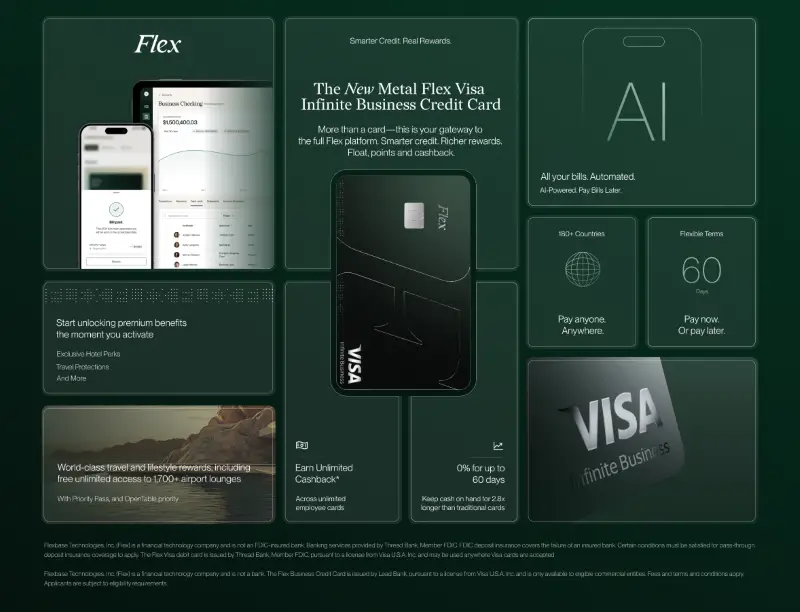
Flex’s Business Credit Card, which provides 60-day float on every transaction, has been a major driver of adoption, acting as the wedge into deeper financial operations. Once owners experience the benefits of the Flex Credit Card, they often go on to adopt Flex’s banking, payments, working capital, and expense management tools to replace fragmented legacy systems. This integrated model has allowed Flex to scale with high efficiency and has created a strong foundation for its expansion into personal finance.

“Our mission is to build the private bank ambitious business owners have always deserved,” said Zaid Rahman, Founder and CEO of Flex. “Middle-market business owners employ 40% of Americans, but the financial system has never been designed around their complex needs. Flex is the first platform that supports every step of their financial lives, from the moment they earn revenue to the moment they spend it personally. Unlike many of our FinTech peers who focus on saving large enterprises money, we focus on helping ambitious owners make more money.”
The momentum is supported by broader market trends indicating consolidations of financial tools, simpler workflows, integrated credit, and unified visibility across business and personal lines. However, personal finance products for affluent individuals have remained largely unchanged for decades. Flex is bridging that gap with a unified system that reflects how these owners actually operate in both their business and personal lives.
“Flex is building a category-defining financial institution,” said Jake Bodanis, Partner at Portage. “The company has proven that middle-market business owners are both massively underserved and extremely valuable customers when given the right financial infrastructure. Flex’s hypergrowth and best in class capital efficiency speaks to how powerful this model is.”
With the long-term goal of building the complete financial stack for middle-market business owners across the United States Flex is capturing the full life cycle of money, offering both business and personal financial products. Flex aims to become the central platform this segment relies on to grow and transfer wealth across generations.
Covington & Burling LLP provided external counsel to Flex on the transaction.
About Flex

Launched in 2023, Flex (a Flexbase Technologies, Inc. brand) is the AI Native “Private Bank” for high net worth business owners in the middle market. Flex is building the category-defining company solving this gap for high net worth business owners with a five-pillar strategy built around private credit, a business finance stack, a personal finance stack, payment solutions, and an ERP built for middle market businesses. Flex is the first platform that supports every step of their financial lives, from the moment they earn revenue to the moment they spend it personally. Visit www.flex.one.
About Portage
Portage is a global investment platform focused on fintech and financial services with over US$5.7 under management, 115+ portfolio companies, and 25+ investment professionals. Our firm has offices in Canada, the United States, Europe, and the Middle East.
Our team partners with ambitious companies across all stages, through Portage Ventures and Portage Capital Solutions. We provide flexible capital and deliver a global network of investors, commercial partners, advisors, and value creation experts. Our dedicated value creation team provides portfolio companies with hands-on support in go-to-market, tech & cyber, business acceleration and M&A, and partnerships to accelerate their paths to success. With deep industry knowledge and entrepreneurial experience, Portage is committed to supporting the leaders who are reshaping financial services.
Our Partnerships team focuses on long-term commercial collaboration opportunities and has generated 140+ partnerships between corporate financial institutions and portfolio companies. Portage is a platform within Sagard, a global multi-strategy alternative asset management firm with over US$33B under management. For more information, visit www.portageinvest.com
Also read:
Image source: flex.one