Click here to get this post in PDF
Understanding Core Types of Auto Insurance Coverage

Driving on today’s roads requires more than just a license; it demands the right auto insurance coverage to protect you and your finances. Finding a policy that fits your budget and meets legal requirements can be complex. This is especially true when you face special situations, such as needing an SR-22 certificate. Understanding how these factors influence your insurance costs is essential for every driver.
This guide will break down the complexities of auto insurance, with a focus on costs related to an SR-22 requirement. We will cover typical filing fees, how driving violations impact your premiums, and practical ways to manage these expenses. Whether you need standard protection or specific guidance for situations like an SR-22, understanding your choices for personal and commercial vehicle coverage is vital. We aim to help you navigate these details so you can secure appropriate coverage and maintain financial security on the road.

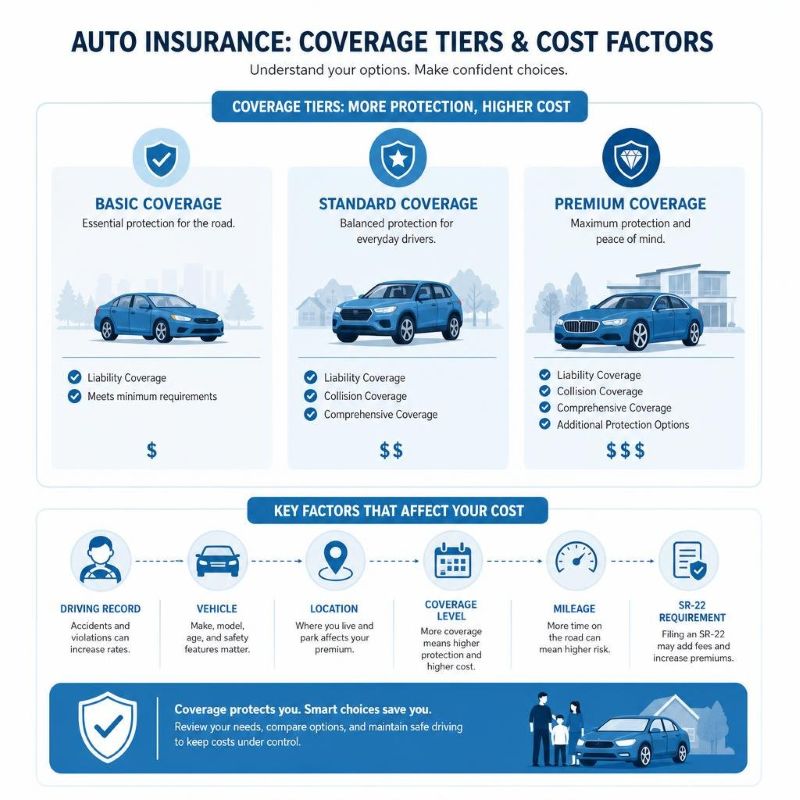
Before diving into the specifics of SR-22s, it’s crucial to grasp the fundamental types of auto insurance coverage available. These foundational coverages determine your level of protection and form the basis of your premium calculations.
The core components typically include:
- Bodily Injury Liability: This covers costs associated with injuries to other people if you are at fault in an accident. It helps pay for their medical expenses, lost wages, and pain and suffering.
- Property Damage Liability: This covers damage to another person’s property (like their car, fence, or building) if you are responsible for an accident.
- Comprehensive Protection: This coverage helps pay for damage to your own vehicle from events other than collisions, such as theft, vandalism, fire, natural disasters, or hitting an animal.
- Collision Coverage: This pays for damage to your own vehicle resulting from a collision with another car or object, regardless of who is at fault.
- Deductible Levels: Both comprehensive and collision coverages typically come with a deductible, which is the amount you pay out of pocket before your insurance coverage kicks in. Higher deductibles usually result in lower premiums.
Understanding these components is the first step in building an insurance policy that truly meets your needs.
Liability Versus Full Auto Insurance Coverage Limits
The distinction between liability-only and full auto insurance coverage is significant, especially when considering your financial protection. State minimums for liability coverage are the legal bare necessities, designed to protect other drivers, not necessarily your own assets. While these minimums might seem appealing due to lower premiums, they often fall short in covering substantial damages or injuries, leaving you personally responsible for the difference.
For example, Allstate’s average monthly full-coverage cost is around $158, while liability-only coverage averages $91 per month as of August 2026. This difference reflects the enhanced protection that full coverage offers.
Full coverage, which typically includes collision and comprehensive protection, provides a more robust safety net. Collision deductibles, the out-of-pocket amount you pay before your insurer covers repair costs for your vehicle after an accident, are a key consideration. Similarly, comprehensive claims cover non-collision related damages. Evaluating your assets and potential risks is crucial when deciding on appropriate coverage limits beyond the state minimums.
| Feature | Liability-Only Coverage | Full Coverage |
|---|
| Purpose | Protects others from damages or injuries you cause | Protects others and your own vehicle |
| Components | Bodily Injury Liability and Property Damage Liability | Liability, Collision and Comprehensive coverage |
| Average Cost | Lower, such as the Allstate average of $91 per month | Higher, such as the Allstate average of $158 per month |
| Your Vehicle | Not covered for damage or theft | Covered for collision damage and non-collision events |
| Deductibles | Not applicable | Applies to Collision and Comprehensive claims |
| Asset Protection | Limited protection against lawsuits for damages exceeding policy limits | Stronger protection for your assets |
High-Risk Mandates and SR-22 Auto Insurance Coverage Requirements
Sometimes, due to certain driving infractions, you may be mandated to carry an SR-22 certificate. It’s important to clarify that an SR-22 is not an insurance policy itself; rather, it’s a certificate or form that your insurance provider files with your state’s Department of Motor Vehicles (DMV) to prove you carry the minimum required liability coverage. This certificate is essentially a guarantee of financial responsibility.
A court order or state DMV typically requires an SR-22 for license reinstatement after serious violations such as a DUI, reckless driving, or driving without insurance. This requirement flags you as a high-risk driver, which has significant implications for your insurance premiums.
When an SR-22 is required, your insurance company, like Allstate, will charge a one-time administrative filing fee to process and submit this form to the state. Allstate typically charges a filing fee of $15 to $25 for an SR-22 form. While this filing fee is a direct cost, the more substantial financial impact comes from the increase in your underlying insurance premiums due to your high-risk classification.
Key Factors That Determine Policy Premiums
Understanding what goes into calculating your auto insurance premiums can help you anticipate costs and identify areas for potential savings. Insurance providers use a complex algorithm to assess your risk, and several key factors play a significant role.

These factors include your driving record, the type of vehicle you drive, your location, annual mileage, and even personal details like your age and credit history. Each element contributes to the overall risk assessment, which directly translates into your policy’s cost.
Driving Violations and Risk Classifications
One of the most significant factors influencing your insurance premiums, especially when an SR-22 is involved, is your driving record. Violations such as speeding tickets, at-fault accidents, and particularly DUI convictions, classify you as a high-risk driver. This classification leads to substantial premium surcharges and rate hikes.
For instance, having an SR-22 on your record can result in higher insurance premiums, potentially increasing by 50% to 100% or more. To illustrate, a driver with a current premium of $1,200 annually could see their costs jump to $1,800–$2,400 per year after an SR-22 requirement.
Allstate’s average rates for high-risk drivers reflect these increases:
- High-risk drivers with a DUI conviction see average monthly costs of $210 with Allstate.
- High-risk drivers with a speeding ticket face average monthly costs of $196 with Allstate.
- High-risk drivers with an at-fault accident on their record see average monthly costs of $200 with Allstate.
These figures, current as of August 2026, highlight the financial consequences of driving infractions and the importance of maintaining a clean driving record.
Age Demographics and Credit History Impact
Beyond driving violations, demographic factors like your age and your credit history also significantly affect your auto insurance premiums with providers like Allstate.
Younger drivers, particularly teen drivers, generally face the highest rates due to their limited driving experience and statistically higher accident rates. As drivers mature, their rates tend to decrease, assuming a clean driving record. For example, Allstate’s average monthly full-coverage rates by age, as of August 2026, show a clear trend:
- Teens: $308
- 20s: $187
- 30s: $142
- 40s: $141
- 50s: $126
- 60s: $111
- 70s: $104
Your credit score is another critical factor in most states (though prohibited from influencing rates in California, Hawaii, Massachusetts, and Michigan). Insurers often use credit-based insurance scores as a predictor of future claims. Generally, drivers with excellent credit pay less for insurance, while those with poor credit face higher premiums. Allstate’s average monthly rates by credit tier, as of August 2026, illustrate this:
- Excellent credit: $126
- Good credit: $146
- Average credit: $147
- Poor credit: $178
These figures underscore how personal financial responsibility can indirectly impact your auto insurance costs.
Strategies to Lower Rates and Manage Premium Surcharges
While an SR-22 requirement or a high-risk classification can lead to increased premiums, there are proactive strategies you can employ to help manage and potentially lower these costs. Rate reduction often involves a combination of discount stacking, defensive driving practices, and smart adjustments to your policy.
Telematics Programs and Behavior-Based Discounts
Many insurance providers, including Allstate, offer telematics programs that monitor your driving habits in exchange for potential discounts. Allstate’s Drivewise program, for example, tracks behaviors such as speeds over 80 mph, hard braking, and the time of day you drive. By demonstrating safe driving habits, you can earn discounts on your premiums.
To maintain eligibility for these discounts, drivers typically need to complete a minimum number of trips—for Drivewise, it’s at least 50 trips during each six-month policy period. It’s worth noting that some programs, in certain states like Pennsylvania, can potentially increase premiums for risky driving behaviors, not just offer discounts. Also, telematics apps sometimes track trips when you’re a passenger, which may require manual classification to avoid inadvertently affecting your driving score. These programs provide an excellent opportunity for drivers to take an active role in lowering their insurance costs through responsible driving.
Deductible Adjustments and Policy Bundling Options
Adjusting your deductible levels is another effective way to manage your insurance costs. Opting for higher deductibles on your collision and comprehensive coverages will typically result in lower monthly premiums, as you’re agreeing to pay more out-of-pocket in the event of a claim.
Beyond deductibles, leveraging policy bundling options can lead to significant savings. Many insurers offer multi-policy discounts when you combine your auto insurance with other policies, such as homeowners or renters insurance. Allstate, for instance, offers programs like Deductible Rewards, which provides an initial $100 collision deductible reduction upon enrollment, plus an additional $100 off per consecutive accident-free year, up to a maximum of $500. Another program, the Safe Driving Bonus, can pay a cash rebate check equal to 5% of your policy premium every six months of accident-free driving. Additionally, simple actions like enrolling in paperless billing or setting up automatic payments can sometimes unlock further discounts.
How to Secure and Maintain Compliance on High-Risk Policies
Securing an SR-22 policy with a provider like Allstate involves a straightforward process, but maintaining continuous compliance is crucial to avoid further penalties or license suspension.
Here are the typical steps to get and maintain an SR-22 certificate:
- Contact Allstate: Reach out to Allstate customer service or a local agent to inform them of your SR-22 requirement. They will guide you through the specific process.
- Provide Details: Be prepared to provide details about the violation that led to the SR-22 mandate, your driver’s license information, and vehicle details.
- Select Coverage: You must select an insurance policy that meets your state’s minimum liability limits. Allstate will then add the SR-22 certificate to this policy.
- Filing with the DMV: Once your policy is active and the SR-22 is attached, Allstate will electronically file the SR-22 form with your state’s Department of Motor Vehicles (DMV). This electronic filing is typically quick, often happening within a few business days.
- Continuous Coverage: The most critical step is to maintain continuous coverage for the entire duration of your SR-22 mandate, which typically ranges from three to five years depending on your state and the nature of the violation. Any lapse in coverage will result in Allstate notifying the DMV, potentially leading to immediate license suspension and restarting your SR-22 requirement period.
- Policy Renewal and Review: Regularly review your policy at renewal times. As you maintain a clean driving record, your risk profile may improve, potentially leading to lower premiums over time.
Frequently Asked Questions About Vehicle Protection
Navigating auto insurance, especially with an SR-22, often brings up specific questions. Here, we address some common inquiries to provide clarity.
How much does an SR-22 certificate typically increase premiums?
The direct cost of an SR-22 is a nominal one-time filing fee, which Allstate typically charges at $15 to $25. However, the true financial impact stems from the associated high-risk driver classification. This can lead to a significant premium increase, often ranging from 50% to 100% or even more, depending on the severity of the violation (e.g., DUI versus a minor speeding ticket), your driving history, and state regulations. For a driver paying $1,200 annually, this could mean an increase to $1,800–$2,400 per year. This higher rate usually applies for the entire duration of the SR-22 mandate, which is often three years.
What is the difference between owner and non-owner liability policies?
An owner liability policy covers a specific vehicle that you own and operate. If you own a car and need an SR-22, it will be attached to your standard auto insurance policy for that vehicle. A non-owner liability policy, on the other hand, provides liability coverage for individuals who do not own a car but may drive borrowed vehicles or rental cars. If you are required to have an SR-22 but do not own a vehicle, a non-owner SR-22 policy will fulfill your state’s financial responsibility requirement by providing secondary coverage when you drive a car that is not yours. It typically does not cover physical damage to the vehicle you are driving.
How long do violation surcharges remain on an auto policy?
The duration for which violation surcharges remain on an auto policy, and consequently how long an SR-22 is required, varies by state and the specific offense. Generally, an SR-22 mandate lasts for three to five years. During this period, your insurer will continue to file the certificate with the DMV, and your premiums will reflect your high-risk status. Once the mandated period is over, and assuming you have maintained continuous coverage and a clean record, your insurer will stop filing the SR-22. At this point, you can request a policy re-evaluation, and your premiums should begin to decrease as your risk rating tier improves. It’s crucial to confirm the exact duration of your SR-22 requirement with your state’s DMV or the court that issued the mandate.
Conclusion
Navigating auto insurance, especially when faced with an SR-22 requirement, can be challenging. However, by understanding the core types of coverage, the factors that influence your premiums, and the strategies available to manage costs, you can make informed decisions. While the direct filing fee for an SR-22 is minimal, the indirect cost through increased premiums is substantial, often leading to a 50% to 100% rise in your annual insurance expenses.
We’ve explored how factors like driving violations, age, and credit score play a role, and highlighted programs like Allstate’s Drivewise, Deductible Rewards, and Safe Driving Bonus that can help offset some of these costs. Maintaining a clean driving record, exploring available discounts, and regularly reviewing your policy are key steps toward long-term savings. Your goal should be to secure adequate coverage, meet all state mandates, and proactively work towards reducing your premiums over time.
You may also like:
7 Ways Commercial Fleets Can Protect Themselves Against False Insurance Claims