Click here to get this post in PDF
Understanding Embedded Analytics for SaaS
At its core, embedded analytics for SaaS involves integrating interactive dashboards, reports, and data visualizations directly into our software applications. This means our users can access critical insights without ever leaving our product’s interface. Unlike traditional business intelligence (BI) tools, which often require users to navigate to a separate platform, embedded analytics delivers data directly within the workflow where decisions are made. This approach is particularly crucial in multi-tenant SaaS environments, where data isolation and personalized experiences are paramount.

This integration is typically achieved through APIs (Application Programming Interfaces) or SDKs (Software Development Kits) provided by embedded analytics platforms. These tools allow us to seamlessly blend analytics capabilities into our application’s UI, ensuring a consistent user experience.
The Core Differences from Standalone BI
The distinction between embedded analytics and standalone BI tools is fundamental, especially for SaaS providers.
- User Workflows: Standalone BI tools, such as Tableau or Power BI (in their traditional forms), are primarily designed for internal data analysts or dedicated BI teams. They require users to switch contexts, log into a separate system, and often have a steep learning curve. Embedded analytics, conversely, is built into our application for the end user. It eliminates context-switching, allowing users to remain focused on their primary tasks while gaining insights.
- Native Experience: With embedded analytics, the dashboards and reports feel like an integral part of our application rather than a bolt-on feature. They inherit our branding, styling, and authentication, delivering a seamless, native user experience. Traditional BI tools, even if linked, inherently break this native feel.
- Data-Driven Culture: By making data insights readily available and intuitive, embedded analytics fosters a data-driven culture among our end-users. They can quickly understand performance, identify trends, and make informed decisions without being data experts or relying on support teams. This direct access significantly reduces the 30-40% of data-related support tickets that teams often face when analytics are not embedded.
How Embedded Analytics Works in Multi-Tenant Environments
For multi-tenant SaaS applications, embedded analytics must handle data isolation with extreme precision. Each customer (tenant) must only be able to see and interact with their own data, never another’s. This is achieved through several robust mechanisms:
- Row-Level Security (RLS): This is a critical feature that filters the underlying data based on the identity of the logged-in user or the tenant they belong to. RLS ensures that even if multiple tenants share the same database, each user’s view is automatically narrowed to only the rows of data they are authorized to see. This is enforced at the data layer, making it highly secure and difficult to bypass.
- Tenant Isolation: Beyond RLS, embedded analytics platforms often employ strategies to ensure complete logical and, in some cases, physical separation of tenant data. This might involve separate schemas, databases, or robust access control policies that prevent cross-tenant data leakage.
- Tokenized Embeds: When embedding analytics, we typically generate secure, time-limited tokens for each user. These tokens carry information about the user’s identity and permissions, which the embedded analytics platform uses to apply RLS and other access controls. This ensures that only authorized users can view specific data and that the embedded content is secure.
- Data-Layer Filtering: The most secure embedded solutions enforce filtering at the data layer itself, rather than just at the UI level. This means that unauthorized data is never even retrieved from the database, providing a stronger guarantee of data privacy and compliance. Failing to isolate data between tenants in a multi-tenant SaaS application violates regulations such as GDPR, CCPA, and SOC 2.
Why SaaS Companies are Choosing to Buy Over Build
The decision to either build an in-house embedded analytics solution or purchase a dedicated platform is pivotal for SaaS companies. While building from scratch might seem appealing for complete control, the strategic and economic realities often favor buying. This trend is driven by factors such as time-to-market, resource allocation, and the hidden costs of maintenance.
The True Cost of Building In-House
Building an embedded analytics solution from the ground up is a complex undertaking that extends far beyond initial development. It’s a continuous investment that can quickly become a significant drain on resources.
- Development Timelines: The journey to a customer-facing dashboard is lengthy. Building embedded analytics in-house typically takes three to six months to reach a first customer-facing dashboard. This delay means lost opportunities to engage users and differentiate our product.
- Infrastructure Costs: Beyond engineering salaries, there are substantial costs for hosting, scaling, and maintaining the analytics stack. This includes servers, databases, data warehousing, and specialized tools for data processing and visualization.
- Custom Content Requests and Data Inconsistencies: As our customer base grows, so do their unique reporting needs. Developers in a study reported spending thirty or more hours a week on customer-specific content, performance problems, and data inconsistencies. This constant demand for custom reports, coupled with the challenge of maintaining data integrity across diverse sources, diverts valuable engineering talent from core product development.
- Maintenance Trap: The initial build is just the beginning. Maintaining custom-built analytics at scale costs an estimated $2-3 million per year in engineering salaries and infrastructure. This “maintenance trap” includes bug fixes, security updates, performance tuning, new feature development, and adapting to evolving data sources and user expectations.
The Strategic Advantages of Buying a Platform
Opting for a specialized embedded analytics platform offers compelling strategic advantages that accelerate value delivery and optimize resource allocation.
- Rapid Deployment: One of the most significant benefits is speed. Buying an embedded analytics platform shortens the time to first dashboard to one to two weeks. This drastically reduces our time-to-market, allowing us to deliver value to customers almost immediately.
- Pre-built Connectors: Dedicated platforms come with a wide array of pre-built connectors to various data sources, including popular databases, cloud services, and APIs. This eliminates the need for our engineering team to develop and maintain these integrations, saving considerable time and effort.
- Automatic Scaling: Embedded analytics platforms are designed for scalability, handling fluctuating user loads and growing data volumes without manual intervention. They abstract away the complexities of infrastructure management, allowing us to focus on our core product.
- Lifecycle Management: These platforms handle the entire analytics lifecycle, from data ingestion and processing to visualization and delivery. This includes ongoing updates, security patches, and performance optimizations, ensuring our embedded analytics remain robust and up to date without consuming our internal resources.
- Focus on Core Competencies: By offloading the complexities of analytics development and maintenance, our engineering teams can concentrate on enhancing our core SaaS product, fostering innovation, and delivering unique value that truly differentiates us in the market. Many SaaS companies find that leveraging a robust SaaS BI embedding platform allows them to achieve this balance effectively.
Key Features of a Robust Embedded Analytics Solution
To truly enhance our SaaS platform, an embedded analytics solution must offer a comprehensive suite of features that prioritize user experience, customization, and security. It’s not enough to display data; the solution must empower users and integrate seamlessly into our brand.

True White-Labeling and Deep Theming
A hallmark of effective embedded analytics is its ability to blend invisibly into our application, appearing as a native component rather than a third-party tool.
- Brand Consistency: True white-labeling allows us to completely remove any vendor branding and apply our own logos, colors, and fonts. This maintains a consistent brand identity across all analytics assets, reinforcing our product’s professional image.
- Custom CSS and Typography: Advanced solutions offer deep theming capabilities, enabling us to apply custom CSS and control typography, spacing, and component styles. This ensures that embedded dashboards perfectly match our application’s design system.
- Domain Masking: For an even more integrated experience, some platforms support domain masking, where the embedded analytics appear to originate from our domain, further solidifying the native feel.
Self-Service Capabilities for End Users
Modern SaaS users expect to interact with their data, not just passively view it. Self-service analytics are crucial for driving engagement and reducing reliance on support teams.
- Drag-and-Drop Builders: Empowering non-technical users to create and customize their own reports and dashboards through intuitive drag-and-drop interfaces is a significant advantage. This reduces the burden on our internal teams and increases user satisfaction.
- Ad-Hoc Reporting: Users should be able to ask their own questions of the data, filter, drill down, and pivot visualizations to explore specific insights relevant to their needs. This flexibility is a key factor in adoption: 86% of buyers rate self-service as crucial, and 80% cite customizable dashboards.
- Data Exporting: The ability to export data in various formats (e.g., CSV, PDF, Excel) allows users to share insights with stakeholders or integrate them into other tools.
- Interactive Filtering: Providing interactive filters, date range selectors, and search functionalities makes dashboards dynamic and responsive to user queries.
Developer-Friendly Integration and Security
Seamless integration and robust security are non-negotiable for any embedded analytics solution in a SaaS context.
- JavaScript SDKs and REST APIs: These tools provide the flexibility and control developers need to deeply integrate analytics into their applications. SDKs offer rich client-side control, while REST APIs enable server-side interactions for data management and automation.
- Role-Based Access Control (RBAC): RBAC allows us to define different levels of access for various user roles within our application. This ensures that specific users or teams only see the data and dashboards relevant to their permissions.
- Single Sign-On (SSO): Integrating with our existing SSO solution (e.g., OAuth, SAML, or JWT) provides a seamless, secure authentication experience. Users don’t need separate logins for the analytics component, reducing friction and enhancing security.
- Semantic Layer: A well-defined semantic layer provides a consistent, business-friendly view of our data. It standardizes metric definitions, calculations, and units, ensuring that all users work with accurate, consistent information, regardless of how they access it.
- AI-Driven Insights: Integrating AI capabilities, such as natural language querying (NLQ) and automated anomaly detection, can elevate embedded analytics. Users can ask questions in plain English (“Show me revenue by region for the last 30 days”) and receive immediate, intelligent insights, making data exploration more intuitive and powerful.
Business Value: Retention, Engagement, and Monetization
Embedded analytics is not merely a technical add-on; it’s a strategic lever that can profoundly impact our business outcomes, driving customer loyalty, increasing product usage, and opening up new revenue opportunities.
Driving Product Stickiness and Reducing Churn
By integrating analytics directly into our SaaS application, we make our product indispensable to our users’ daily operations.
- Daily Decision-Making: When users can make critical decisions within our application using real-time data, our product becomes central to their workflow. Customers who rely on embedded dashboards for daily decisions are significantly less likely to churn. This constant reinforcement of the value makes our application “sticky.”
- Value Realization: Embedded analytics helps users quickly realize the value of our product. They can see the impact of their actions, track progress against goals, and identify areas for improvement, all within the familiar context of our application.
- Support Ticket Reduction: Empowering users with self-service analytics reduces their need to contact support for data requests. Teams report 30-40% reductions in data-related support tickets after embedding analytics, freeing up support staff to focus on more complex issues.
- User Engagement: Providing immediate, relevant insights increases user engagement. Product-led SaaS companies that embed analytics report up to 3x increases in analytics feature usage within the first two months of deployment, indicating a direct correlation between accessibility and adoption.
Unlocking New Revenue Streams
Embedded analytics can transform from a cost center into a profit center, creating new monetization opportunities for our SaaS business.
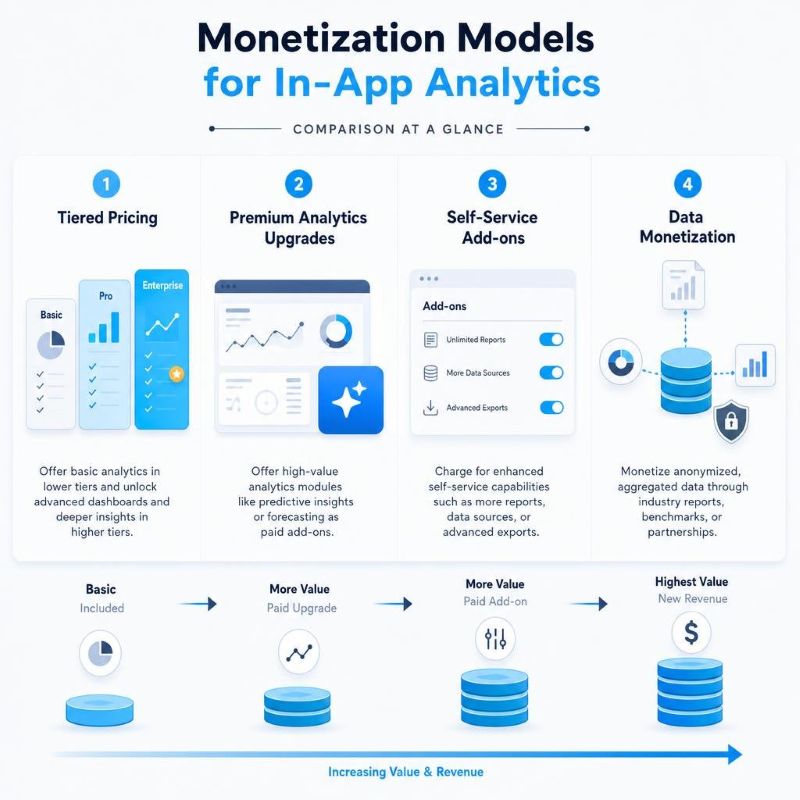
- Tiered Pricing: We can offer basic analytics as part of our standard subscription and then introduce advanced dashboards, deeper insights, or more frequent data refreshes as premium features in higher-priced tiers.
- Premium Analytics Upgrades: Specific, high-value analytics modules (e.g., predictive analytics, industry benchmarks, advanced forecasting) can be offered as optional add-ons or upgrades.
- Self-Service Add-ons: Charging for increased self-service capabilities, such as the ability to create unlimited custom reports, access to a wider range of data sources, or advanced data export options, can appeal to power users.
- Data Monetization: In some industries, anonymized and aggregated data insights can be monetized through industry reports, benchmarks, or partnerships, provided appropriate data privacy and compliance measures are in place.
Best Practices for Implementing Embedded Analytics
Successful implementation of embedded analytics requires careful planning and adherence to best practices, particularly concerning data governance, security, and performance. Our goal is to deliver powerful insights without compromising the integrity or speed of our core application.
Ensuring Data Isolation and Security Compliance
In multi-tenant SaaS environments, data security and compliance are paramount. Any failure in these areas can have severe consequences, including legal penalties and reputational damage.
- GDPR, CCPA, and SOC 2 Compliance: We must ensure that our embedded analytics solution complies with relevant data protection regulations, including GDPR (General Data Protection Regulation), CCPA (California Consumer Privacy Act), and SOC 2 (Service Organization Control 2). This includes robust data encryption, access controls, and audit trails. As previously noted, failing to isolate data between tenants is a direct compliance violation.
- Query-Level Filtering: The most secure approach is to enforce data filtering at the query level, ensuring that only authorized data is ever retrieved from the database for a specific user or tenant. This is more secure than relying solely on UI-level filtering, which can be bypassed.
- Dynamic Permissions: Implement dynamic role-based and row-level security that integrates seamlessly with our existing authentication and authorization systems. This allows us to define granular permissions that adapt to changes in user roles or tenant configurations.
- Audit Trails: Maintain comprehensive audit trails of all data access and modifications within the embedded analytics environment. This provides accountability and helps in demonstrating compliance during audits.

Optimizing Performance at Scale
Embedded analytics, especially with growing data volumes and user concurrency, can impact the performance of our host application if not properly optimized.
- Caching Strategies: Implement intelligent caching mechanisms at multiple levels (data sources, query results, dashboard rendering) to reduce database load and speed up dashboard load times. This is crucial for delivering a snappy user experience.
- Query Optimization: Work closely with our embedded analytics platform to optimize data queries. This includes using efficient SQL, leveraging database indexes, and ensuring that complex calculations are performed at the most appropriate stage of the data pipeline.
- Data Warehouse Tuning: For large-scale data, a well-designed, well-tuned data warehouse or data lakehouse is essential. This provides a performant, scalable foundation for our embedded analytics, ensuring data can be accessed and processed quickly.
- Load Balancing and Scalability: Ensure our embedded analytics infrastructure can scale horizontally to handle thousands of concurrent users. This might involve load balancing, distributed processing, and auto-scaling capabilities to maintain performance during peak usage.
- Asynchronous Loading: Load embedded dashboards asynchronously within our application to prevent them from blocking the rendering of other UI elements, thus maintaining a smooth overall user experience.
Frequently Asked Questions about Embedded Analytics
As we explore the integration of embedded analytics, several common questions arise regarding implementation, security, and licensing.
What is the typical timeline to launch embedded analytics?
The timeline for launching embedded analytics varies significantly depending on whether we choose to build an in-house solution or buy a dedicated platform. Building an embedded analytics solution from scratch typically takes three to six months to reach a first customer-facing dashboard. This lengthy period is due to the complexities of developing the entire stack, including data connectors and visualization engines, as well as security and multi-tenancy features. In contrast, by leveraging a specialized embedded analytics platform, we can shorten the time to first dashboard to one to two weeks. This dramatic reduction in time-to-market enables us to deliver value to our customers much faster and iterate on our analytics offerings more quickly.
How does row-level security protect tenant data?
Row-level security (RLS) is a fundamental mechanism for protecting tenant data in multi-tenant SaaS environments. It works by filtering the underlying data rows that a user can access based on their identity and associated permissions, or the tenant they belong to. When a user requests data, the RLS policy automatically applies a filter to the database query, ensuring that only data relevant to their specific tenant or role is returned. For example, if a SaaS application serves multiple companies, RLS would ensure that an employee from Company A can only see data belonging to Company A, even if all companies’ data resides in the same database table. This enforcement happens at the data layer, making it highly robust and preventing unauthorized access to other tenants’ information.
Do end users need separate BI licenses to view embedded dashboards?
Typically, no. One of the key advantages of embedded analytics platforms, especially for SaaS providers, is that they often operate on a capacity- or usage-based licensing model rather than a per-user license model for end users of our SaaS application. This means that our customers (the end-users of our embedded analytics) do not need to acquire individual licenses for the underlying BI tool (e.g., a Power BI Pro or Tableau Creator license). Instead, we, as the SaaS provider, license the embedded analytics platform based on factors like the computing capacity used, the number of renders, or a fixed-price model. This approach allows us to scale our analytics offering to thousands, or even millions, of end users without incurring prohibitive per-user licensing costs, making it a cost-effective solution for delivering insights to our entire customer base.
Conclusion
In the rapidly evolving SaaS landscape of July 2026, embedded analytics has cemented its position as a non-negotiable component for competitive platforms. It’s no longer just about presenting data; it’s about seamlessly integrating actionable intelligence into the very fabric of our applications, empowering users, and driving tangible business outcomes.
By understanding the distinct advantages of embedded analytics over traditional BI, particularly in multi-tenant environments, we can make informed decisions that accelerate our product roadmap. The strategic choice to buy, rather than build, offers unparalleled speed to market, reduces the burden on engineering resources, and sidesteps the costly maintenance trap of in-house solutions.
A robust embedded analytics solution, characterized by true white-labeling, powerful self-service capabilities, and developer-friendly, secure integration, is essential for delivering a superior user experience. This, in turn, directly translates into increased product stickiness, reduced customer churn, and the exciting potential to unlock new revenue streams through premium analytics offerings.
As we look to the future, embracing best practices for data isolation, security compliance, and performance optimization will be critical to ensuring the long-term success and scalability of our embedded analytics initiatives. By prioritizing these elements, we not only enhance our platforms but also future-proof our businesses, ensuring we remain at the forefront of innovation and continue to deliver exceptional value to our customers.
You may also like: Stackpack Raises $6.3M to Solve the $475B Vendor Chaos Problem