Click here to get this post in PDF
Foundations and Hierarchy of Digital Marketing Strategies

In August 2026, the digital marketing landscape is in constant motion. New technologies, especially AI, are changing how customers find and interact with brands. This means businesses need more than just a website or social media page to stand out.
A strong digital marketing strategy is no longer optional; it’s essential for growth. It helps you cut through the noise, reach the right audience, and build lasting customer relationships. For instance, brands with integrated, multi-channel efforts keep 89% of their customers, far more than those using single channels. To navigate this complex environment and build truly effective online campaigns, many businesses seek specialized marketing and engagement services.
This extensive guide will help you understand the core of effective digital marketing strategies. We will look at what makes a strategy different from everyday tactics. We will cover the main types of digital marketing, how to combine them, and the critical role of data. We’ll also explore how new trends, like AI and mobile marketing, shape modern approaches. Our goal is to provide clear steps for businesses aiming for sustainable success.
At its heart, a digital marketing strategy is a long-term, high-level plan designed to achieve specific business goals by defining objectives, identifying target audiences, and providing a framework across various digital channels. It’s the architectural blueprint for your online presence, guiding every action and investment. Without this foundational structure, individual marketing efforts risk becoming disjointed, inefficient, and ultimately ineffective. We see it as the strategic roadmap that orchestrates all channel activities, ensuring a cohesive customer journey and fostering long-term momentum.

Strategic Vision vs. Tactical Execution
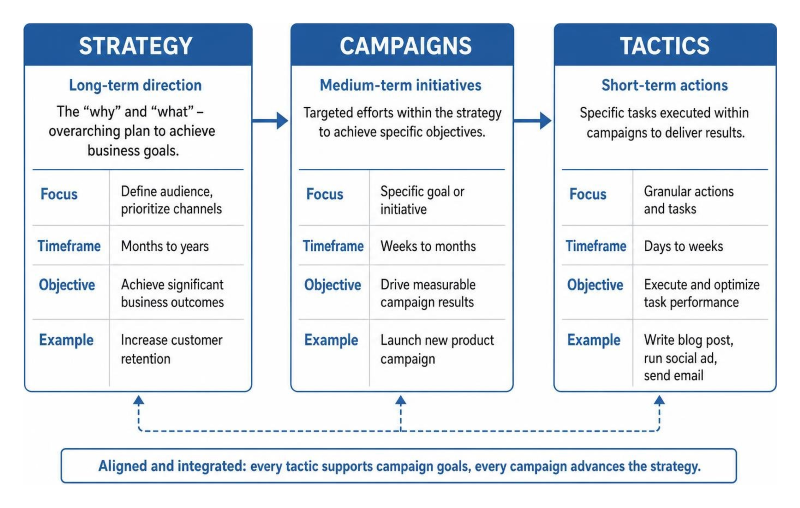
Understanding the distinction between strategy, campaigns, and tactics is crucial for any business. A digital marketing strategy is the overarching “why” and “what” – it sets the direction, defines the audience, and prioritizes channels to move a stranger toward becoming a customer and an advocate. It’s a broad, long-term vision, often spanning months to years, focused on achieving significant business outcomes.
Marketing campaigns, on the other hand, are medium-term, targeted initiatives designed to achieve specific objectives within the broader strategy. They are time-bound, typically lasting weeks or months, and focus on a particular goal, such as launching a new product or increasing sign-ups. Campaigns integrate multiple tactics and channels to deliver a unified message.
Tactics are the granular, short-term actions executed within campaigns. These are the “how” – the specific tasks like writing a blog post, running a social media ad, or sending an email newsletter. Tactics are the daily operational steps that bring a campaign, and ultimately the strategy, to life. Without a clear strategy, tactics can become isolated efforts, leading to wasted resources and diluted impact. For instance, creating content without a strategic understanding of audience intent and distribution channels is like building a house without a foundation.
To ensure clarity and measurable progress, we advocate for setting SMART goals (Specific, Measurable, Attainable, Relevant, Timely) at the strategic level. These goals then cascade down to campaign objectives and inform the selection of appropriate tactics. This hierarchical approach ensures every marketing activity contributes directly to the overarching business objectives, fostering a directional amalgam that prevents scattered efforts.
Balancing Owned, Paid, and Earned Media
A robust digital marketing strategy effectively balances three core types of media: owned, paid, and earned. Each plays a distinct role in reaching and engaging your audience, and their integration forms a resilient media mix.
Owned media refers to any digital channel that your business controls entirely. This includes your website, blog, email list, and proprietary social media profiles. These assets are invaluable because they provide audience ownership, protecting you from algorithm changes on rented platforms. For example, email remains one of the most effective digital marketing techniques, returning an impressive $36 to $42 for every $1 spent, making it a cornerstone of an owned media strategy. Building an evergreen resource library on your website, filled with articles and guides, consistently attracts organic search traffic, which SEO drives approximately 53% of all website traffic.
Paid media encompasses any marketing effort for which you pay. This includes search engine marketing (PPC), social media advertising, display ads, and influencer marketing. Paid channels offer immediate reach and precise targeting, allowing you to amplify your message to highly specific audience segments. While they provide quick results, their effectiveness is often short-lived once funding stops. Paid media is best utilized to accelerate proven content and messaging that originates from your owned channels, or to capture high-intent audiences. Marketers are increasingly investing here, with global digital ad spend projected to reach over $1 trillion in 2026.
Earned media is the organic exposure your brand receives through third-party validation. This includes customer reviews, testimonials, social media mentions, press coverage, and word-of-mouth. Earned media builds credibility and trust, as it comes from sources perceived as unbiased. While you can’t directly control earned media, a strong owned and paid media strategy can significantly influence its generation. For instance, providing exceptional value through content marketing can lead to natural shares and mentions, generating 3x more leads than outbound marketing at 62% lower cost. The goal is to create content and experiences so compelling that others want to share them.
The most effective strategies integrate these three types of media, using owned assets as the foundation, paid media for amplification, and earned media for credibility and reach. This diversification ensures a resilient strategy that minimizes vulnerability to changes in any single channel.
Essential Growth Pillars and Channel Synchronization
Effective digital marketing strategies are built upon several essential pillars, each contributing to a synchronized effort to achieve business objectives. These pillars are not isolated but work in concert, with customer intent and conversion optimization as guiding principles.
Aligning Digital Marketing Strategies with Specific Business Objectives
Before diving into channels, we must clearly define what success looks like. Different business goals require distinct strategic approaches:
- Brand Awareness: If the goal is to increase brand recognition, strategies will focus on broad reach and consistent messaging across social media, display advertising, and content marketing designed for shareability. Tactics might include viral campaigns, influencer partnerships (with 87.49% of marketers planning to increase influencer budgets in 2026), and engaging video content.
- Lead Generation: For generating qualified leads, the strategy shifts to capturing contact information. This involves SEO-optimized content that answers high-intent queries, lead magnets (e.g., e-books, webinars), landing pages with clear calls-to-action, and email marketing for nurturing prospects.
- Revenue Expansion: To drive sales and increase customer lifetime value, strategies will prioritize conversion rate optimization (CRO) on websites, personalized email campaigns (75% of consumers are more likely to buy from brands that deliver personalized content), retargeting ads, and loyalty programs.
- Customer Retention: Keeping existing customers engaged and loyal is often more cost-effective than acquiring new ones. Strategies here focus on lifecycle marketing, customer support via digital channels, personalized content delivery, and community building.
A full-funnel alignment ensures that every digital touchpoint guides the customer through their journey, from initial discovery to becoming a loyal advocate.
Search Engine Visibility and Generative Answer Optimization
In 2026, search engine visibility goes beyond traditional SEO. While SEO still drives approximately 53% of all website traffic by optimizing for Google’s algorithms, we now also contend with Generative Engine Optimization (GEO) and Answer Engine Optimization (AEO). These refer to optimizing content to be cited and recommended in natural language AI responses from platforms like Google AI Overviews, ChatGPT, and Perplexity.
AI search visitors convert at significantly higher rates—up to 23 times more—because the AI engine pre-qualifies their intent through natural language problem-solving before they even click. This means that while AI summaries might reduce clicks to traditional links (users click traditional links only 8% of the time with an AI summary versus 15% without one), the traffic they do send is incredibly valuable.
Our strategy must involve:
- Technical SEO: Ensuring websites are fast, mobile-friendly, secure, and easily crawlable by search engines. Core Web Vitals (LCP, CLS, INP) remain critical.
- Content Authority: Creating deeply expert, original, and structured content that directly answers user questions. This makes it a prime candidate for AI citation. 76.1% of URLs cited in Google AI Overviews rank in the top 10 organic results, underscoring SEO’s foundational role.
- Q&A Formatting: Structuring content with clear headings and direct answers that generative AI can easily extract.
- Citation Frequency: Building a strong online presence where your brand is consistently cited as an authority across various reputable sources.

First-Party Data Capture and Email Nurturing
In an era of increasing data privacy regulations and the deprecation of third-party cookies, first-party data has become an invaluable asset. This is data you collect directly from your audience through their interactions with your owned channels.
Email marketing stands out as the ultimate first-party data channel, providing an owned relationship that is immune to algorithmic shifts on rented platforms. Strategies for leveraging email and first-party data include:
- Subscriber Capture: Implementing lead magnets (e.g., free guides, exclusive content) on your website to incentivize email sign-ups.
- Lifecycle Nurturing: Developing automated email sequences that guide subscribers through the customer journey, from onboarding to conversion and retention.
- Audience Segmentation: Segmenting your email list based on demographics, behavior, and preferences to deliver highly personalized content. This personalization significantly boosts engagement and conversion.
- Privacy Compliance: Ensuring all data collection practices are transparent and compliant with regulations like GDPR and CCPA, building trust with your audience.
By focusing on building a robust email list and nurturing those relationships, businesses create a direct, high-ROI channel for communication and sales, generating $36 to $42 for every $1 invested.
Multi-Channel Integration and Performance Attribution
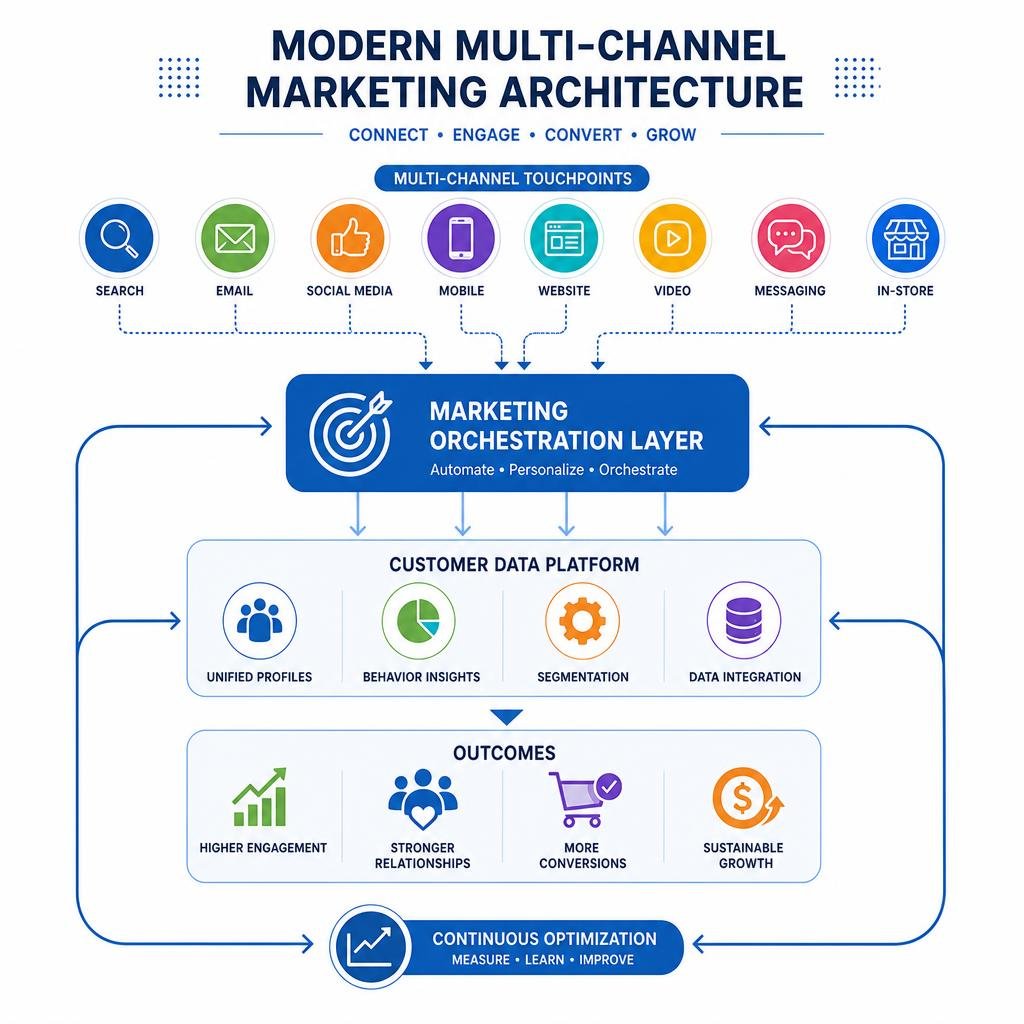
In today’s complex digital landscape, customers rarely interact with a brand through a single channel. They move seamlessly across social media, search engines, email, and websites. An integrated digital marketing strategy acknowledges this reality, aligning every digital channel around shared goals, shared audience segments, and consistent messaging. This coordinated approach is not merely juggling multiple channels in silos; it’s about creating a unified customer experience that compounds the impact of your marketing efforts.
Connecting Omnichannel Touchpoints for Customer Retention
The power of omnichannel engagement cannot be overstated. Brands with strong omnichannel engagement retain 89% of customers, a stark contrast to the 33% retention rate of single-channel brands. This significant difference highlights why integrating customer touchpoints is critical, especially for long-term growth and customer lifetime value (CLV).
A truly integrated strategy maps the full customer journey, ensuring seamless handoffs and consistent brand messaging across every interaction. For example, a prospective buyer might discover your brand through a paid social ad, then read an SEO-optimized blog post, open a retargeting email, and finally convert through organic search. In an integrated system, each of these touchpoints delivers a consistent narrative, reinforcing the brand’s value proposition and building trust.
Key elements of connecting omnichannel touchpoints include:
- Unified Messaging: Ensuring your brand’s voice, tone, and core value proposition are consistent across all channels.
- Shared Audience Segments: Using common audience data across CRM, analytics, and advertising platforms to personalize experiences.
- Behavioral Triggers: Implementing automated responses based on customer actions (e.g., an email triggered after a website visit or an abandoned cart).
- Cross-Functional Planning: Breaking down internal silos between marketing, sales, and customer service teams to ensure a cohesive customer experience.
By creating a continuous, personalized customer journey, we not only improve conversion rates but also significantly enhance customer satisfaction and loyalty, leading to higher retention rates and increased CLV.
Measuring ROI and Multi-Touch Conversion Metrics
Data and analytics are the backbone of any effective digital marketing strategy. They provide the insights needed to measure performance, identify areas for improvement, and optimize campaigns in real-time. Without robust measurement, marketing efforts are simply shots in the dark.
Traditional “last-click” attribution, which gives all credit to the final touchpoint before conversion, is no longer sufficient in a multi-channel world. Instead, we embrace multi-touch attribution models that distribute credit across all touchpoints in the customer journey. This provides a more accurate understanding of which channels contribute to conversions, allowing for more informed budget allocation.
Key Performance Indicators (KPIs) should always align with your overarching business goals. Instead of focusing solely on vanity metrics like social media likes or impressions, we prioritize outcome metrics that directly impact the bottom line. These include:
- Customer Acquisition Cost (CAC): The total cost of acquiring a new customer.
- Return on Ad Spend (ROAS): The revenue generated for every dollar spent on advertising.
- Customer Lifetime Value (CLV): The total revenue a business can expect from a customer throughout their relationship.
- Conversion Rates: The percentage of users who complete a desired action (e.g., purchase, sign-up).
- Pipeline Revenue: The total value of potential sales generated by marketing efforts.
Implementing a centralized reporting dashboard that pulls data from all channels allows for a holistic view of performance. This enables us to “fail fast,” quickly identifying underperforming campaigns and reallocating budget to proven concepts. By rigorously tracking these metrics, we can demonstrate the true ROI of our digital marketing efforts and continuously refine our strategy for maximum impact.
Navigating Emerging Trends and Common Pitfalls
The digital marketing landscape is in perpetual motion, driven by technological advancements and evolving consumer behaviors. To maintain a competitive edge, businesses must not only adapt to emerging trends but also proactively address common pitfalls that can derail even the most well-intentioned strategies.
Modernizing Digital Marketing Strategies for AI and Automation
Artificial intelligence (AI) is arguably the most transformative trend shaping digital marketing in 2026. From content creation to customer service, AI is reshaping how we operate. However, integrating AI effectively requires a strategic approach, not just adopting every new tool.
- AI Search Optimization (GEO/AEO): As discussed, optimizing for AI-driven answer engines is paramount. This involves creating highly structured, authoritative content that AI models can easily cite. We’ve seen that AI-referred leads convert significantly better because the AI pre-qualifies user intent.
- Agentic Workflows: AI is moving beyond simple automation to agentic workflows, where autonomous agents can dynamically optimize subject lines, send times, and messaging in real-time. This allows for unprecedented levels of personalization and efficiency, addressing the fact that 78% of marketers need more personalized content than they can currently produce.
- Predictive Modeling: AI-powered analytics can predict customer behavior, identify churn risks, and forecast trends, enabling proactive marketing interventions.
- Dynamic Personalization: AI allows for hyper-personalized content delivery, not just based on demographics, but on real-time behavioral data, enhancing the customer experience and boosting conversion rates.
- Content Differentiation: While AI simplifies content creation for 71% of marketers, 53% also report it saturates the market and hinders differentiation. This means our strategy must focus on deeply expert, original content that stands out, rather than generic, AI-generated material.
Only 6% of marketers have fully embedded AI into their workflows, indicating a significant opportunity for early adopters to gain a competitive advantage.
Overcoming Channel Fragmentation and Budget Waste
One of the most common challenges businesses face is channel fragmentation – trying to be everywhere at once without a coherent strategy. This leads to diluted efforts, inconsistent messaging, and wasted budget. We often see businesses running paid advertising campaigns without a high-converting website or an owned email list in place, which is akin to adding fuel to a car without an engine.
Common mistakes that break channel integration include:
- Siloed Departments: Marketing teams operating independently (e.g., SEO team not communicating with social media team).
- Last-Click Attribution: Relying solely on the final touchpoint, leading to underinvestment in top-of-funnel channels.
- Disconnected Calendars: Lack of a unified marketing calendar, resulting in uncoordinated campaign launches.
- Vanity Metrics Focus: Prioritizing impressions or follower counts over true business outcomes like revenue or lead quality.
- Ignoring First-Party Data: Over-reliance on third-party data or rented channels, making the business vulnerable to external changes.
To overcome these challenges, businesses should:
- Centralize Strategy: Develop one overarching strategy with clear, shared goals across all teams.
- Integrate Data: Implement systems that share audience and performance data across platforms.
- Prioritize Foundational Assets: Ensure owned channels (website, email list) are optimized before scaling paid efforts.
- Allocate Budget Strategically: A recommended budget split is 70-80% on core/growth strategies and 10-20% on emerging experimental channels.
- Seek Expert Guidance: For businesses navigating complex integrations or lacking internal expertise, partnering with a specialized digital marketing agency can provide the necessary strategic alignment and scalable execution. They can help build a coordinated, measurement-driven strategy across search, social, email, and paid media, ensuring resources are optimized for growth.
By addressing these pitfalls and strategically integrating channels, we can maximize the compounding effect of our marketing efforts and ensure every dollar spent contributes to sustainable growth.
Frequently Asked Questions
How does a digital strategy differ from a tactical plan?
A digital marketing strategy is the overarching vision and long-term roadmap, defining why you are marketing, who you are targeting, and the primary channels you’ll use to achieve broad business goals. It’s the “what” and “why.” A tactical plan, conversely, is the detailed, step-by-step operational calendar that outlines how and when specific actions will be executed within a campaign. It covers granular tasks, timelines, and resource allocation. The strategy provides the direction, while the plan provides the execution details.
Which digital marketing channel generates the highest ROI?
While effectiveness varies by industry and specific goals, email marketing consistently delivers one of the highest returns on investment, generating $36 to $42 for every $1 spent. This is largely due to its direct communication, personalization capabilities, and the fact that it’s an owned channel. Organic search (SEO and GEO) also offers strong long-term ROI by driving highly qualified, intent-based traffic at a relatively low cost once established. These owned media channels build compounding value over time, making them foundational to any high-ROI strategy.
How often should a growing business update its strategy?
While a foundational digital marketing strategy might have a lifespan of 1 to 3 years, we recommend quarterly reviews and adjustments for the tactical plan and even the strategic direction. The digital landscape, especially in 2026 with rapid AI advancements and algorithm shifts, changes rapidly. Regular reviews allow us to evaluate channel performance, address funnel leaks, adapt to new technologies (like AI search optimization), and reallocate resources effectively. Annual planning sets the broad direction, but continuous optimization through quarterly assessments ensures agility and sustained relevance.
Conclusion
In August 2026, navigating the digital marketing landscape demands more than just participation; it requires strategic discipline and a commitment to integrated, data-driven approaches. We’ve explored how a robust digital marketing strategy, distinct from mere tactics, serves as the essential blueprint for growth. By balancing owned, paid, and earned media, aligning channels with specific business objectives, and prioritizing first-party data and generative answer optimization, businesses can build scalable momentum.
The future of digital marketing is increasingly shaped by AI and automation, demanding modern strategies that embrace agentic workflows and intelligent personalization. Overcoming channel fragmentation and budget waste through cohesive integration and rigorous measurement will be paramount. By focusing on outcome metrics, continuously adapting to market shifts, and leveraging expert guidance when needed, businesses can not only survive but thrive. The ultimate goal is to build a marketing engine that delivers compounding growth, fosters deep customer relationships, and ensures long-term success in an ever-evolving digital world.
You may also like:
Tips on Integrating Text Message Marketing Into Campaigns
Why You Should Choose Marketing Automation For Your Business